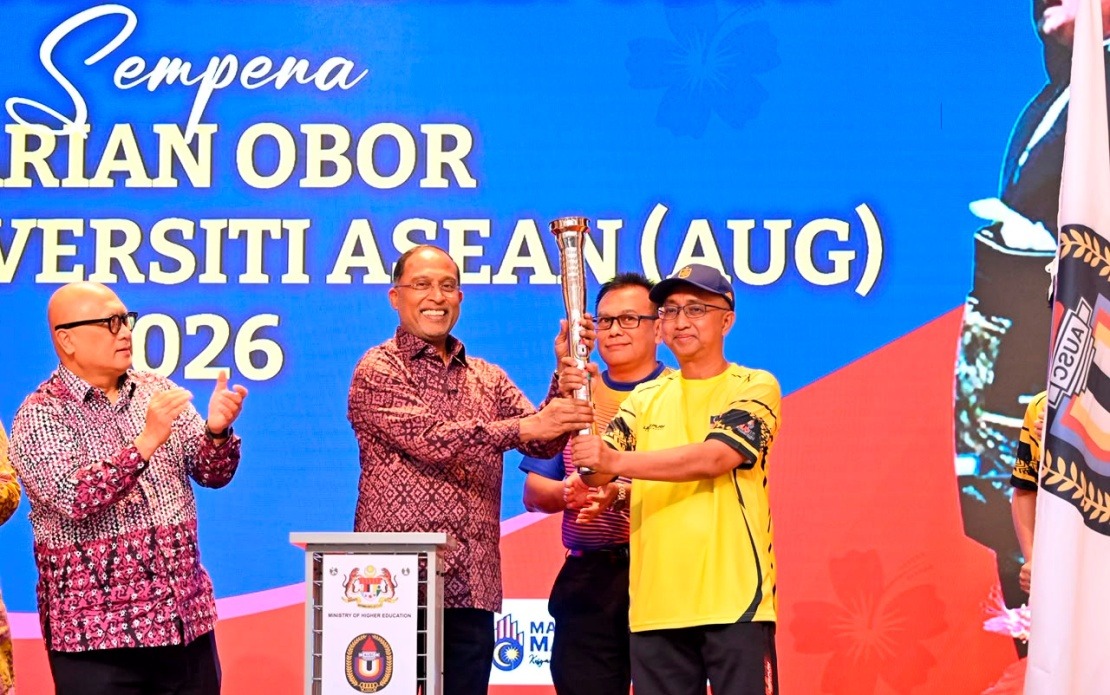
Malaysia has embarked on its ceremonial countdown to hosting the ASEAN University Games in December 2026, with the symbolic torch run commencing at the Ministry of Higher Education headquarters in Putrajaya. The event represents a pivotal moment in the nation's preparations for what is shaping up to be the most significant gathering of university athletes across Southeast Asia, bringing together competitors from 11 countries for a fortnight of regional sporting excellence.
Higher Education Minister Datuk Seri Dr Zambry Abd Kadir formally transferred the torch to Malaysian contingent chief Prof Dr Mohammad Ismail during ceremonies held alongside the MOHE Monthly Assembly. The handover carried deeper significance beyond mere ceremonial protocol—it underscored the government's commitment to leveraging higher education institutions as vehicles for national sporting achievement and regional soft power. Prof Dr Mohammad Ismail, who simultaneously serves as Universiti Malaysia Kelantan's Deputy Vice-Chancellor for Student and Alumni Affairs, assumes responsibility for steering the nation's university delegation toward medal glory on the ASEAN stage.
Dr Zambry's address during the torch transfer articulated a vision extending beyond competitive victory. He urged Malaysian athletes to recognise themselves as standard-bearers not merely for their respective universities but for the nation itself, emphasising the intersection between sporting achievement and national representation. His call for competitors to "carry the Malaysian torch and the torch of victory" reflected an understanding that regional sporting events function as showcases for national capability and character, particularly among young people who represent both their institutions and their country.
The torch run itself involved four accomplished national athletes whose credentials span diverse disciplines. Long jumper Andre Anura Anuar and shot putter Nani Sahirah Maryata represent Universiti Putra Malaysia, leveraging their track record in field events. Karate competitor Thevendran Kaliana Sundram carries credentials from Universiti Pertahanan Nasional Malaysia, while taekwondo athlete Lee Hui Yee represents Sultan Salahuddin Abdul Aziz Shah Polytechnic. This deliberate assembly of athletes from various sporting backgrounds and educational institutions projected a message of inclusivity and breadth in Malaysia's sporting ecosystem.
The torch's physical journey through government and educational spaces mapped out Malaysia's institutional commitment to the upcoming games. Beginning at MOHE grounds in Putrajaya, the torch proceeded to the Ministry of Tourism, Arts and Culture before returning to its starting point. This routing symbolically connected education governance with cultural and tourism infrastructure—a telling acknowledgement that hosting major international sporting events carries implications for national image and economic benefit beyond the purely athletic sphere.
Yet the torch run's geographical significance extends further still. The subsequent route incorporates Universiti Kebangsaan Malaysia, Universiti Putra Malaysia, Universiti Pertahanan Nasional Malaysia, Universiti Malaya, and Universiti Teknologi MARA—essentially tracing a path through Malaysia's premier public universities. This deliberate integration of major academic institutions underscores how the games will serve as a unifying endeavour across the nation's higher education landscape, with each university contributing athletes, facilities, and institutional pride to the broader national effort.
The scale of AUG 2026 reflects both the ambition and complexity of hosting a regional multi-sport competition. Scheduled for December 10 to 19, the games will accommodate approximately 4,669 total participants. This figure encompasses 2,849 athletes and officials representing all 11 participating countries, supplemented by 700 referees and competition officials managing the various sporting disciplines, and 920 volunteers ensuring the logistics of such a sprawling event function seamlessly. For Malaysia, this represents an opportunity to demonstrate organisational capability while providing thousands of young people with continental sporting experience.
The competition's geographical distribution across multiple venues reflects pragmatic hosting decisions suited to Malaysia's urban geography. Shah Alam, Kuala Lumpur, Serdang, and Bangi will collectively host 19 sports encompassing the breadth of athletic disciplines recognised at the university level. This multi-venue approach distributes infrastructure demands while potentially enhancing local engagement across the Klang Valley region and beyond. The choice of these locations suggests reliance on existing university and municipal sporting facilities rather than construction of entirely new venues—a fiscally prudent approach that nonetheless requires careful coordination.
The games operate under the thematic banner "HOLISTIC.EXCELLENCE," a designation that extends the competition's significance beyond raw athletic performance. This conceptual framing positions AUG 2026 not merely as a showcase for sporting prowess but as a demonstration of comprehensive excellence encompassing athletic achievement, institutional quality, cultural sophistication, and organisational capability. For Malaysian stakeholders—from government officials to university administrators to the participating athletes themselves—the torch run serves as a tangible reminder that the December competition will be scrutinised across multiple dimensions by regional observers.
From a broader Southeast Asian perspective, Malaysia's hosting of AUG 2026 carries implications for regional soft power competition among ASEAN nations. University games project images of national vitality, youth development, and institutional excellence. The games provide platforms where nations compete not just in athletic metrics but in demonstrating their capacity to organise major international events, their commitment to young people's development, and their standing within regional hierarchies. For Malaysia, successfully executing AUG 2026 contributes to narratives about the nation's regional leadership and its capacity to serve as a credible convener of ASEAN-level activities.
The torch run itself, while ceremonial in nature, functions as a public relations instrument that builds anticipation and awareness among Malaysia's university population. By physically moving the torch through educational institutions and government ministries, organisers ensure visibility across constituencies whose participation and support will determine the games' success. Student athletes witness their peers being honoured; university administrators recognise institutional involvement; government officials reaffirm commitment. These ripples of engagement extend far beyond the torch's physical journey, creating momentum that translates into volunteer recruitment, sponsorship activation, and public interest generation.
Looking ahead, the five-month preparation period remaining before December's competition will test Malaysia's capacity to convert ceremonial enthusiasm into operational excellence. The torch run marks the transition from planning phases into active engagement with stakeholder communities. For the 2,849 athletes already thinking about their December performances, for the 920 volunteers still to be recruited and trained, and for the various institutional and governmental actors responsible for seamless execution, the torch run's commencement signals that preparation is no longer an abstraction—it is now an active, visible reality that demands sustained attention and resources until the final medal ceremonies conclude.

