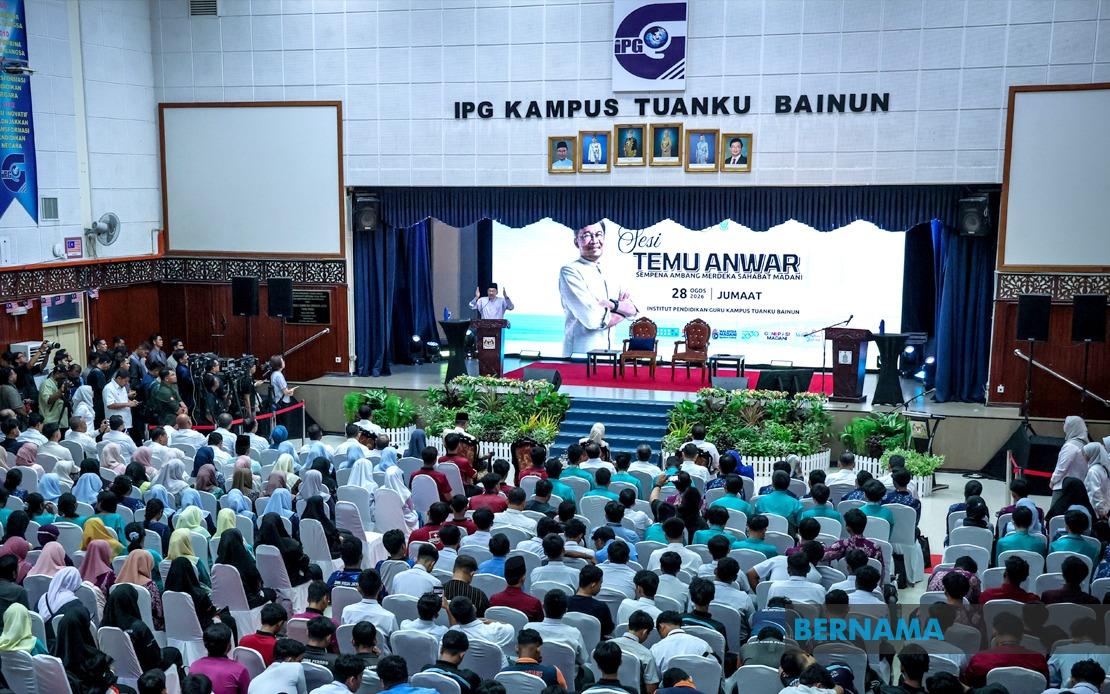
Prime Minister Datuk Seri Anwar Ibrahim has positioned the repeal of the Universities and University Colleges Act 1971 (AUKU) as a watershed moment for Malaysian higher education, framing it not merely as a legal reform but as an ideological pivot toward trusting young people with intellectual autonomy. Speaking during a Temu Anwar session in Bukit Mertajam, Anwar outlined his government's conviction that university students should enjoy expanded liberty to articulate their perspectives and engage in substantive debate about matters affecting society. Education Minister Datuk Seri Fadhlina Sidek attended the forum, underscoring the administration's commitment to the policy shift.
At the heart of Anwar's argument lies a fundamental challenge to half-century-old restrictions. The AUKU, enacted in 1971, imposed significant curbs on campus activism, student organising, and political engagement—rules that the Prime Minister now characterises as anachronistic and counterproductive. By invoking the democratic principle that 18-year-olds hold voting rights, Anwar poses a rhetorical question that resonates with efforts across Southeast Asia to recalibrate the relationship between state and university: if young people can cast ballots that shape national destiny, why should they be barred from public discourse on campus?
The repeal signals a philosophical departure from an era when policymakers viewed student mobilisation primarily through a security lens. The original AUKU was introduced during a period of heightened anxiety about campus unrest and its potential to destabilise governance. Five decades on, Anwar's administration appears to have concluded that the costs of suppression—intellectual stagnation, alienation of youth, suppression of dissent—outweigh the risks of permitting open expression. This recalibration matters not only for Malaysia but for regional observers questioning how authoritarian and semi-authoritarian systems manage youthful political energy.
Crucially, Anwar frames the reform as an investment in national human capital. He emphasises that unconstrained discourse cultivates three capacities essential to modern economies and pluralistic societies: creativity, reasoned judgement, and critical thinking. This framing appeals to contemporary development rhetoric—the notion that knowledge economies thrive when citizens can question assumptions, propose novel solutions, and engage in evidence-based reasoning. By tying AUKU repeal to these aspirational outcomes, Anwar attempts to shift the narrative from civil liberties concerns (which some conservative observers resist) to national competitiveness and innovation.
Simultaneously, Anwar acknowledges the inevitability of intellectual error and disagreement. His statement that student opinions "may not always be right" serves multiple rhetorical purposes: it concedes that freedom of expression entails exposure to mistaken, even dangerous ideas, yet implies that sunlight—not suppression—is the appropriate remedy. This reflects a confidence in the capacity of universities and intellectual communities to self-correct through debate and evidence. Such reasoning would likely be contentious in some Malaysian circles, where concerns about ideological influence or national security considerations persist.
The timing of Anwar's remarks warrants consideration. Malaysia's higher education sector has long grappled with brain drain, partly attributable to perceptions that local universities restrict intellectual freedom compared to regional and global counterparts. International rankings, faculty recruitment, and student choice all reflect international norms around campus autonomy and speech rights. By embracing AUKU repeal, Anwar's government positions Malaysia as aligned with contemporary global standards for university governance, potentially enhancing the international reputation and competitiveness of Malaysian institutions.
Yet implementation will determine whether the reform translates from policy into lived reality. Repealing legislation represents only one dimension; institutional cultures, administrative practices, and informal pressures can persist long after formal rules change. Malaysian universities, like their counterparts elsewhere, must cultivate environments where students genuinely feel empowered to express unpopular views without fear of retaliation or stigma. This requires not just permissive rules but active institutional commitment from leadership.
The student who raised the question about politics during the Temu Anwar session exemplifies the constituency most directly affected. Young Malaysians navigating tertiary education today will experience vastly different constraints than their predecessors did, potentially enabling greater engagement with civic and political questions on campus. Whether this translates into elevated youth participation in formal politics, strengthened democratic institutions, or simply more vibrant intellectual discourse on campus remains an open question.
Regionally, Malaysia's AUKU repeal offers a case study in how middle-income democracies manage transitions from restrictive to permissive regulatory frameworks. Other Southeast Asian nations wrestling with analogous issues—Thailand's restrictions on student activism, Vietnam's constraints on campus discourse—may observe whether Malaysian outcomes vindicate Anwar's confidence in the benefits of liberalisation. Success could embolden regional peers; setbacks might reinforce scepticism about risks associated with expanded freedoms.
Anwar's emphasis on the voting age threshold also carries implicit commentary on Malaysia's broader democratic architecture. If citizens at 18 deserve voice in elections, the logic extends beyond campuses to public discourse generally. This reasoning could anticipate future debates about media freedom, assembly rights, and political participation—domains where Malaysia's record remains contested among international observers.
The reform's success will ultimately depend on whether it catalyses genuine cultural shifts within Malaysian universities and society. Structural change without accompanying ideological evolution often yields disappointing results. If campus leaders, academics, and administrators embrace the intellectual ethos that AUKU repeal ostensibly enables, Malaysia's universities could emerge as more dynamic intellectual spaces. Conversely, if stakeholders approach the change instrumentally or defensively, the benefits may remain latent.

