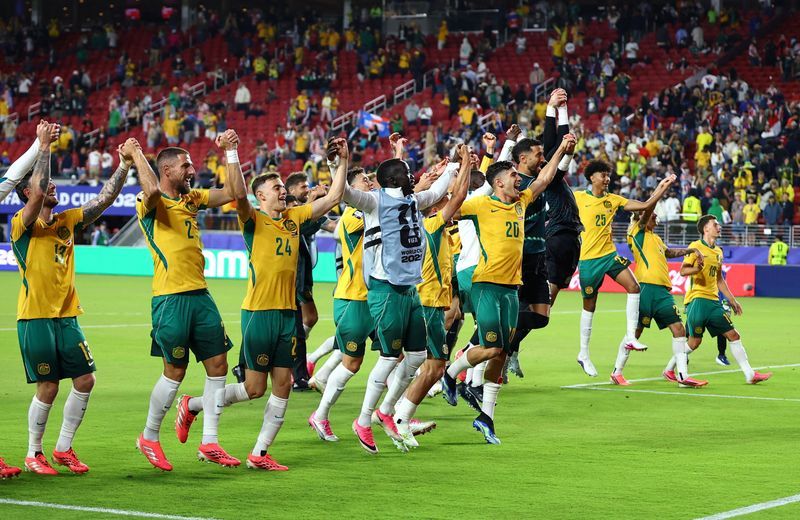
Australia has secured a place in the World Cup knockout round for the third time in the tournament's history following a tightly contested 0-0 draw with Paraguay at San Francisco Bay Area Stadium on Thursday. The match, played in California's Santa Clara region, was characterised by physical play and limited goalscoring opportunities, with both teams struggling to convert chances throughout the 90 minutes. Tony Popovic's side demonstrated enough defensive solidity to claim second place in Group D, cementing their passage to the round of 32 just four years after reaching the last 16 in Qatar.
The result leaves Paraguay in a state of uncertainty regarding their own progression. The South Americans sit on four points and must now wait for outcomes in other group matches to determine whether they qualify as one of the tournament's eight best-finishing third-placed sides. This outcome represents a significant turnaround for the 2010 World Cup quarter-finalists, who entered this tournament as dark horses but have found competitive international football increasingly demanding.
Popovic demonstrated tactical boldness by making six alterations to the starting lineup, signalling an aggressive approach aimed at breaking down Paraguay's defensive structure. The introduction of Nestory Irankunda, known for his dynamic play, alongside forward Cristian Volpato, reflected the coach's intention to generate attacking impetus. With Jacob Italiano unavailable through injury, Jordan Bos shifted from left back to cover the right flank, a positional adjustment that would prove instrumental in Australia's attacking strategy throughout the encounter.
Early phases saw Australia dominate territory, with the team launching several promising moves down the right flank. However, the Socceroos encountered persistent difficulties in the final third, unable to convert promising positions into genuine scoring opportunities. Jackson Irvine had a particularly poor moment in the opening stages when Volpato's pass released him with space in the penalty area, yet Irvine's subsequent shot flew directly at Paraguay goalkeeper Orlando Gill rather than finding the back of the net. Bos and Volpato combined on several occasions without seriously troubling Gill, who remained relatively unexposed during Australia's first-half dominance.
Paraguay's attacking threat remained minimal throughout the opening 45 minutes, managing just a single attempt as Gustavo Alfaro's team struggled to establish rhythm against Australia's organised defensive setup. The introduction of Mauricio, a Brazilian-born attacker, at half-time signalled Alfaro's intention to inject greater attacking menace into his side's performance. The forward's impact was immediate, testing Australia's goalkeeper Matthew Ryan with a long-range effort within five minutes of the restart, though the attempt lacked the precision required to trouble the shot-stopper.
As the contest progressed, Paraguay grew into the encounter with marked improvement, particularly through the contributions of Julio Enciso, whose energetic movement repeatedly caused Australia defensive complications. Enciso came closest to breaking the deadlock with approximately eight minutes remaining, orchestrating a low drive that passed agonisingly wide of the left post. His movement and link-up play demonstrated Paraguay's growing confidence as the match wore on, suggesting that Alfaro's tactical adjustments and personnel changes had successfully shifted the game's momentum away from their opponents.
Australia's most dangerous moment arrived during the closing stages when Bos surged forward from the right flank in the 89th minute. The fullback managed to slip past two Paraguay defenders, burst into the penalty area, and unleash a shot that whistled narrowly beyond the far post. The chance sparked anticipation among the Australian supporters, but the Socceroos could not capitalise on this moment of opportunity. Mauricio provided a final examination of Australia's defence moments later with a low shot from the edge of the box, yet his attempt lacked sufficient conviction and was comfortably collected by Ryan.
The draw represents a functional, if uninspiring, outcome for Australia's World Cup campaign. The team's qualification was built on substance rather than aesthetics, with the emphasis clearly placed on defensive organisation and capitalising on limited openings. For Malaysian and Southeast Asian audiences, Australia's progression demonstrates the unpredictability of international football tournaments, where consistency and tactical discipline often triumph over attacking flair. The Socceroos' ability to rotate their squad while maintaining competitive standards reflects the depth within the Australian football system and the development pathway that has enabled the nation to become a fixture in recent World Cup tournaments.
Australia's progression as Group D runners-up means they will face the second-placed team from Group G in the round of 16. That group remains genuinely competitive, with Egypt scheduled to face Iran and Belgium set to meet New Zealand on Friday. The complexity of these remaining group fixtures underscores the tournament's unpredictability, with multiple scenarios still capable of determining Group G's final standings and consequently Australia's next opponent. For the Socceroos, the knockout stage presents an opportunity to build on their group-stage performance and demonstrate that their qualification was no mere accident of favourable scheduling or fortunate results.
Popovic's team selection strategy, evidenced by the six changes to the starting eleven, suggests that depth and squad rotation will remain central to Australia's World Cup strategy going forward. The inclusion of Irankunda and Volpato, combined with the positional flexibility shown by Bos, indicates that the coaching staff possesses tactical flexibility that could prove invaluable in knockout football. However, the inability to convert chances created against Paraguay raises questions about the Socceroos' capacity to breach more resilient defensive structures in the tournament's later stages, where margins between progression and elimination narrow considerably.

