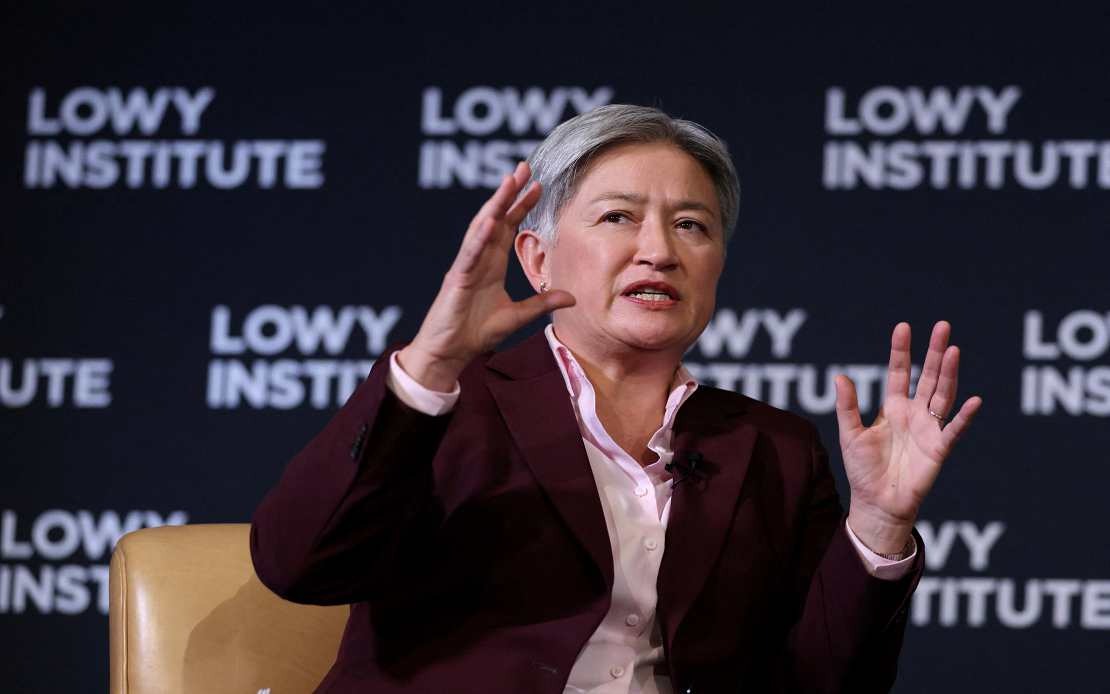
Australia's Foreign Affairs Minister Penny Wong has delivered a stark warning about the political direction her country is taking, cautioning that advocates of monoculturalism are pushing the nation toward self-imposed isolation and weakness. Speaking at the Lowy Institute in Sydney on Friday, Wong directly challenged the notion that Australia should abandon its multicultural character, framing such calls as a dangerous retreat into what she termed a "melancholic fantasy of monoculture."
Wong's intervention comes amid a noticeable political shift within Australia. Populist Senator Pauline Hanson, whose right-wing One Nation party has been gaining traction across the country, declared in June that Australia must function as a monocultural society. This statement has become emblematic of a broader nationalist movement within Australian politics that seeks to fundamentally reorient the nation's approach to immigration, international engagement, and cultural identity.
The Foreign Minister articulated a compelling counterargument to this direction, emphasizing that Australia's multicultural character is not merely a social policy choice but rather an essential foundation for national prosperity and influence. "The call for a monoculture is a call for Australia to curtail our choices and to cut off our connections. To look inwards, to have no friends to work with, no partners to trade with, and no opportunities to grow from," Wong stated during her address. Her comments underscore a fundamental disagreement within Australian politics about whether the nation's future lies in greater openness or strategic isolation.
The political landscape Wong is responding to has shifted significantly. Recent polling data paints a picture of a country where traditional major parties are losing ground to insurgent movements. A YouGov Australia survey conducted in July revealed that One Nation commands the voting intention of 26 percent of Australians, a remarkable ascent from the 6.4 percent of votes the party secured at the 2025 election. This represents a fourfold increase in electoral support in a single year, signaling profound discontent with the existing political establishment.
This surge in One Nation support has come at the expense of both major parties. The governing Labour Party has seen its support decline from 34.5 percent at the 2025 election to 28 percent, while the opposition Coalition has slumped even more dramatically from 31.8 percent to just 20 percent. The fragmentation of the traditional two-party system, with One Nation capturing nearly a quarter of voter intention, suggests an electorate increasingly willing to embrace alternatives to mainstream politics.
One Nation's policy platform, should the party gain power at the 2028 general election, would represent a dramatic reversal of Australia's post-war approach to international engagement. The party has committed to substantially curtailing immigration flows into the country, reducing foreign aid commitments, and withdrawing Australia from multilateral institutions that have been cornerstones of the nation's diplomatic and strategic architecture. Such a reorientation would have profound implications not just for Australia but for the broader Indo-Pacific region and its major partners.
Underlying One Nation's political ascendancy is a measurable shift in public sentiment regarding immigration. The Lowy Institute's annual poll for 2026, released in June, found that 55 percent of Australians believe the total number of migrants entering the country is too high. This represents a gradual hardening of attitudes over successive years, rising from 53 percent in 2025 and 48 percent in 2024. The trend suggests that anti-immigration sentiment has become increasingly mainstream rather than confined to the political periphery.
For Malaysia and other Southeast Asian nations, Australia's political trajectory carries significant implications. Australia remains a major regional actor with substantial economic and strategic interests throughout Southeast Asia. A shift toward the kind of isolationist posture One Nation advocates could reshape trade relationships, reduce engagement in regional institutions, and alter the balance of power within the Indo-Pacific. Additionally, as a destination for skilled migration and education from the region, Australia's immigration policies directly affect opportunities for Southeast Asian citizens and professionals.
Wong's speech represents the established foreign policy establishment's attempt to reframe the monoculturalism debate beyond questions of social cohesion to matters of national interest and geopolitical power. Her argument posits that in an interconnected world where prosperity depends on trading relationships, diplomatic partnerships, and intellectual exchange, cultural homogeneity is not a strength but rather a self-imposed limitation. This framing seeks to reposition multicultural immigration from a cultural or moral question to an economic and strategic imperative.
The timing of Wong's intervention, occurring in the lead-up to the 2028 election cycle, underscores how central immigration and cultural identity have become to Australian political debate. Her willingness to directly challenge One Nation's foundational premise suggests that the Labour government views the party not as a fringe concern but as a genuine political threat requiring substantive intellectual engagement. The question of whether such arguments can arrest One Nation's momentum will largely determine the nature of Australia's engagement with its region in the coming years.

