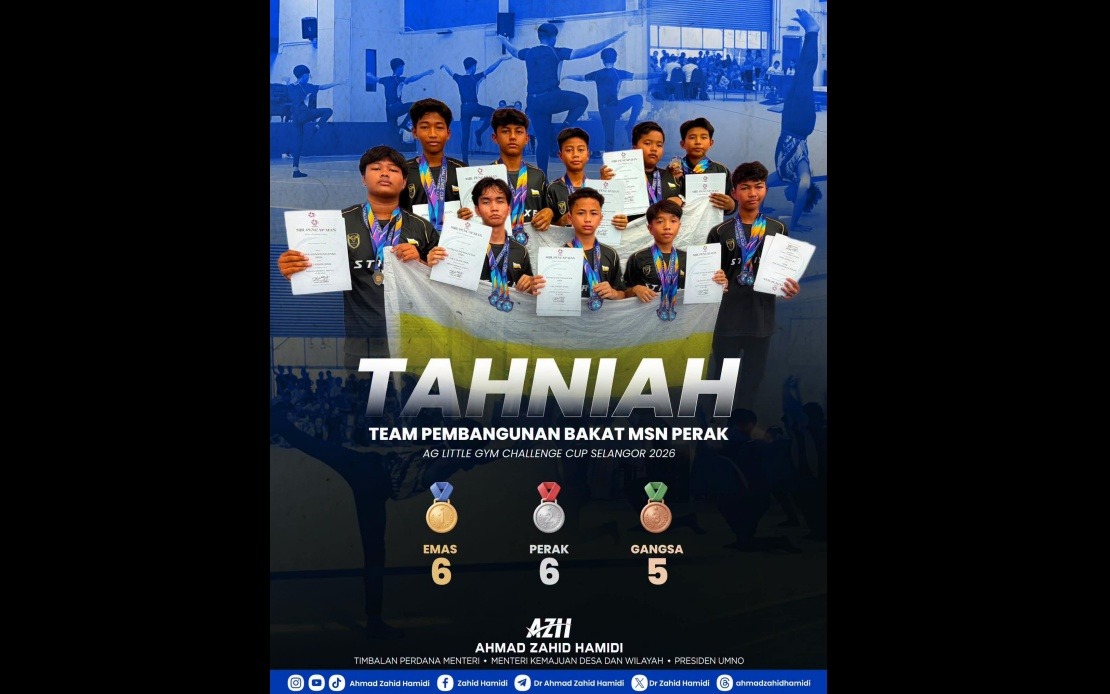
A young gymnastics contingent from Bagan Datuk has etched their names into local sporting history by delivering an exceptional performance at the AG Little Gym Challenge Cup Selangor 2026, held in Kajang on August 1. The team's haul of six gold medals, supplemented by six silver and five bronze medals, represents a significant achievement for the district and demonstrates the calibre of athletic talent emerging from the Perak community.
Deputy Prime Minister Datuk Seri Dr Ahmad Zahid Hamidi, who represents Bagan Datuk as Member of Parliament, moved swiftly to celebrate the accomplishment through a public Facebook announcement. His prompt recognition underscores the broader political significance attached to sporting success in Malaysian constituencies, where athletic achievements frequently serve as platforms for highlighting constituent pride and community development. Zahid's endorsement reflects a wider appreciation within Malaysia's leadership for youth excellence beyond the academic sphere, signalling institutional support for grassroots sports development initiatives.
In his statement, Zahid articulated a vision of holistic youth development that transcends traditional academic boundaries. He stressed that the Bagan Datuk athletes have proven the district's young people possess capabilities spanning multiple domains, from intellectual pursuits to competitive athletics. This framing is particularly significant in a Malaysian context where educational achievement often dominates discussions of youth success, sometimes marginalising recognition of sporting prowess and physical development. By elevating these gymnasts' accomplishments to the national political level, Zahid effectively repositioned sports as a legitimate and prestigious avenue for youth achievement.
The Deputy Prime Minister extended formal congratulations to every participant involved in the endeavour, explicitly acknowledging the systemic support structures that enabled success. His recognition of coaches, parents, and the broader team infrastructure reflects an understanding that individual medals emerge from collective effort and institutional commitment. This perspective aligns with contemporary thinking in sports development policy, which increasingly emphasises the roles played by mentorship, parental involvement, and coaching excellence as foundational elements of athlete success. Within Malaysia's federal framework, such acknowledgment also implicitly encourages other districts and state authorities to invest similarly in youth sports programmes.
The Bagan Datuk Generasi Muda Gymnastics Club independently amplified the achievement through their own social media channels, demonstrating how localised sports organisations now function as autonomous communications entities. Their post elevated the narrative beyond mere medal counting by explicitly connecting the physical achievements to deeper character qualities including determination, discipline, and perseverance. This messaging strategy reflects evolving understandings of sports development in Malaysia, where competitive success increasingly serves as a vehicle for cultivating personal resilience and psychological fortitude among young athletes.
The club's statement strategically positioned this accomplishment as merely an intermediate milestone rather than a terminal objective, framing the medals as evidence of capability while simultaneously motivating continued improvement. This mindset proves particularly valuable in Malaysian sports culture, where sustained excellence requires maintaining momentum across multiple competition cycles and seasons. The messaging function here extends beyond simple celebration; it serves to condition young athletes toward perpetual enhancement and to signal to potential supporters and sponsors that this programme has structural aspirations extending well beyond single competitions.
For Malaysian sports observers, the Bagan Datuk result carries implications worth examining. Gymnastics has historically occupied a secondary position within Malaysia's sporting consciousness, overshadowed by football, badminton, and other more visible disciplines. Yet this achievement demonstrates that excellence in less prominent sports requires identical levels of dedication, coaching quality, and financial investment as more traditional Malaysian sporting pursuits. The success story from Kajang may consequently encourage greater resource allocation toward gymnastics development across other Malaysian states and districts.
Within the broader Southeast Asian sporting context, the Bagan Datuk performance represents the kind of localised excellence that gradually constructs national competitive advantage. While individual district achievements may seem modest in isolation, accumulated success across multiple regions and sports creates the foundation for national sporting strength. The gymnastics prowess emerging from this Perak district contributes incrementally to the technical and competitive depth available to Malaysian national sporting organisations when assembling representative teams.
The recognition accorded to these young gymnasts also reflects shifting demographic realities within Malaysian sports participation. Gymnastics requires sustained participation from childhood through adolescence and into adulthood, demanding significant parental commitment and accessible training infrastructure. The emergence of successful programmes in districts like Bagan Datuk indicates that such structural prerequisites increasingly exist across Malaysia's hinterland regions, not merely in major urban centres. This geographic democratisation of elite sports opportunity potentially creates fairer national talent identification processes.
Moving forward, the challenge facing the Bagan Datuk Generasi Muda Gymnastics Club involves translating competition success into sustained programme development and athlete retention. Malaysian youth sports organisations frequently encounter difficulties maintaining momentum after initial victories, as attention focuses elsewhere and resources become dispersed. The explicit commitment articulated in the club's statement to continued training intensification suggests awareness of these challenges and determination to surmount them through systematic effort rather than relying solely on past accomplishments to maintain participant motivation.
The intersection of political acknowledgment, grassroots organisational initiative, and athletic achievement visible in this case study illustrates how Malaysian sporting success increasingly emerges from interconnected stakeholder networks. National leaders, local clubs, coaching staff, families, and the young athletes themselves all contributed essential ingredients to the Kajang result. Replicating such success across other Malaysian districts and sports requires understanding and supporting these complex webs of institutional and personal investment, a lesson the Bagan Datuk experience reinforces compellingly.

