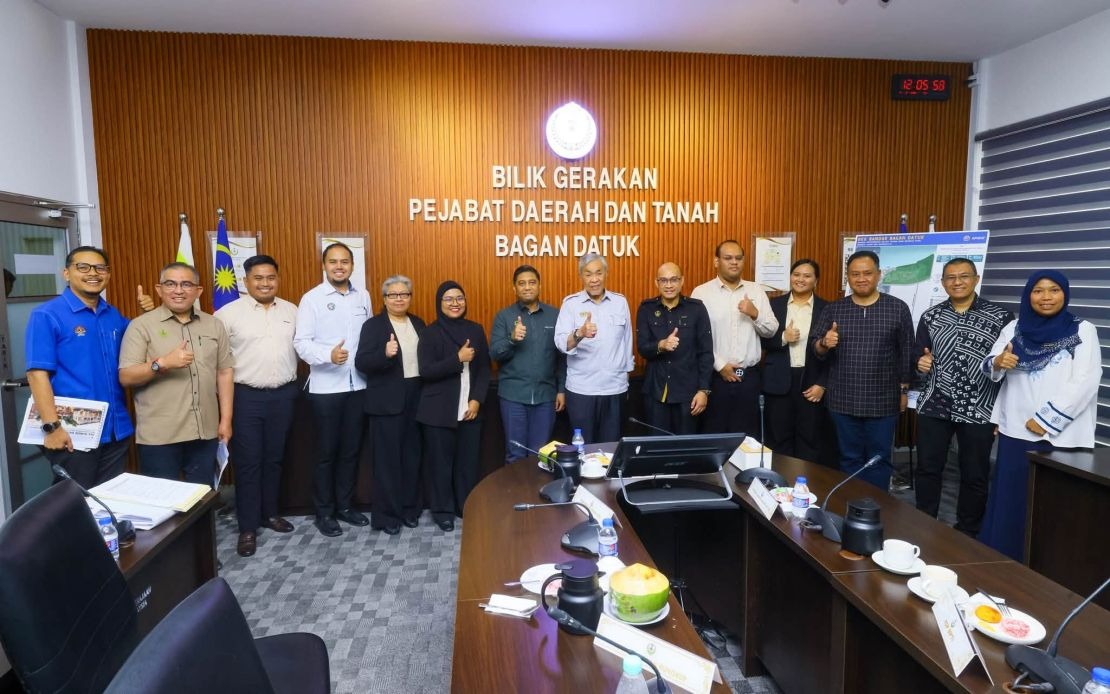
Deputy Prime Minister Datuk Seri Dr Ahmad Zahid Hamidi has signalled his commitment to transforming Bagan Datuk into a comprehensive administrative centre that balances livability with competitive economic positioning. Speaking in Ipoh on August 14, Zahid, who represents the parliamentary constituency, outlined an ambitious vision for the Perak district that extends beyond conventional development to encompass a thoughtfully designed urban environment incorporating parks and green spaces alongside modern amenities.
The Bagan Datuk lawmaker emphasised that the constituency possesses significant untapped potential, yet realising this vision requires coordinated effort from multiple stakeholders and government agencies. His remarks followed a detailed review of the Bagan Datuk special area plan (RKK), a strategic planning document developed in collaboration with the Teluk Intan Municipal Council, Bagan Datuk District Office, and professional urban planning consultants. This collaborative approach reflects the recognition that successful town development demands comprehensive coordination across municipal, district, and land administration functions.
Zahid's vision extends beyond mere infrastructure expansion to encompass holistic urban design principles that prioritise resident welfare. The proposed development framework anticipates enhanced public facilities, modernised infrastructure networks, and diversified economic opportunities that could attract both businesses and talent to the region. By framing Bagan Datuk as an "administrative town in a park," Zahid signalled an intention to combine government functionality with environmental consciousness—an approach increasingly valued in Southeast Asian urban planning where rapid development has often come at environmental cost.
As a native of Bagan Datuk, Zahid's personal connection to the constituency appears to inform his development priorities. He articulated a desire to ensure that growth programmes remain grounded in community needs rather than imposing external models unsuited to local conditions. This emphasis on listening to constituent concerns and integrating grassroots input reflects broader expectations for responsive governance, particularly in districts where rapid change could strain existing social fabric.
The special area plan represents a departure from ad-hoc development patterns that have characterised many Malaysian towns, instead adopting a master-planning approach that theoretically prevents fragmented growth. By subjecting the Bagan Datuk development framework to formal study and consultation processes, authorities signal commitment to strategic foresight. However, the translation of such plans into tangible investment depends substantially on fiscal allocation, private sector participation, and sustained political will beyond electoral cycles.
For Malaysian readers, Bagan Datuk's planned transformation carries implications for regional development patterns across Perak and beyond. The district's position within the larger Teluk Intan municipal framework means that successful development could create ripple effects throughout surrounding communities. Additionally, if the administrative hub model succeeds in attracting government functions and commercial activity, it could offer lessons for other underutilised parliamentary constituencies seeking economic diversification.
The timing of this development initiative coincides with broader discussions about decentralising economic activity away from the Klang Valley and other overstretched metropolitan regions. By positioning Bagan Datuk as a viable alternative centre for administrative functions and commercial enterprise, planners could contribute to more geographically balanced national development. This aligns with longstanding policy objectives to reduce pressure on congested urban cores whilst simultaneously providing provincial towns with economic vitality.
Economic opportunity represents a central component of Zahid's vision, suggesting that Bagan Datuk's future development will not focus exclusively on government offices but encompass commercial, residential, and light industrial elements. The prospect of broader economic opportunities could retain talent within the district rather than driving youth migration to major cities—a persistent challenge facing many Malaysian provincial towns. Enhanced employment prospects, coupled with improved living standards and environmental quality, might render Bagan Datuk an attractive destination for young professionals and families.
Zahid's commitment to ensuring that development benefits local communities reflects awareness that poorly implemented growth can displace residents or concentrate gains among property developers and external investors. By emphasising community needs during planning phases, authorities theoretically create conditions for more inclusive outcomes, though execution remains critical. The involvement of district-level offices in the planning process suggests mechanisms for incorporating local perspectives, though effectiveness depends on genuine consultation rather than performative engagement.
The infrastructure component of Bagan Datuk's planned development warrants particular attention, as inadequate utilities and transport connections have historically constrained growth in secondary towns. Modern administrative centres require robust telecommunications networks, reliable power supply, efficient water systems, and connectivity to regional transport corridors. If planners address these foundational elements comprehensively, they establish prerequisites for sustained development; conversely, infrastructure shortcomings could undermine even well-intentioned planning frameworks.
Looking forward, monitoring how the Bagan Datuk special area plan translates from paper to reality will indicate whether Malaysia can execute sophisticated urban planning at district level. Success would demonstrate capacity for strategic regional development unconstrained by metropolitan bias; failure would suggest systemic obstacles to implementing even carefully formulated plans. For residents and stakeholders in Bagan Datuk, the coming years will test whether political commitment and planning documents genuinely materialise into the livable, economically vibrant town envisioned by their Member of Parliament.

