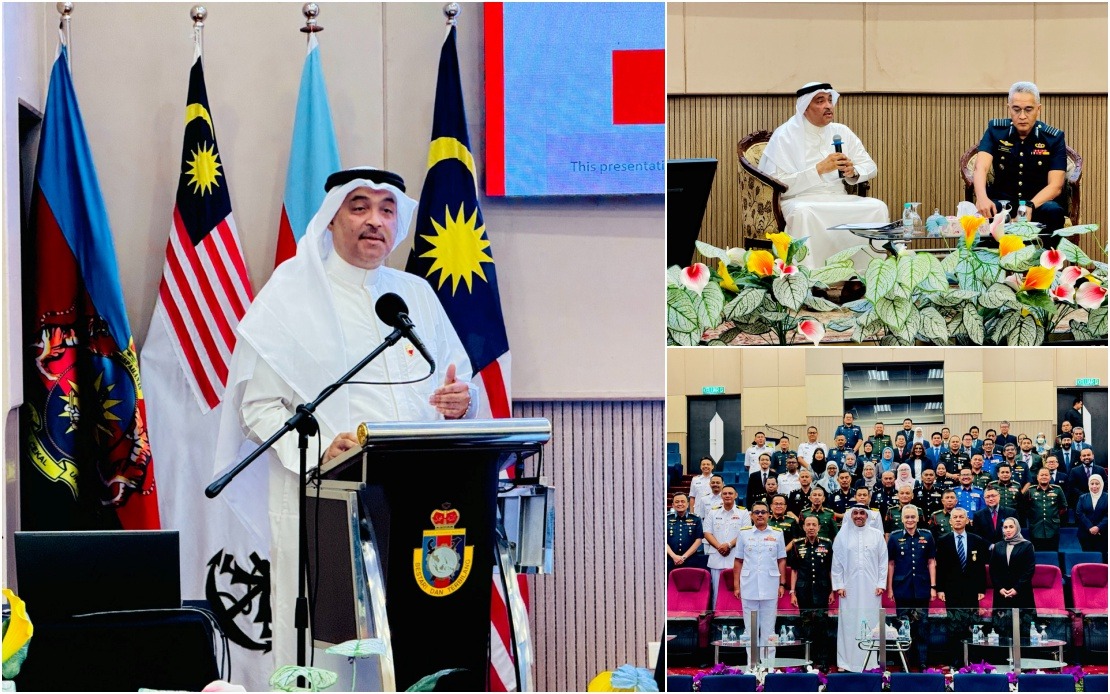
The relationship between Bahrain and Malaysia is entering a more substantive phase, with both Gulf and Southeast Asian interests increasingly aligned on matters of regional security and strategic cooperation. Speaking at the National Resilience College in Putrajaya, Bahrain's Ambassador to Malaysia Dr Waleed Khalifa Al Manea outlined how the two nations are building a comprehensive partnership that extends beyond traditional diplomatic channels into defence, maritime affairs and multilateral security mechanisms.
The foundation for this deepening engagement rests on strong personal relationships between the monarchies and prime ministers of both nations. His Majesty King Hamad bin Isa Al Khalifa of Bahrain and His Majesty Sultan Ibrahim, King of Malaysia, have established the political framework for expanded cooperation, while their respective heads of government—His Royal Highness Prince Salman bin Hamad Al Khalifa and Datuk Seri Anwar Ibrahim—continue driving concrete initiatives that translate diplomatic goodwill into actionable programmes. This leadership consensus creates the conditions necessary for meaningful progress across multiple domains.
One symbolic marker of this partnership's growth appears in an unexpected venue: motorsport. Malaysia's hosting of the 2026 Formula 1 Gulf Air Bahrain Grand Prix represents more than a sporting spectacle. Such high-profile international events serve as diplomatic soft power tools, elevating bilateral relations onto a global stage and signalling to the international community that the two nations occupy aligned positions on regional matters. For Malaysia, it underscores the country's growing engagement with Gulf affairs; for Bahrain, it demonstrates the kingdom's expanding reach into Southeast Asian strategic circles.
The substance of this partnership, however, extends into security domains where Malaysia has direct interests. Bahrain faces persistent challenges from Iran's military posturing in the Persian Gulf, including attacks on critical infrastructure, civilian populations and maritime navigation routes that carry global significance. These tensions carry immediate implications for ASEAN and Malaysia specifically, as disruptions to Gulf shipping lanes affect Southeast Asian trade and energy supplies. When tensions escalate in the Strait of Hormuz or along Gulf shipping corridors, the economic shockwaves ripple through Malaysian ports and energy markets.
During Bahrain's presidency of the UN Security Council in April, the kingdom prioritised international coordination on maritime security and freedom of navigation—issues where Malaysia holds substantial stakes. The Gulf Cooperation Council member states face real vulnerabilities in protecting their territorial waters and critical infrastructure, lessons that carry relevance for Southeast Asian nations managing their own maritime security in increasingly contested waters. Malaysia's co-sponsorship of UN Security Council Resolution 2817 reflected this convergence of interests, with both nations affirming commitments to protecting civilians, respecting state sovereignty and maintaining secure shipping lanes.
Al Manea's lecture to Malaysia's defence establishment—attended by senior officers from the Malaysian Armed Forces, Royal Malaysia Police and Maritime Enforcement Agency, alongside members of Parliament and academic experts—demonstrates that this partnership operates at institutional levels beyond ceremonial diplomacy. The National Resilience College gathering represented a structured effort to brief Malaysia's security community on Bahrain's strategic thinking regarding regional threats, Iran's military activities and the diplomatic architectures being constructed to counter these challenges. Such direct engagement between defence establishments creates the mutual understanding necessary for coordinated responses to shared security challenges.
Bahrain's approach to regional security combines three complementary elements: defence of state sovereignty, protection of civilian populations, and advancement of diplomatic solutions. This framework appeals to Malaysia's own security philosophy, which emphasises territorial integrity while maintaining diplomatic channels and multilateral engagement. By articulating this comprehensive approach, Al Manea positioned Bahrain not as a militaristic actor seeking confrontation but as a state attempting to maintain stability through balanced means—an important distinction for Malaysia, which values non-confrontational approaches to regional disputes.
The Iranian dimension of Gulf security carries particular weight in any Malaysia-Bahrain discussion. Iran's attacks on GCC member states generate reverberations throughout Asia, affecting insurance costs for shipping, energy prices and maritime insurance premiums that ultimately impact Southeast Asian economies. When Iran targets vital infrastructure or maritime routes, the consequences extend far beyond the immediate region. Malaysian officials and defence planners need to understand Bahrain's perspective on Iranian intentions, escalation risks and the threshold at which military responses become necessary—precisely the kind of intelligence and analysis sharing that deepens through such high-level engagements.
For Malaysia, engagement with Bahrain on Gulf security matters provides valuable perspective on managing a powerful neighbour with contested regional ambitions. Just as Bahrain navigates its relationship with Iran across relatively short distances, Malaysia manages its own complex relationships with larger regional powers. The diplomatic and security strategies Bahrain employs—emphasising documentation of violations, coordination through multilateral mechanisms like the UN Security Council, and coalition-building among affected states—offer applicable lessons for Malaysian policymakers addressing their own strategic environment.
The timing of this partnership expansion reflects broader geopolitical shifts. ASEAN nations increasingly recognise that Middle East stability carries consequences for Southeast Asia, while Gulf states recognise that their security strategies benefit from engagement with rising powers in Asia. Malaysia's position as a major Southeast Asian player and a Muslim-majority nation with significant Islamic credentials makes it particularly valuable as a partner for Bahrain. By strengthening ties with Malaysia, Bahrain gains influence with ASEAN and potentially better positioning within broader Asian strategic calculations.
Looking forward, the Malaysia-Bahrain partnership will likely expand into areas beyond defence and security. Trade cooperation, investment flows, educational exchanges and tourism represent growth areas, particularly as both nations seek to diversify their economic partnerships. However, the security and diplomatic dimensions will remain foundational, reflecting the reality that regional stability ultimately enables prosperity. As Middle East tensions persist and maritime security challenges multiply, the cooperation framework between Bahrain and Malaysia may prove increasingly consequential for maintaining international order in zones critical to both nations' futures.

