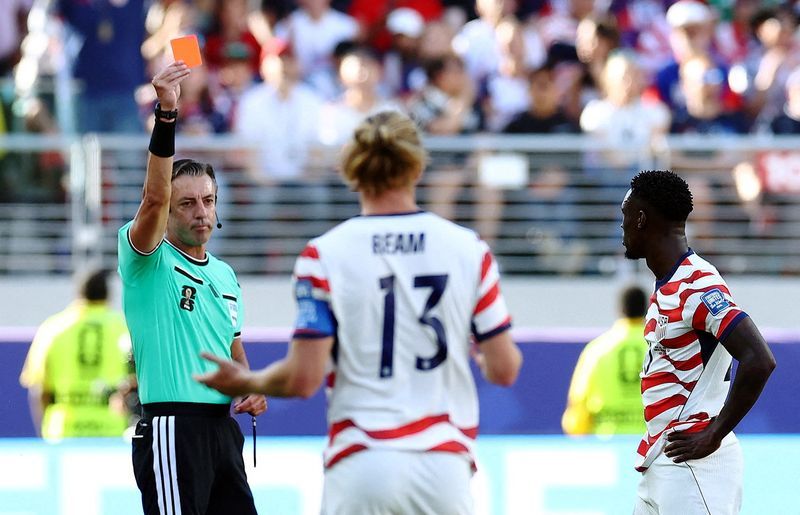
The aftermath of FIFA's decision to overturn Folarin Balogun's World Cup red card suspension threatens to erode public faith in football's disciplinary framework, according to two of English football's most influential figures. Howard Webb, who heads the Premier League's refereeing operations through Pro Ref, and Richard Masters, the league's chief executive, have warned that the controversial episode carries troubling implications for the integrity of officiating both at global and domestic levels. Their concerns come as the new Premier League season prepares to commence with heightened scrutiny of refereeing decisions likely to intensify in the months ahead.
The Balogun case represents one of the tournament's most contentious moments, marked by the explicit intervention of U.S. President Donald Trump in FIFA's disciplinary process. After the initial red card dismissal, FIFA subsequently lifted the American forward's suspension through procedures that observers have criticised for lacking transparency and proper governance structure. Webb, a former referee of the 2010 World Cup final, articulated particular unease not so much with the original on-field decision itself, but rather with the institutional failure that allowed political influence to reshape the penalty after the fact.
Webb elaborated on his reservations, emphasising that the damage extended beyond the specific incident to the broader perception it created about how football's governing bodies function. He noted that admissions of political pressure being placed on FIFA, combined with the subsequent reversal through what appeared to be an ad-hoc process, established a dangerous precedent. The incident occurred at a time when online discourse increasingly frames disputed officiating decisions as evidence of systemic corruption, a phenomenon Webb described as deeply troubling for the sport's credibility.
The Premier League official highlighted how social media has transformed the consumption and interpretation of refereeing decisions. Controversies that previously might have been confined to post-match analysis now spiral into broader narratives of misconduct and hidden agendas, often constructed without factual foundation. Webb expressed frustration that the Balogun affair provides ammunition for those predisposed to distrust official processes, particularly when the mechanisms that overturned the suspension appeared nebulous and politically influenced rather than grounded in established protocols.
Masters similarly lamented that the World Cup's narrative had been hijacked by off-field drama rather than celebrating the quality football on display. He noted that discussion should have centred on Spain's impressive campaign and England's heartbreaking semi-final elimination, yet instead became dominated by governance failures and political interference. This shift in focus represents a missed opportunity to celebrate the tournament's sporting merits while allowing legitimate institutional concerns to overshadow the competition itself.
The Premier League chief executive identified specific regulatory gaps that the Balogun episode exposed within FIFA's disciplinary framework. Unlike many domestic competitions, FIFA's regulations contain no formal mechanism for reviewing and overturning red card decisions once issued. This absence created the conditions for the controversial handling of Balogun's case, forcing FIFA to improvise solutions that ultimately undermined institutional credibility. Masters characterised the situation as exceptionally difficult to comprehend and noted that FIFA's inability to address the issue through established procedures contributed substantially to the controversy.
The timing of these concerns proves particularly significant as the Premier League season launches with unprecedented regulatory changes designed to accelerate match tempo and reduce time-wasting. Webb outlined that referees will administer fewer warnings and issue more direct penalties for infractions, applying new interpretations from the outset rather than phasing them in gradually. This stricter enforcement approach, while aimed at improving the spectacle, will inevitably generate contentious moments that invite scrutiny and analysis from fans increasingly primed to question officiating integrity following the Balogun controversy.
Webb acknowledged that every major VAR review and refereeing decision throughout the season faces heightened scrutiny, creating an environment where the fallout from the World Cup episode may persistently influence how audiences interpret officials' actions. He expressed particular concern that the precedent set by FIFA's handling of Balogun could fuel suspicions that similar mechanisms exist across football's various levels of governance, encouraging viewers to see corruption or incompetence in decisions they might otherwise accept without question. The challenge facing match officials intensifies when institutional trust has been compromised at the global level.
Yet Webb maintained that the new enforcement protocols represent a genuine attempt to improve football rather than an opportunity for corruption or bias. He explained that contact remains part of the game and that referees will maintain appropriate thresholds rather than penalising every contact point. The objective involves encouraging tactical adjustments from players, who will recognise that marginal offences now warrant punishment, thereby reducing the frequency of controversial situations rather than generating additional controversy. Webb suggested that by season's end, observers should be able to identify measurable improvements in how many infractions receive appropriate penalties.
The Premier League's positioning ahead of this season reflects a broader institutional anxiety about maintaining public confidence in officiating at a moment when global governance failures have created scepticism. Webb and Masters both recognise that while officials cannot control FIFA's decision-making, they bear responsibility for ensuring that Premier League officiating operates with transparency, consistency, and integrity. Their public statements serve both as warning about the broader damage caused by the Balogun episode and as reassurance that English football's domestic competition operates according to principles that prioritise sporting merit over external pressure.
The conversation also underscores Southeast Asian football's indirect exposure to these governance challenges. As regional competitions and players increasingly navigate international football governance structures, the precedents established by cases like Balogun's influence how confidence operates across the global game. Malaysian and Southeast Asian football communities observe how major football nations handle disciplinary integrity, with implications for how regional competitions establish their own standards and respond to external pressures that might threaten sporting fairness.

