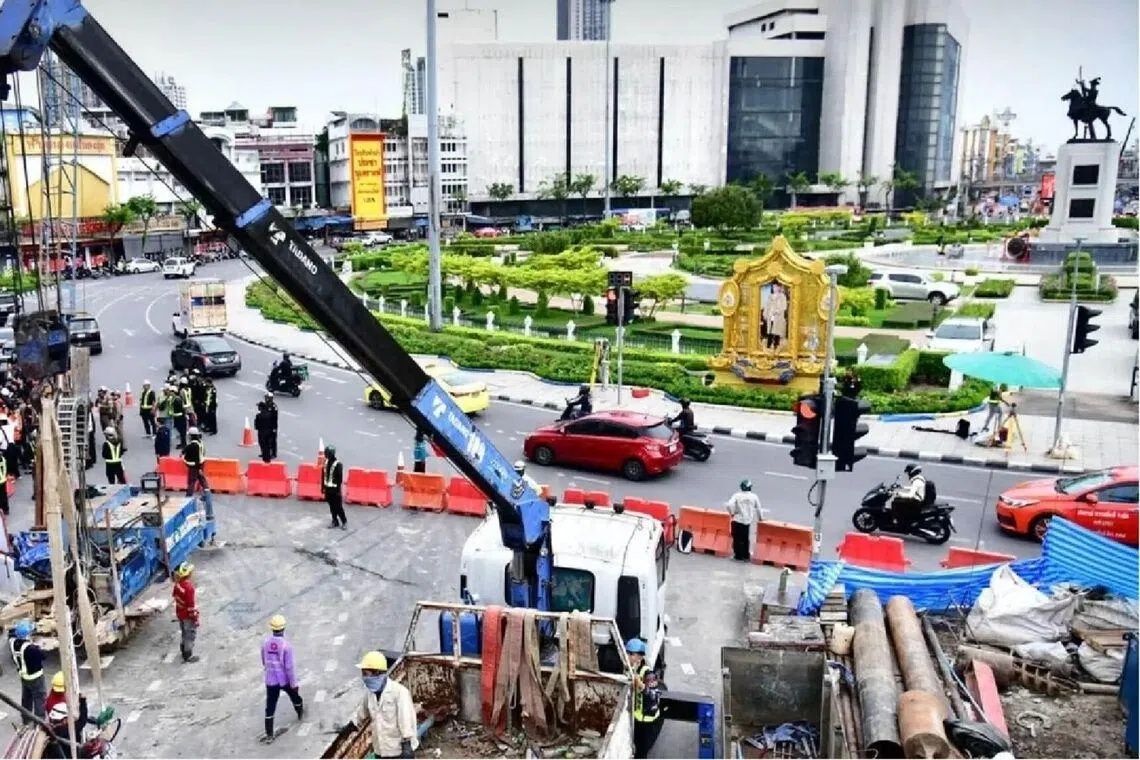
Bangkok's authorities have responded swiftly to a geotechnical crisis unfolding along the southern Purple Line extension, evacuating some 60 residents from three commercial buildings located within 30 metres of a subsidence site that emerged near Wongwian Yai this week. The incident underscores the considerable engineering challenges posed by Bangkok's ambitious mass transit expansion programme, particularly given the city's complex underground geology and existing infrastructure. Governor Chadchart Sittipunt visited the affected zone on July 9 alongside senior officials, taking a hands-on approach to what could have escalated into a more serious urban disaster had containment measures not been deployed promptly.
The root cause traced back to water infiltration within a drainage sump positioned at the lowest elevation of the southern Purple Line tunnel. This seepage allowed surrounding soil to gradually flow into the underground structure, destabilising ground layers above and ultimately causing visible subsidence of the road surface itself. Such incidents represent a particular hazard in central Bangkok, where dense urban development leaves little margin for error in underground construction. The affected section of Prajadhipok Road stretches approximately 200 metres from the Ban Khaek intersection to Wongwian Yai, and authorities closed all outbound lanes as a precautionary measure, converting two inbound lanes for temporary outbound use to maintain essential traffic flow through this congested commercial corridor.
The evacuation process has proceeded in orderly fashion, with the Mass Rapid Transit Authority of Thailand's contractor accepting financial responsibility for accommodation, compensation, and ancillary costs. Residents have been relocated to hotel accommodation and similar temporary facilities, with current projections suggesting they will remain displaced for approximately one week pending structural assessments. This approach balances public safety imperatives against the practical disruption caused by forced relocation, though the psychological and economic impact on affected businesses warrants close attention from municipal authorities.
Technological safeguards now supplement traditional monitoring approaches. The Department of Disaster Prevention and Mitigation has installed two Rescue Guardian monitoring units on nearby buildings, instruments capable of detecting minute tilting movements and structural shifts in real time. These systems transmit continuous data to central monitoring stations, triggering immediate alerts if abnormal movement patterns emerge. Placement of sensors within 30 metres of visible road cracks establishes a responsive early-warning network that could prove critical should conditions deteriorate unexpectedly. This proactive instrumentation reflects lessons learned from previous Bangkok subsidence incidents and represents sound risk management in an urban environment.
Engineers from Thailand's national Urban Search and Rescue team have joined local specialists in evaluating surrounding structures and ensuring that response protocols meet established engineering and public safety standards. The forward command centre established near the subsidence point coordinates activities across multiple agencies—the Bangkok Metropolitan Administration, the Mass Rapid Transit Authority, the project contractor, district authorities, police, and emergency services—creating integrated oversight that should prevent the compartmentalised decision-making that sometimes compounds urban infrastructure crises. Round-the-clock operations, supported by generators, lighting equipment, and specialised machinery, demonstrate commitment to intensive monitoring and rapid response capability.
The immediate engineering priority involves sealing the drainage sump leak and preventing continued soil migration into the tunnel structure. Instrumentation operates continuously to track road surface movement, soil displacement, water leakage rates, and building condition, generating datasets that will inform decisions about timeline and protocols for reopening the affected corridor. Authorities have indicated that restrictions will be eased only after engineers formally certify that buildings, road infrastructure, and surrounding structures meet safety thresholds. This graduated approach, while frustrating for motorists and business operators, reflects appropriate caution given the potential consequences of premature reinstatement of normal traffic loads.
The incident's geographic and operational context warrants particular attention. This subsidence event has occurred along the same southern Purple Line alignment as an earlier collapse near Vajira Hospital, though different contractors executed those respective sections. Such clustering raises questions about whether broader design or geological assessment issues may persist across the extension, potentially requiring system-wide review protocols. Industry observers in Southeast Asia will be monitoring whether Bangkok's metropolitan authorities initiate comprehensive geological audits of remaining Purple Line construction to identify and mitigate similar vulnerabilities before they trigger further incidents.
Traffic management complexities extend beyond immediate closure logistics. Prajadhipok Road functions as a critical artery in Bangkok's transportation network, serving as a major bottleneck near significant educational institutions including Suankularb Wittayalai School and Suksanari School. Governor Chadchart has signalled that authorities may implement lessons from the Vajira Hospital subsidence response, potentially including enhanced school shuttle services to reduce private vehicle traffic during peak periods. Such measures, while beneficial for safety and congestion management, require coordination with school administrators and parents' associations, introducing additional stakeholder complexity that officials must navigate.
Motorised traffic has been redirected to alternative routes including Itsaraphap, Lat Ya, and Somdet Chao Phraya roads for vehicles arriving from Memorial Bridge or Phra Pok Klao Bridge via the Ban Khaek intersection. These secondary routes, while functional, lack the capacity efficiency of the primary corridor and will experience elevated congestion during the closure period. Authorities have deferred announcement of longer-term traffic arrangements pending engineering determinations about closure duration, a reasonable but administratively unsatisfying position that leaves the business community and commuting public in uncertainty about disruption timelines.
The broader implications extend beyond immediate incident management. Bangkok's ongoing expansion of the mass transit system, while essential for urban sustainability and congestion relief, inevitably creates construction-related hazards in a densely settled environment. This incident reinforces the importance of robust geological investigation, stringent contractor oversight, comprehensive insurance and compensation frameworks, and transparent public communication. For Malaysian observers, particularly those in Klang Valley concerned about the MRT Circle Line and anticipated Metro extensions, Bangkok's experience offers instructive cautionary lessons about maintaining rigorous engineering standards and maintaining contingency capacity in construction programming.
The Bangkok Metropolitan Administration and the Department of Disaster Prevention and Mitigation have committed to continuous assessment of building and infrastructure stability before permitting resident returns or restriction relief. This methodical approach, grounded in engineering verification rather than schedule pressure, should ultimately reinforce public confidence in official decision-making. However, the incident also highlights the tension inherent in rapid urban infrastructure development—innovation and expansion inevitably introduce execution risks that no amount of planning can entirely eliminate. The question for Bangkok authorities and regional peers becomes how to optimise that risk-benefit balance while maintaining credibility with communities whose neighbourhoods bear the immediate consequences of subsurface engineering challenges.

