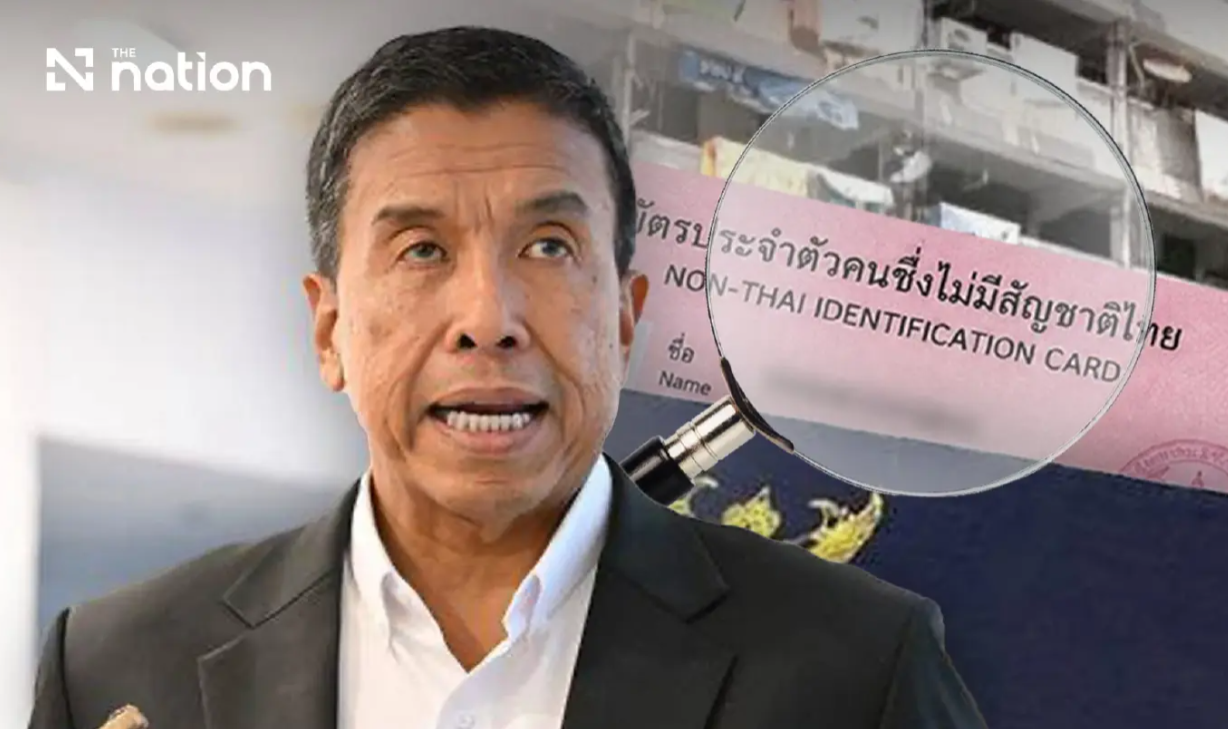
Bangkok Governor Chadchart Sittipunt has initiated a sweeping examination of 10 years of household-registration data across all 50 district offices in the capital, responding to evidence of systematic manipulation in the issuance of pink cards—the distinctive identification documents issued to non-Thai nationals living in Thailand. The unprecedented scope of the audit reflects mounting concern that vulnerabilities in Thailand's civil-registration framework have been exploited to circumvent nationality requirements and facilitate fraudulent documentation.
The investigation targets records spanning from 2017 onwards, with particular focus on whether foreign nationals were illegally transferred into household registrations—a key prerequisite for obtaining pink-card authorization. Bangkok's administrative authorities instructed all district offices to submit preliminary findings by August 21, signalling the urgency with which city leadership views the matter. The underlying concern is that deliberate gaps in the registration system allowed individuals to manufacture or manipulate their place within official household structures, thereby meeting documentary requirements they would otherwise fail to satisfy.
The scheme appears to have involved multiple methods of circumventing standard procedures. In one variation, birth certificates belonging to children of foreign nationals born in Thailand but later taken abroad remained on file domestically. These documents were then allegedly repurposed to transfer unrelated individuals into household registrations under the children's identities. Other cases revealed the transfer of names from central household registers into standard registrations, or the fabrication of parent-child relationships—arrangements colloquially termed "phantom child" and "phantom father" schemes. Each method exploited different procedural weak points within a registration system designed to document legitimate familial and residential relationships.
The irregularities came to light most clearly in Din Daeng district, where authorities discovered a 40-square-metre property listing between 40 and 45 registered residents—a density that immediately suggested serious documentation problems. Subsequent examination of Din Daeng records throughout 2024 uncovered more than 2,000 registrations displaying suspicious characteristics, predominantly unusual address transfers that deviated from normal residential patterns. This concentration in a single district has prompted wider investigations to determine whether similar manipulation occurred elsewhere across Bangkok's administrative divisions.
The scale of the suspected fraud has prompted administrative action against personnel implicated in the breaches. Four Bangkok Metropolitan Administration employees have been temporarily suspended pending formal disciplinary investigations, with a fourth removal announced as the inquiry expanded. Officials emphasize that suspension represents an administrative measure rather than a determination of culpability, and that separate police proceedings are ongoing. This distinction is important given the potential involvement of multiple actors across different administrative levels, some of whom may no longer be in government service.
Governor Chadchart has acknowledged that roughly 3,000 questionable registrations have been identified, though he cautioned that this figure remains unconfirmed. Significantly, he noted that problematic registrations are likely distributed across multiple properties rather than concentrated in individual locations, meaning the underlying problem extends beyond the high-profile Din Daeng cases. Initial screening efforts will focus on homes with at least 15 registered residents, though authorities have signalled their intention to lower this threshold subsequently to enable broader random sampling of individual properties and identify patterns that might otherwise remain concealed.
The investigation's financial dimension represents a particularly complex challenge for Bangkok authorities. The city administration suspects that brokers facilitating fraudulent registrations may have paid government employees to approve irregular applications, yet the BMA lacks independent authority to compel disclosure of financial records or transactions from individuals outside the administration. Police cooperation is therefore essential to trace money flows between suspected brokers and officials, a requirement that highlights the interconnected nature of potential corruption across administrative and law-enforcement boundaries.
Chadchart has committed to establishing a formal investigation committee to examine both the registration records and the conduct of implicated individuals, with explicit instructions that inquiries should follow evidence wherever it leads, including towards retired senior executives and officials no longer in active service. This commitment to pursue accountability irrespective of hierarchical position or retirement status reflects acknowledgement that systematic fraud of this magnitude necessarily implicates decision-making at multiple administrative tiers. Legal consequences will ultimately depend on findings and applicable law, leaving open the possibility of prosecutions if evidence warrants action.
Beyond immediate investigatory measures, the Bangkok Metropolitan Administration is implementing structural reforms intended to prevent recurrence of similar breaches. Approval authority for household registrations will be distributed among multiple officials rather than concentrated in individual employees, specifically requiring coordination between district directors and section heads. This diffusion of decision-making authority aims to reduce opportunities for personal abuse and entrench institutional oversight. Additionally, officials working in sensitive registration positions will be subject to periodic rotation, disrupting the development of established relationships that might be exploited by brokers seeking to circumvent procedures.
The BMA is simultaneously expanding existing anti-corruption policies with renewed emphasis on administrative affairs and civil registration, signalling that governance frameworks in these domains require strengthening. The administration recognizes that procedural transparency must be enhanced while protecting legitimate applicants from unfair treatment during investigation. This balancing act—between rigorous scrutiny of suspicious cases and fair treatment of individuals whose registrations warrant review—will substantially test administrative capacity and institutional impartiality as the decade-long audit progresses.
The pink-card fraud investigation carries implications extending beyond Bangkok's administrative machinery. Thailand's civil-registration system underpins numerous government functions and private-sector transactions; if documentation can be manufactured through deliberate exploitation of procedural gaps, the integrity of identity verification across multiple domains faces compromise. For Myanmar's Rohingya refugee population and others seeking to establish legitimate residence status within Thailand, the investigation's outcome may shape government approaches to documentation requirements and verification procedures. Similarly, Malaysian and other Southeast Asian nationals residing in Thailand may face heightened scrutiny of their registration status and documentation, even where no irregularities exist.

