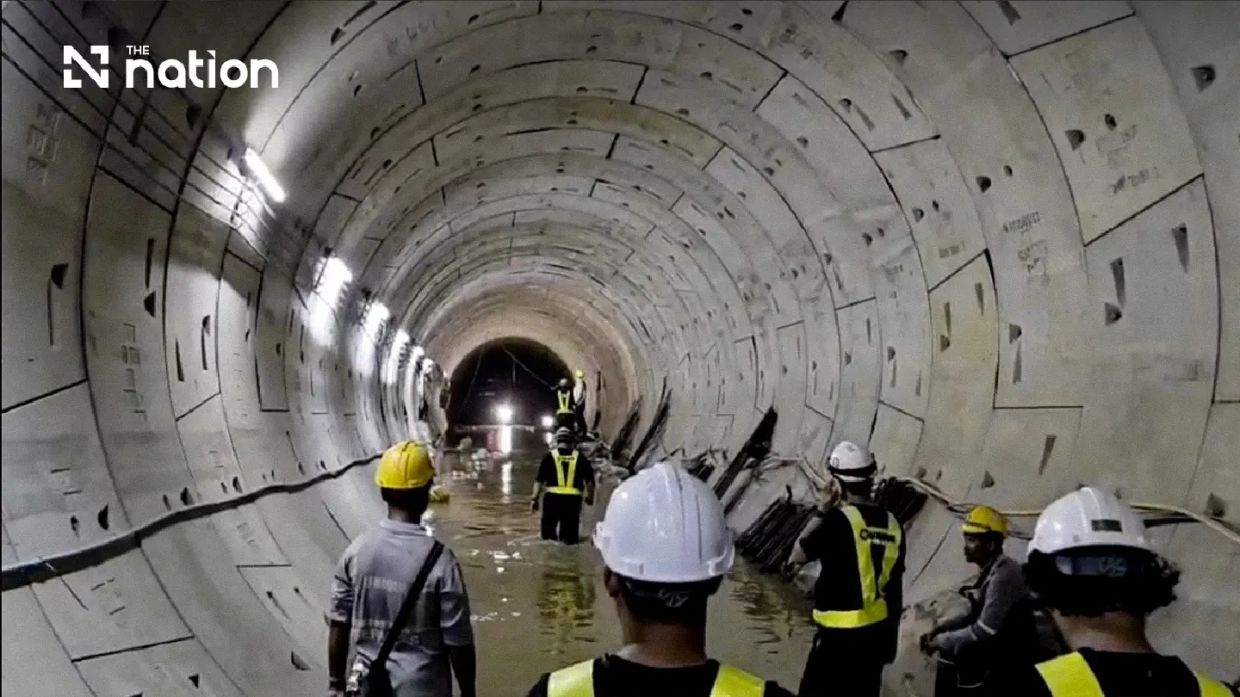
Bangkok's troubled mass transit expansion hit another setback Wednesday night when heavy monsoon rains forced water into a construction tunnel beneath the southern Purple Line extension, triggering an unprecedented late-night mobilisation of Thailand's top transport officials and Prime Minister Anutin Charnvirakul himself. The incident underscores persistent vulnerabilities in the capital's ambitious but accident-prone rail infrastructure project, which has already weathered a major tunnel collapse near Vajira Hospital that left motorists stranded and raised questions about project supervision.
The water intrusion was detected in an underground shaft beneath the Tao Poon–Rat Burana section of the Purple Line, which follows the Kanchanaphisek Ring Road corridor. As Bangkok experienced intense rainfall on July 8, groundwater levels inside the active construction worksite climbed steadily throughout the day, eventually breaching containment protocols. The affected area forms part of Contract 4, a 14.982 billion baht construction package spanning the Saphan Phut–Dao Khanong corridor and executed by Unique Engineering and Construction Public Company Limited. Current work focuses on tunnel excavation and retaining wall installation, activities particularly vulnerable to water ingress when heavy rain saturates Bangkok's notoriously porous geology.
Anutin's decision to arrive at the site around midnight, accompanied by Deputy Prime Minister and Transport Minister Phiphat Ratchakitprakarn and multiple deputy ministers, signalled the government's acute sensitivity to fresh tunnel mishaps. The show of high-level force reflected lessons learned from the Vajira Hospital collapse, which became a political liability and exposed systemic gaps in project governance. By assembling senior officials immediately, the government sought to demonstrate decisive crisis management while the incident remained manageable—a public relations strategy designed to prevent erosion of confidence in the broader Purple Line programme.
Deputy Transport Minister Phattharaphong Phatraprasit provided reassurance that preliminary assessments found the situation "under control," though he demanded that Unique Engineering and the Mass Rapid Transit Authority of Thailand conduct exhaustive technical reviews to identify the leak's precise origin and implement corrective measures before water damage threatened tunnel structural integrity or project timelines. His directive reflected standard protocol for infrastructure crises: stabilise the immediate threat, investigate root causes thoroughly, and restore public confidence through visible oversight. Engineers immediately began installing equipment to monitor ground movements in surrounding structures and buildings—a precautionary measure indicating concern that water pressure might trigger subsidence similar to the Vajira incident.
Anutin distinguished the Wongwian Yai incident from the previous tunnel collapse by emphasising that authorities had detected the leak early and moved swiftly to contain it rather than discovering structural damage after catastrophic failure. He noted that water levels, while monitored continuously, had not risen to the point necessitating road closures or evacuation of nearby premises. This narrative framing—presenting early detection as evidence of improved project management—attempted to convert a potential crisis into proof of systemic learning. The prime minister stated that controlling the water level was possible "at this stage," though his conditional phrasing suggested continuing uncertainty about whether the situation might deteriorate if rainfall persisted.
The incident occurs amid broader scrutiny of Thailand's infrastructure ambitions and governance capacity. The Purple Line project, which aims to connect southern Bangkok to key commercial and residential zones, represents the kind of massive infrastructure undertaking that defines Southeast Asian development aspirations. Yet repeated setbacks—from the Vajira Hospital collapse to environmental concerns about tunnel construction in densely populated areas—raise questions about planning rigour, contractor oversight, and Thailand's ability to manage complex underground projects in challenging tropical conditions. For Malaysian observers, the Bangkok experience offers cautionary lessons as Kuala Lumpur pursues its own extensive rail expansion through the Klang Valley and beyond.
What distinguishes this incident from routine construction mishaps is its intersection with infrastructure security and political legitimacy. Thailand's government, keen to demonstrate effective crisis response, mobilised resources that signalled serious concern without descending into panic. Yet the very fact that a prime minister felt compelled to visit a tunnel leak site at midnight reveals the reputational stakes involved. Each Purple Line incident erodes public and investor confidence in project credibility, potentially affecting both completion timelines and future infrastructure financing in Thailand and the broader region.
The investigation process, according to Anutin, was not expected to consume excessive time, suggesting authorities intended to reach conclusions and implement repairs rapidly. Coordination between the MRTA, consulting engineers, and Unique Engineering was described as collaborative and solution-focused, with all parties reportedly confident in the situation's controllability. However, such assurances, offered in real-time during an unfolding incident, carry inherent limitations. Engineering assessments conducted under political pressure and media scrutiny may prioritise expeditious solutions over exhaustive analysis, potentially missing underlying systemic vulnerabilities.
The deployment of multiple ministers and the prime minister himself, rather than delegating the response to transport ministry staff, reflected both the seriousness of the incident and the government's determination to avoid perceptions of indifference. Anutin's explanation that he had simply notified colleagues via group chat before heading to the site attempted to characterise the response as routine coordination rather than crisis escalation—a subtle but significant distinction in managing public psychology around infrastructure safety. Yet the contrast between this night-time mobilisation and typical project oversight suggested that standard supervision mechanisms had proven insufficient to prevent water intrusion in the first place.
For Malaysia and other Southeast Asian nations pursuing rapid transit expansion, the Purple Line saga illustrates how geological, meteorological, and engineering factors intersect to create infrastructure hazards that planning documents often underestimate. Bangkok's tropical monsoon climate, combined with deep urban excavation in soft soil conditions, creates genuine technical challenges requiring sophisticated management. More broadly, the incident demonstrates how infrastructure accidents can become political watersheds, determining whether governments are perceived as competent or negligent, ultimately affecting electoral viability and policy legitimacy.
The water level inside the tunnel, maintained through active pumping and drainage operations launched since morning, remained stable as of Anutin's midnight visit, with no indication of rapid increase. Monitoring equipment tracked nearby structures for subsidence or abnormal movement, so far revealing nothing alarming. These technical details, while reassuring, must be contextualised within a longer project history marked by detection failures and surprise collapses. The transition from Wednesday night's controlled response to subsequent weeks would determine whether officials had genuinely mastered tunnel construction risks or had simply benefited from fortunate timing and luck.
Moving forward, the incident will likely prompt renewed scrutiny of Purple Line contracts, particularly regarding environmental assessment and water management protocols during monsoon season. Both Thai and international engineering standards may require revision to address vulnerabilities exposed during construction. The balance between accelerating project completion and ensuring genuine safety—a tension evident in government statements urging both rapid repairs and rigorous inspection—will define whether the Purple Line ultimately delivers the efficient, reliable transit system that Bangkok residents expect or becomes a monument to infrastructure ambition exceeding execution capacity.

