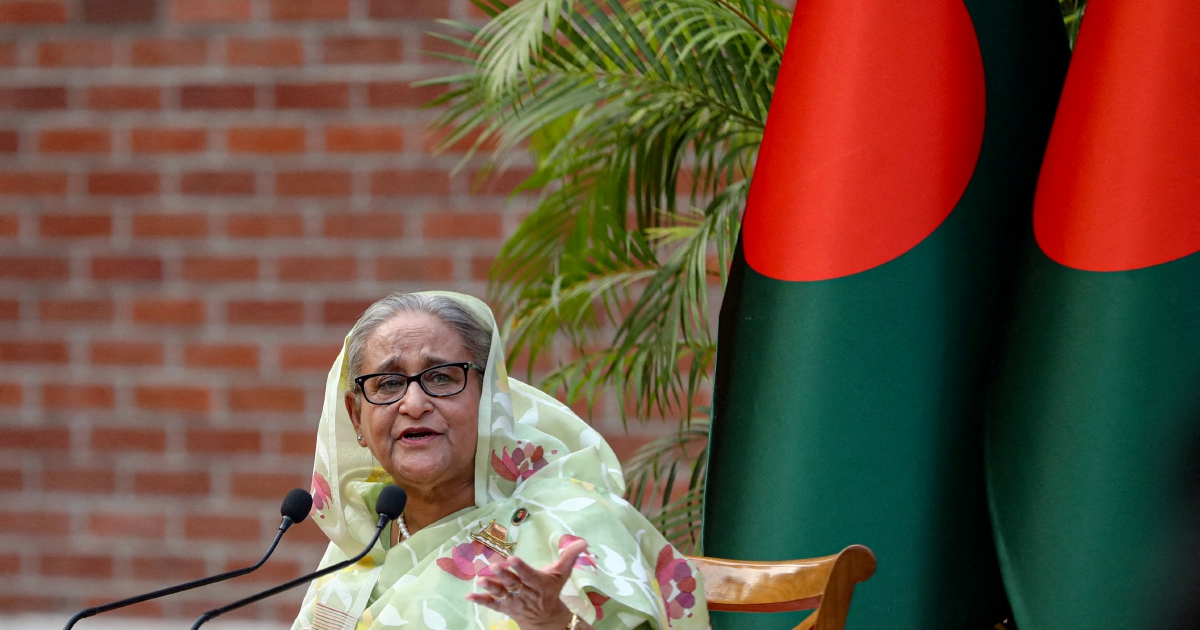
Bangladesh authorities have moved aggressively to seize roughly US$6.2 billion in assets associated with ousted prime minister Sheikh Hasina, in what represents one of the most substantial financial clawbacks since her government collapsed. The confiscation, announced through official channels on Wednesday, encompasses holdings belonging to the former leader herself, her immediate family circle, and a network of ten prominent business groups with deep ties to her administration.
The scale of the asset seizure underscores the sweeping financial entanglements that characterised Hasina's tenure and the institutional capture that opposition leaders argue had pervaded Bangladesh's economy during her years in power. The 760 billion taka figure represents a concrete attempt by Bangladesh's interim authorities to recover state resources and establish public accountability for what critics contend was widespread crony capitalism. These actions reflect the political momentum behind recent governance transitions and suggest sustained pressure on former power networks across multiple sectors of the economy.
The inclusion of ten business groups in the confiscation order signals that investigators have expanded their focus beyond immediate family members to encompass the commercial ecosystem that flourished during Hasina's administration. This approach mirrors accountability efforts in other post-transition contexts, where authorities have targeted not only individuals but also the corporations through which political patronage operated. The breadth of the seizure indicates systematic documentation of financial flows and ownership structures, a process that typically involves cooperation between Bangladesh's anti-corruption agencies, financial intelligence units, and other investigative bodies.
For Malaysian observers and policymakers, the Bangladesh case presents instructive parallels and contrasts with domestic experiences of political transition and financial accountability. Malaysia has likewise grappled with questions of recovering assets tied to previous administrations and managing the opacity that accumulates around long-serving leaders. The Bangladesh seizure demonstrates both the technical capacity of state institutions to identify and freeze assets—a capability that requires sophisticated financial tracking infrastructure—and the political will necessary to pursue such measures against entrenched elites.
The timing and pace of these confiscations also reflects broader regional patterns. Southeast Asia has witnessed recurring cycles in which newly installed governments prioritise the dismantling of predecessor networks and the symbolic recovery of perceived misappropriated resources. These efforts often serve dual purposes: they provide tangible evidence of anti-corruption commitment to domestic constituencies and international observers, while simultaneously establishing new norms around acceptable behaviour and political accountability.
However, the practical implementation of such asset seizures frequently encounters obstacles. Converting frozen assets into actual recoverable revenue requires navigating complex legal frameworks, international cooperation on assets held abroad, and sustained bureaucratic effort across multiple agencies. Bangladesh's authorities will face pressure to demonstrate that the confiscated holdings can be properly managed and eventually directed toward public purposes, rather than becoming caught in protracted legal disputes or administrative limbo.
The targeting of business groups alongside individual family members points to a recognition that modern patronage networks operate through corporate vehicles rather than purely personal channels. This suggests Bangladesh's investigators have been sufficiently resourced to trace ownership chains, identify beneficial owners behind shell entities, and establish material connections between ostensibly independent enterprises and the Hasina administration. Such investigative capacity, while increasingly common in anti-corruption work globally, remains unevenly distributed across Southeast Asia and requires substantial institutional investment.
Regional observers should also note that large-scale asset seizures of this kind inevitably generate questions about due process, asset management, and the risk of misuse of confiscation powers by successor administrations. Bangladesh's interim authority will face scrutiny regarding whether confiscated assets are being inventoried transparently, held securely, and eventually returned to legitimate owners or directed toward clearly identified public purposes. International monitors and civil society organisations across the region will likely track how these resources are managed as a barometer of the interim administration's governance credentials.
The confiscation also carries implications for Bangladesh's investor climate and international standing. While measures against corruption can enhance long-term institutional credibility, large-scale seizures of assets tied to particular political figures may generate concern among international investors about the predictability and stability of Bangladesh's regulatory environment. The perception that political transitions carry substantial economic consequences for associated elites—even when legally justified—can influence foreign investment decisions and the willingness of multinational enterprises to conduct complex commercial operations in the jurisdiction.
For Malaysian and Southeast Asian policymakers, the Bangladesh precedent illustrates the enduring challenge of balancing accountability objectives against institutional stability and economic continuity. The confiscation represents a moment of political clarity and institutional assertion, but its longer-term success will depend on how effectively Bangladesh's authorities can convert frozen assets into demonstrable public benefit while maintaining the rule-based legitimacy that such measures require to survive legal challenges and international scrutiny.
The effort also highlights the specialised technical and legal expertise required to pursue financial accountability at this scale. Bangladesh's experience may prompt other Southeast Asian jurisdictions to evaluate their own anti-corruption infrastructure and asset recovery capabilities, particularly as political transitions and questions of institutional accountability continue to shape the region's governance trajectory.

