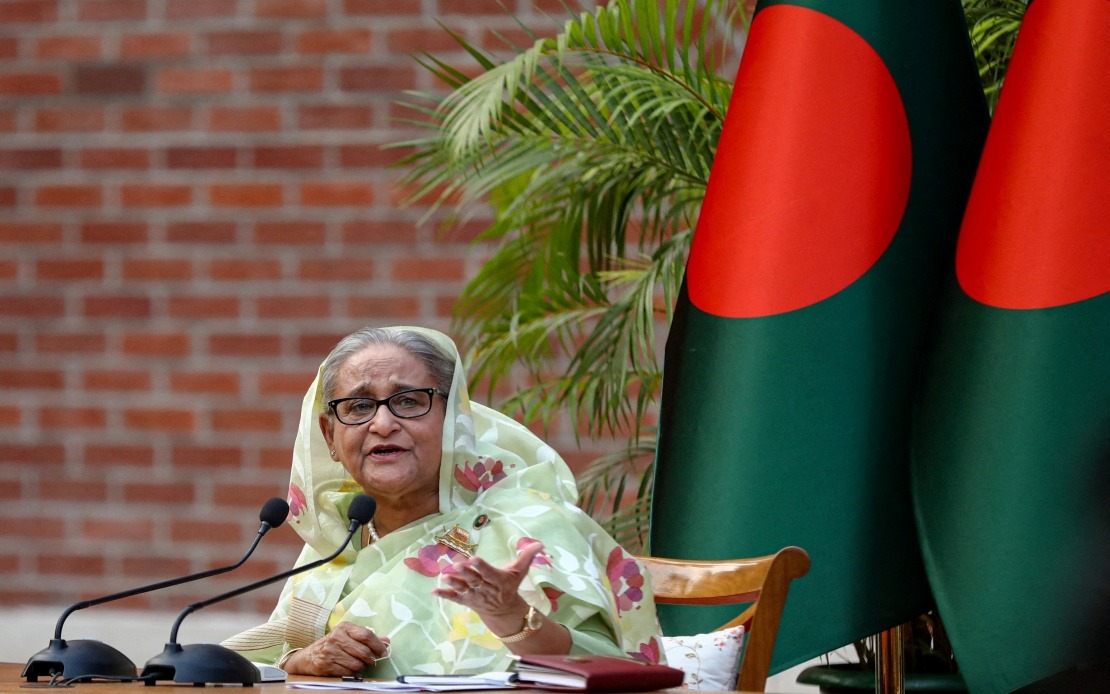
Sheikh Hasina, Bangladesh's former Prime Minister, has made a dramatic public declaration that she intends to return to her homeland and submit to the courts, even as she faces a capital punishment sentence handed down in her absence. Speaking through a written interview with Kyodo News, the 78-year-old exiled leader acknowledged the grave personal risks she would encounter—potential imprisonment or execution—yet insisted her commitment to the legal process outweighs these dangers. Her statement comes as tensions mount between India, where she currently resides, and Dhaka over an extradition request that could fundamentally reshape Bangladesh's political trajectory in the coming months.
Hasina's resignation and flight to India in August 2024 represented a dramatic reversal of fortune for a leader who had dominated Bangladeshi politics for nearly three decades. Her departure followed mass student-led demonstrations that began as a response to a court decision reinstating a 30 percent job quota for descendants of those who fought in Bangladesh's 1971 independence war. What started as a focused protest movement rapidly evolved into a broader anti-government uprising that exposed deep fractures in Bangladeshi society and public dissatisfaction with her administration's governance, corruption allegations, and democratic practices.
The scale of violence that accompanied the upheaval remains contested and deeply consequential. The United Nations has estimated that approximately 1,400 people lost their lives during the unrest, with the vast majority killed by security forces deployed to suppress the demonstrations. Hasina has consistently denied responsibility for ordering lethal action against protesters, instead contending that the movement was orchestrated and manipulated by political rivals seeking to exploit legitimate grievances for their own advancement. This fundamental disagreement over causation and intent lies at the heart of her legal jeopardy and the broader question of accountability in Bangladesh.
In November 2025, Bangladesh's war crimes tribunal convicted Hasina of crimes against humanity in absentia and imposed a death sentence. The trial's conduct has attracted international scrutiny, with Human Rights Watch expressing concerns about the proceedings' fairness given her absence, though the organization simultaneously emphasized that those genuinely responsible for state abuses deserve accountability through proper legal channels. This creates a complex dynamic where Hasina's death sentence lacks universal legitimacy while the underlying question of responsibility remains unresolved. She has challenged the conviction as politically motivated and suggested that forensic examination by independent international experts could establish the truth about how each death occurred and which weapons were used, potentially creating space for evidence-based rather than politically driven conclusions.
The Indian government's handling of the extradition request presents Southeast Asia with a delicate diplomatic situation. New Delhi received Bangladesh's formal request and has indicated it is reviewing the matter through the lens of applicable legal and judicial frameworks. India's response will carry significant weight not only for Hasina personally but for bilateral relations between the two nations and for broader regional stability. Bangladesh under its new leadership, following elections won by the opposition Bangladesh Nationalist Party in February 2026, has signaled its intention to bring Hasina back for trial. Zahed Ur Rahman, information adviser to current Prime Minister Tarique Rahman, stated in July that the government would facilitate her return and ensure she received a proper opportunity to mount a legal defense.
The political landscape that produced Hasina's downfall has been substantially remade. An interim administration led by Muhammad Yunus, the Nobel Peace Prize laureate, governed Bangladesh in the immediate aftermath of her departure before elections brought the Bangladesh Nationalist Party to power. Significantly, all activities of Hasina's Awami League party have been banned since May 2025, effectively removing her political organization from the country's democratic processes. This institutional transformation creates a fundamentally different context for any return she might attempt, one where her political base has been dismantled and the ruling coalition has little incentive to treat her benevolently.
Hasina's public statements reveal a leader attempting to rehabilitate her image and define the narrative around her tenure and departure. She has emphasized that Bangladesh requires genuine healing and that reconciliation cannot mean allowing those responsible for crimes to escape accountability. Yet she frames herself as accepting this principle rather than as its subject. In broader comments about Bangladesh's future, she has highlighted the nation's importance not only to its own citizens but to South Asia's stability, the Bay of Bengal's strategic balance, and development partners including Japan, which has invested substantially in Bangladeshi infrastructure including a railway project. These remarks appear designed to position her as a statesperson concerned with national interests rather than as a political figure fleeing prosecution.
The Holey Artisan Bakery attack in July 2016, which killed 20 people including nine Italians, seven Japanese nationals, and others, occurred during Hasina's tenure and demonstrated the security challenges her government faced from Islamist militant organizations. Seven militants received death sentences in 2019, later commuted to life imprisonment. The attack's international dimensions—killing Japanese citizens working on a Japan International Cooperation Agency project—underscored how Bangladeshi security failures could have regional ramifications. This historical precedent suggests how instability in Bangladesh creates ripple effects across South Asia and affects nations with significant economic investments in the country.
Malaysian observers of Bangladeshi politics should recognize the implications for regional stability and ASEAN-adjacent geopolitics. A Bangladesh wracked by political instability, factional violence, or questions about the legitimacy of legal proceedings against former leaders creates an environment conducive to radicalization, economic disruption, and humanitarian crises. The Rohingya refugee situation, which has created substantial burdens for Bangladesh, illustrates how political dysfunction in one country becomes a challenge for the broader region. Malaysia's own experiences with political transitions and judicial processes in contested contexts provide relevant reference points for understanding the delicate balance between accountability and political stability that Bangladesh must navigate.
The question of whether Hasina will actually return remains unresolved. Her public declaration may represent genuine intent, political positioning, or an attempt to maintain leverage in negotiations regarding her fate. If India denies the extradition request, Bangladesh's new government would face the challenge of pursuing justice against a former leader beyond its territorial reach. Conversely, if India agrees to extradition, the trial would occur in Bangladesh under a government explicitly opposed to her party and presumably skeptical of claims that the proceedings lack political motivation. Either scenario carries risks for Bangladesh's long-term democratic development and the rule of law, suggesting that the outcome of this extraordinary political drama will echo far beyond Dhaka.

