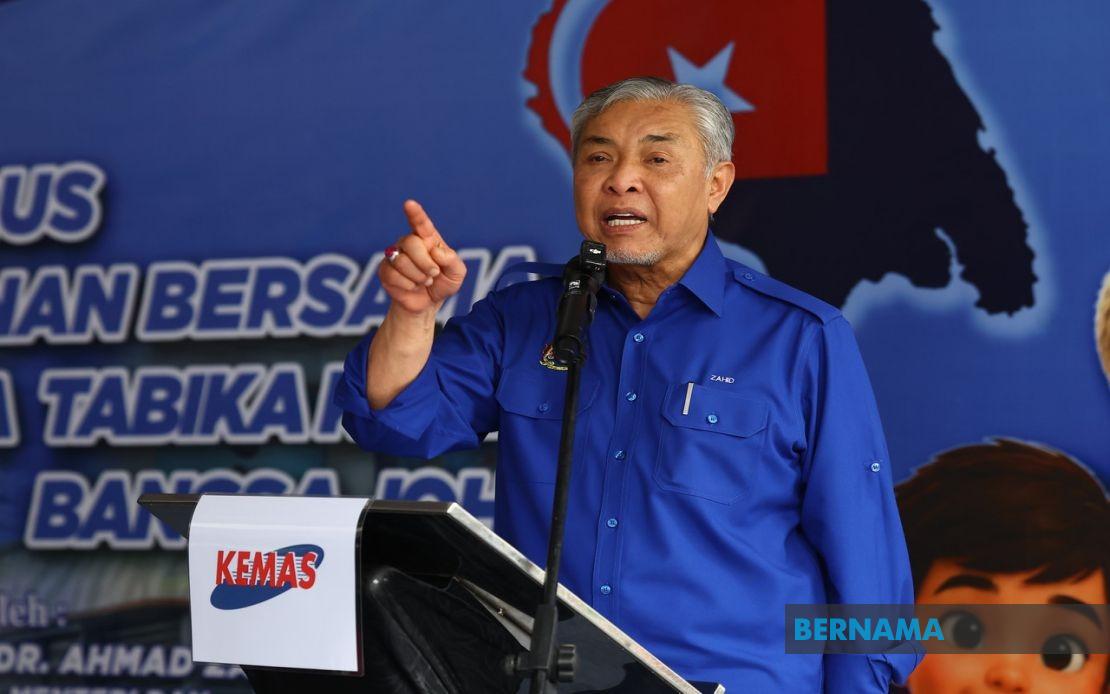
Bangsa Johor KEMAS Kindergarten has achieved a significant milestone by becoming the first community-based kindergarten across Malaysia to adopt English-medium instruction alongside comprehensive digital learning integration into its early childhood curriculum. The programme, unveiled in Johor Bahru, represents a deliberate pivot towards modernising the nation's foundational education systems and positioning young learners for greater global competitiveness.
Deputy Prime Minister Datuk Seri Dr Ahmad Zahid Hamidi, speaking in his capacity as Rural and Regional Development Minister, framed the initiative as a watershed moment for Malaysia's approach to kindergarten education. He emphasised that the innovation transcends mere operational updates, instead reflecting a fundamental reconceptualisation of how early childhood institutions should prepare students to navigate an increasingly digital and English-dominant global economy.
The uniqueness of Bangsa Johor KEMAS Kindergarten extends beyond its curriculum content to encompass its pedagogical philosophy and instructional design. Unlike conventional KEMAS kindergartens operating across the country, this facility has been deliberately structured with differentiated teaching methodologies, modern learning technologies, and an expanded focus on English language acquisition. Critically, Islamic education—specifically Quranic instruction—maintains its position as a non-negotiable educational pillar, ensuring that linguistic and technological advancement does not displace foundational religious and cultural values.
What distinguishes this model operationally is its departure from traditional classroom delivery methods. Rather than relying solely on conventional whiteboards and paper-based materials, the kindergarten integrates computer-based technology and digital platforms throughout its teaching and learning processes. This transition acknowledges the reality that today's children will inevitably operate within digital environments and must develop technological literacy from their earliest educational experiences.
The Johor State Government has committed RM3.6 million to establish and sustain this initiative, a substantial investment that signals political prioritisation of early childhood development. Johor Menteri Besar Datuk Onn Hafiz Ghazi highlighted that this programme operates as a cornerstone of the broader Sekolah Rintis Bangsa Johor ecosystem, a state-level initiative introduced by the Regent designed to ensure comprehensive, structured nurturing of children's intellectual and social development from foundational years onwards.
The physical infrastructure comprises five separate premises distributed across four locations within Johor—two facilities in Johor Bahru and two in Pasir Gudang—collectively housing seven classrooms. This geographic distribution enables accessibility across multiple population centres while maintaining quality standards and allowing for scalability if the model proves successful. The infrastructure investment encompasses not merely physical spaces but also technological systems, learning materials, and environmental design optimised for digital-enhanced pedagogy.
Teacher capacity-building represents a crucial component of the RM3.6 million allocation. Staff undergoing training must develop dual competencies: proficiency in English-medium instruction and pedagogical skills for integrating digital tools meaningfully into lesson design. This investment in human capital acknowledges that even the most technologically advanced facilities cannot succeed without educators capable of leveraging those technologies effectively and maintaining pedagogical integrity.
The collaboration between Johor State Government and the federal Rural and Regional Development Ministry, facilitated through the Community Development Department (KEMAS), demonstrates coordination between state and federal educational governance. Such institutional collaboration, often challenging within Malaysia's complex federalised education system, becomes essential when pioneering new models that require both policy flexibility and resource allocation across governmental layers.
For Malaysia's broader early childhood education landscape, this initiative carries implications extending beyond Johor's borders. Community kindergartens serve predominantly lower-income families who typically lack access to private international schools offering English-medium instruction from early ages. By demonstrating that publicly-funded, community-based institutions can deliver comparable linguistic and technological offerings, the Bangsa Johor model potentially creates a template for reducing educational inequality and democratising access to premium learning experiences.
The programme's emphasis on English proficiency aligns with regional economic realities. Southeast Asian economies increasingly demand workforces capable of international communication and cross-border collaboration. Beginning English acquisition at kindergarten age, rather than primary school, provides cumulative advantages in fluency and confidence. For Malaysian students competing regionally against peers from Singapore, Vietnam, Thailand, and the Philippines—where early English instruction is standard—this represents a necessary competitive adjustment.
The integration of Islamic education with English-medium instruction and digital learning reflects a modernisation strategy that rejects false dichotomies between traditional values and contemporary competencies. This approach acknowledges that Malaysian society increasingly expects educational institutions to cultivate students who are simultaneously rooted in Islamic and cultural traditions whilst equipped to participate in global, secular, technology-driven environments. Achieving this balance represents one of Malaysia's distinctive educational challenges.
Looking forward, the success of Bangsa Johor KEMAS Kindergarten will likely influence conversations about replicating this model nationally. If outcomes data demonstrates superior language acquisition, enhanced digital literacy, and maintained cultural-religious grounding compared to conventional KEMAS facilities, policymakers may consider broader adoption. Conversely, any implementation challenges will illuminate the genuine resource and training requirements for similar programmes, potentially informing more realistic national education planning and budget allocation.
The initiative ultimately reflects recognition that early childhood education quality matters profoundly for long-term national competitiveness and social mobility. By investing in modernised kindergarten programming in community settings, the Johor Government positions its youngest residents for academic success whilst demonstrating to other state governments that prioritising foundational education yields measurable returns in human development.

