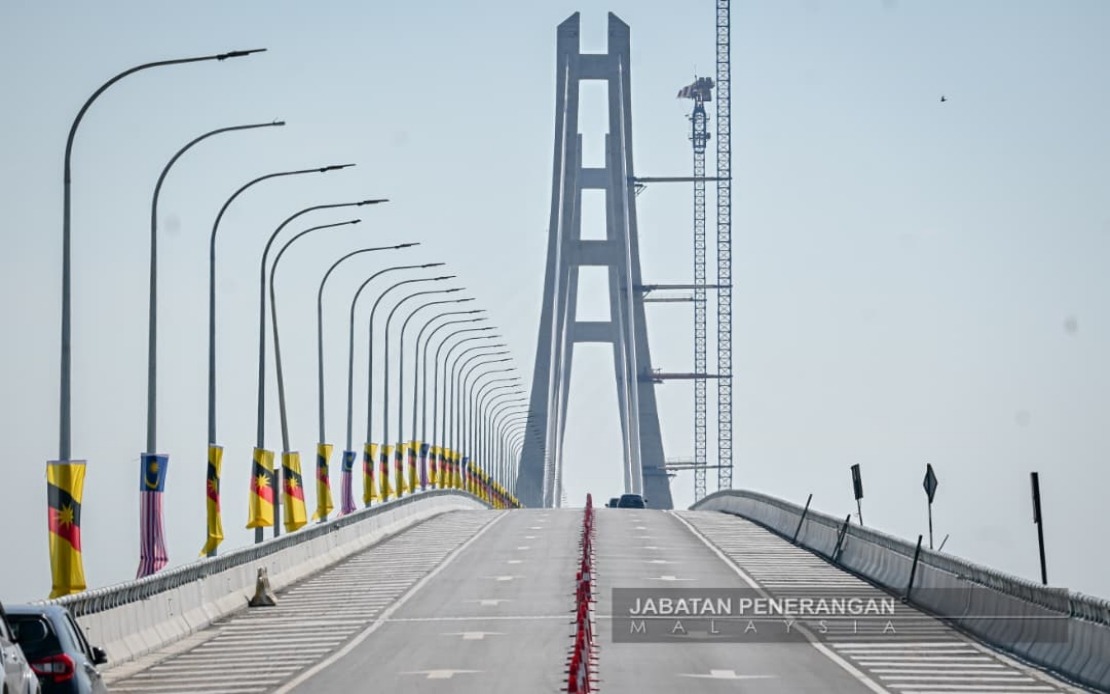
Sarawak has crossed a crucial development threshold with the opening of the Batang Lupar 1 Bridge, an engineering feat that Premier Tan Sri Abang Johari Tun Openg describes as transformative for the state's coastal economy. The bridge, which unseats the ferry service that has served the region for generations, represents more than mere infrastructure—it symbolizes the state's commitment to modernizing transport corridors and unlocking development potential across four strategic districts: Sebuyau, Betong, Sri Aman and Samarahan.
The 4.844-kilometre bridge, constructed at a cost of RM848.75 million, is engineered to carry both the aspirations and the commerce of Sarawak's coastal communities. By spanning Malaysia's longest river, the structure eliminates a bottleneck that has constrained movement, commerce and agricultural distribution for decades. The project responds directly to demands from residents and elected representatives frustrated by the ferry's unreliability—particularly the treacherous conditions at the Batang Lupar River mouth, where strong waves and winds have periodically caused accidents and disrupted travel plans. The bridge's completion signals an end to that chapter of isolation and dependency.
The facility now holds official recognition from the Malaysia Book of Records as the nation's longest river bridge, a designation that underscores its engineering significance within the Malaysian context. This recognition came during the opening ceremony, where MBOR representative Megat Faris Hussein Megat Muzaffar Shah presented the certificate. For Sarawak, the accolade reinforces the state's positioning as a centre of infrastructure innovation and modern development, drawing attention from investors and observers interested in tangible progress in regional connectivity.
Within the broader ecosystem of Sarawak's development strategy, the Batang Lupar 1 Bridge functions as a critical node in the Sarawak Second Trunk Road (STRR) project. This RM3.21 billion initiative aims to establish a comprehensive coastal road network that reshapes how people and goods move throughout the state. The bridge is not merely a crossing—it is an arterial connection within a larger vascular system designed to pump economic activity through previously disconnected regions. The full STRR network is scheduled for completion by 2030, suggesting that the region stands at the beginning of a five-year transformation period.
The practical implications of this connectivity are substantial and measurable. Travel between Kuching and Sibu will be shortened from 396 kilometres to 252 kilometres—a reduction of 144 kilometres that translates into fewer hours on the road, lower fuel consumption, and faster transport of perishable goods. For agricultural producers in the region, this efficiency gain could prove economically decisive. Crops can reach urban markets in better condition and with reduced logistics costs, potentially improving farm-gate prices and encouraging greater production. The time savings alone justify decades of ferry inconvenience.
Deputy Premier Datuk Amar Douglas Uggah Embas, who holds the portfolio for Infrastructure and Port Development, emphasized that the ferry service has become historical artifact rather than functioning necessity. Where crossing once consumed up to an hour under favourable conditions, and where adverse weather could paralyze movement entirely, journeys are now predictable and weather-independent. This reliability carries enormous value for businesses attempting to establish supply chains, for medical emergencies requiring urgent transport, and for students commuting to educational institutions. The social fabric of these districts can now knit together more tightly, enabling interaction and commerce that geography previously restricted.
The bridge's opening occurs within a broader regional context where Southeast Asian nations are increasingly competing for infrastructure investment and economic growth. Malaysia's ability to deliver large-scale, strategically important projects demonstrates institutional capacity and commitment to equitable development. For the Sarawak government, the bridge becomes tangible evidence of governance effectiveness—a monument to planning, execution and delivery that resonates with both local constituents and potential investors evaluating the state's investment climate. The project's completion on schedule and budget (or near to it) enhances confidence in the administration's capacity to manage subsequent STRR phases.
The agricultural sector stands particularly positioned to benefit from the improved connectivity. Sarawak's coastal districts have significant agricultural potential, particularly in palm oil, rice cultivation, and aquaculture. Currently, transportation logistics and ferry delays impose costs that squeeze farmer margins and discourage investment in expanded production. The bridge removes these artificial constraints, allowing agricultural enterprises to compete more effectively in regional and national markets. For Malaysian agricultural policy, this infrastructure investment represents a practical mechanism for boosting rural incomes and reducing urban-rural economic disparities—objectives that align with national development priorities.
Investment flows may accelerate as the improved connectivity increases land accessibility and commercial viability. Entrepreneurs considering ventures in these districts previously faced genuine transportation constraints that inflated operational costs and limited market access. With the bridge operational and the STRR expanding, the investment calculus shifts favourably. Industrial parks, processing facilities, and commercial enterprises become more feasible propositions. The state government has implicitly positioned these districts as emerging economic zones within Sarawak's growth strategy, and infrastructure improvements are the prerequisite foundation upon which such development depends.
The elimination of ferry dependence carries psychological as well as practical significance. For residents of these districts, the bridge represents public investment in their region's future—a signal that government prioritizes their development and recognizes their potential. Ferry services, by contrast, carry associations with historical marginalization and infrastructural neglect. The bridge becomes a symbol of modernization and integration into Sarawak's mainstream economy. This psychological dimension, while difficult to quantify, influences local political sentiment, business confidence, and community receptiveness to subsequent development initiatives.
Looking forward, the Batang Lupar 1 Bridge represents an intermediate milestone rather than a terminal achievement. The broader STRR project encompasses multiple phases and investments, all aimed at creating a modern coastal transport corridor. The bridge's successful opening and initial operation will generate data and experience that inform subsequent phases of the project. Construction techniques, maintenance protocols, and traffic management lessons learned here will inform future sections of the road network. As the STRR expands toward full completion in 2030, this bridge will be recognized as foundational—the project that pioneered the state's commitment to coastal corridor modernization.
For Malaysian observers and the broader Southeast Asian region, the Batang Lupar 1 Bridge exemplifies infrastructure development strategy focused on regional equity and connectivity. Rather than concentrating investment solely in already-developed urban cores, the project directs substantial resources toward connecting peripheral districts and unlocking their latent economic potential. This approach aligns with development philosophy emphasizing balanced growth and spatial equity. As other Southeast Asian nations contemplate similar connectivity challenges in their own peripheral regions, Sarawak's experience with this bridge project offers instructive lessons in project management, financing, and regional development outcomes.

