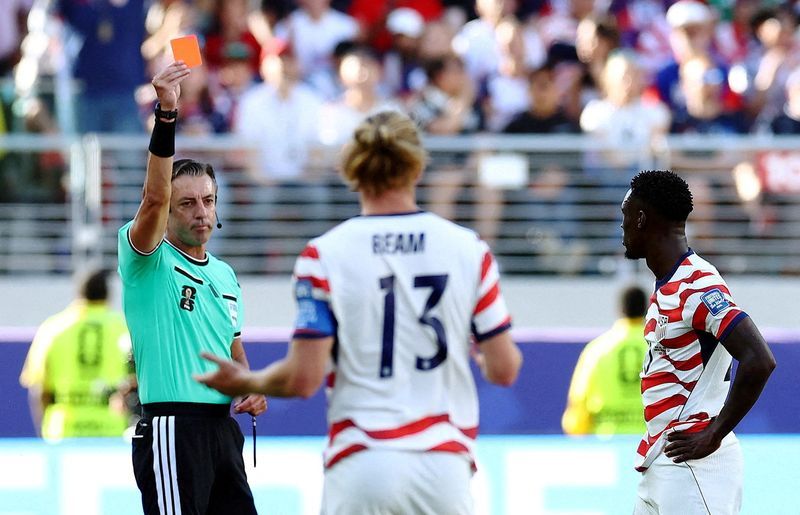
The suspension of a red-card ban for a key American player immediately before Belgium's World Cup knockout encounter with the United States has ignited fierce criticism across Brussels, as politicians and ordinary Belgians alike questioned how political pressure could override FIFA's disciplinary framework. The dramatic reversal—triggered by a personal phone call from U.S. President Donald Trump to FIFA President Gianni Infantino—has exposed deep vulnerabilities in the sport's governance structures and raised uncomfortable questions about the independence of international football's governing body at its most visible moment.
The footballer's original disqualification stemmed from a serious infraction serious enough to warrant ejection from play. Standard protocol dictates that such sanctions stand unless compelling new evidence or procedural errors emerge upon formal appeal. The circumstances surrounding this particular reversal, however, departed sharply from established precedent. Rather than following orthodox channels for disciplinary review, the intervention traced directly to the White House, creating an unprecedented situation where high-level political engagement appeared to reshape competitive outcomes in advance of a major sporting event. For Belgian observers and officials, this represented an alarming precedent that threatened to subordinate athletic fairness to political expediency.
Therese Kpooubie, a Brussels resident interviewed about the controversy, articulated the bewilderment felt across Belgium regarding the decision's legitimacy. She questioned the fundamental purpose of disciplinary mechanisms within football, noting that red cards exist precisely because players commit infractions serious enough to warrant removal from competition. Once a referee issues such a card, Kpooubie reasoned, the punishment reflects a judgment about conduct already made through proper channels. The suggestion that political intervention could retroactively erase what she termed a legitimate sporting decision struck her as incomprehensible and, more troublingly, as evidence of corruption seeping into the professional sport's core processes.
Belgium's Deputy Prime Minister Maxime Prevot moved beyond casual commentary to articulate official government concern about the situation. Prevot suggested that if the reversal indeed resulted from Trump's direct appeal, the decision would constitute a fundamental violation of sporting principles and basic rules of competitive fairness. His statement signalled that Belgian leadership viewed the matter not merely as an isolated dispute between national federations but as a systemic challenge to the integrity mechanisms that supposedly govern international football. Coming from a sitting government official, his intervention underscored how severely Brussels interpreted FIFA's apparent capitulation to political pressure.
Other ordinary Belgians struck a different tone while addressing the same fundamental concern about fairness. Bastien Noel, another interviewed member of the public, acknowledged the decision's apparent finality but encouraged his countrymen to channel their frustration into competitive performance. Rather than treating the unfavourable ruling as an excuse for defeat, he argued that Belgium's football representatives should demonstrate their superiority through play itself, proving that external interference cannot diminish their determination or capacity to advance in tournament competition. This perspective—accepting an unjust situation while vowing to overcome it through excellence—reflected a pragmatic nationalism channelling indignation into sporting motivation.
The U.S. Ambassador to Belgium, Bill White, felt compelled to issue a public denial regarding American interference in FIFA's decision-making processes. White's statement on social media rejected suggestions that Trump had lobbied FIFA directly to reverse the suspension, instead characterizing the president's interaction with FIFA leadership as a post-hoc expression of gratitude. This defensive posture indicated awareness that the optics surrounding the intervention had damaged American standing in Belgium and potentially across European public opinion more broadly. Whether accurate or not, White's denial could not alter perceptions among Belgian citizens and officials that political pressure had influenced a sporting outcome.
The broader implications of this incident extend far beyond a single World Cup match between Belgium and the United States. If FIFA's disciplinary decisions can be reversed through direct presidential appeals, then the organization's pretence to independent governance collapses entirely. Teams competing against the United States would have legitimate grounds to question whether future controversial rulings might similarly favour American interests. For smaller footballing nations and those without direct political access to FIFA leadership, the prospect of unequal treatment in disciplinary matters could undermine confidence in international tournament fairness. Belgium's response—combining official criticism with calls for sporting redemption—represents the measured frustration of a nation confronting an institution's apparent unwillingness to resist political pressure.
The timing of this incident carries particular significance for football governance more broadly. World Cup tournaments represent global sporting events where neutrality and procedural integrity supposedly transcend national interests. When a sitting head of state can successfully petition for reversal of disciplinary decisions, the tournament's legitimacy as a fair competition becomes questionable. Future matches and rulings will now occur under a cloud of suspicion about whether FIFA's decisions reflect genuine judgment or political favour. This corrosive effect on institutional credibility will persist regardless of Belgium's performance against the United States, as other nations and observers question whether the playing field remains genuinely level.
For Malaysian and Southeast Asian observers following this controversy, the incident offers cautionary lessons about the dangers facing international sporting organizations when they fail to maintain independence from political interference. Regional nations often find themselves disadvantaged when wealthy, powerful states can directly influence governing bodies through executive pressure. The Belgian situation illustrates how such interference operates in practice—not through formal corruption or bribery, but through the subtle yet decisive leverage that only major powers possess. As Southeast Asian nations continue developing their football and other sports programmes, understanding how global sporting governance can be compromised offers valuable perspective on the institutional frameworks required to protect competitive integrity.

