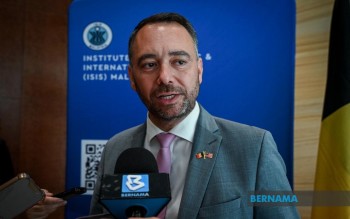
Belgium is positioning itself as a strategic partner for Malaysia's renewable energy ambitions, with Deputy Prime Minister Maxime Prévot signalling strong interest in transferring offshore wind expertise during a visit to Kuala Lumpur this week. Despite the challenges of limited coastal geography, Belgium has emerged as an unexpected leader in offshore energy generation, a distinction the country now wishes to leverage through deeper collaboration with Southeast Asian nations pursuing accelerated decarbonisation pathways.
The initiative represents a significant shift in how developed European economies are engaging with ASEAN on climate and energy matters. Rather than imposing conditions or framing green transitions as purely environmental imperatives, Belgium is framing offshore wind as a practical, economically viable solution that can address both power security and climate objectives simultaneously. For Malaysia, which has committed to achieving net-zero emissions by 2050, such technical partnerships could prove instrumental in navigating the complex engineering and regulatory requirements of establishing large-scale offshore wind infrastructure.
Belgium's credentials in this field are substantial despite its geographical constraints. The country operates offshore wind farms currently generating two gigawatts of electricity from just 60 kilometres of coastline, a remarkable feat of energy density that underscores sophisticated engineering and project management capabilities. More ambitiously, Belgium plans to expand this capacity to between six and seven gigawatts over the coming decade, equivalent to the electrical output of five to seven nuclear power stations. This expansion demonstrates Belgium's serious commitment to eliminating fossil fuel dependence and suggests the country has developed robust supply chains, skilled workforces, and regulatory frameworks that could be adapted to the Southeast Asian context.
The broader European Union backing for ASEAN's energy transition adds considerable weight to Belgium's bilateral overture. During his address at the 39th Asia-Pacific Roundtable in Kuala Lumpur, Prévot announced that the EU and member states intend to mobilise €10 billion under the Global Gateway Strategy specifically to support the ASEAN Power Grid and regional energy transition initiatives. This figure represents a substantial commitment that extends far beyond Belgium's individual capacity, signalling that offshore energy cooperation would be embedded within a comprehensive European strategy for Southeast Asian development. The €10 billion investment framework addresses a critical gap in financing for regional infrastructure modernisation, a persistent challenge that has limited ASEAN's progress toward renewable energy targets.
Offshore energy represents only one dimension of the proposed Belgium-Malaysia partnership. Prévot identified semiconductors, logistics, clinical trials, biotechnology research and development, and pharmaceuticals as additional sectors with significant bilateral potential. This multi-sectoral approach reflects a realistic understanding that economic partnerships require diversification to create resilience and mutual benefit across multiple industries. For Malaysia, which has positioned itself as a Southeast Asian manufacturing and technology hub, such a comprehensive engagement strategy offers opportunities to deepen technology transfer and establish Malaysia as a preferred investment destination for European firms seeking to establish regional operations.
The context of Malaysia-Belgium bilateral relations reveals growing economic interdependence that underpins these diplomatic initiatives. Trade between the two nations reached RM9.74 billion in 2025, with Malaysia exporting RM6.85 billion in goods and importing RM2.89 billion, reflecting Malaysia's significant role as a supplier of raw materials and manufactured goods to European markets. Beyond trade, Belgian investors have demonstrated considerable confidence in Malaysia's economic fundamentals, with 67 projects involving Belgian participation approved as of 2025, collectively representing RM5.1 billion in investment capital and the potential creation of 4,605 employment opportunities. These figures suggest that Belgium views Malaysia not as a peripheral market but as a core investment destination within Southeast Asia, warranting high-level diplomatic engagement.
PreVot's visit, which marks his first journey to Malaysia since assuming office in February 2025, should be understood as a deliberate signalling of European priorities under his leadership. The choice to prioritise ASEAN engagement and renewable energy partnerships early in his tenure reflects broader European anxieties about geopolitical positioning in the Indo-Pacific region, where competition with China and the United States for influence and economic advantage has intensified considerably. By positioning Belgium and the EU as partners in ASEAN's energy transition rather than external actors imposing conditions, European diplomacy seeks to establish durable relationships based on mutual development objectives.
The ASEAN Power Grid initiative, which forms the centrepiece of European investment intentions, carries particular significance for regional energy security and economic integration. By facilitating greater interconnectivity between national electricity systems, the power grid would enable more efficient distribution of renewable energy across Southeast Asia, reducing individual nations' dependency on fossil fuel imports and enhancing energy sovereignty. Malaysia, as a major regional economy and existing energy exporter, would occupy a strategically important position within such an interconnected system, potentially benefiting from opportunities to export surplus renewable capacity to neighbouring countries while simultaneously improving domestic energy security through access to regional generation sources.
For Malaysia specifically, the convergence of Belgian technical expertise, EU financing, and regional energy transition objectives creates a multi-layered opportunity set. The government has set ambitious renewable energy targets as part of its commitment to climate action, yet faces substantial technical and financial barriers to scaling offshore wind generation. Belgian expertise could accelerate the learning curve and reduce implementation risks, while EU financing through the Global Gateway Strategy would alleviate budgetary constraints that have historically limited Malaysia's renewable energy investment. The diplomatic framing of such cooperation as partnership between equals, rather than technology transfer from developed to developing nations, also creates conditions for more sustainable engagement that maintains Malaysian agency in determining energy transition pathways.
The broader implications for Southeast Asia extend beyond bilateral Malaysia-Belgium relations to questions about how the region will finance and implement its energy transition amid intensifying global competition for influence. European offers of partnership and investment stand in contrast to alternative models of engagement from other major powers, each carrying distinct expectations and conditionalities. Malaysia's careful navigation of these competing offers reflects the strategic importance of the energy transition not merely as an environmental imperative but as a fundamental reorganisation of regional political economy with consequences for sovereignty, development trajectories, and alignment within the emerging multipolar international system.

