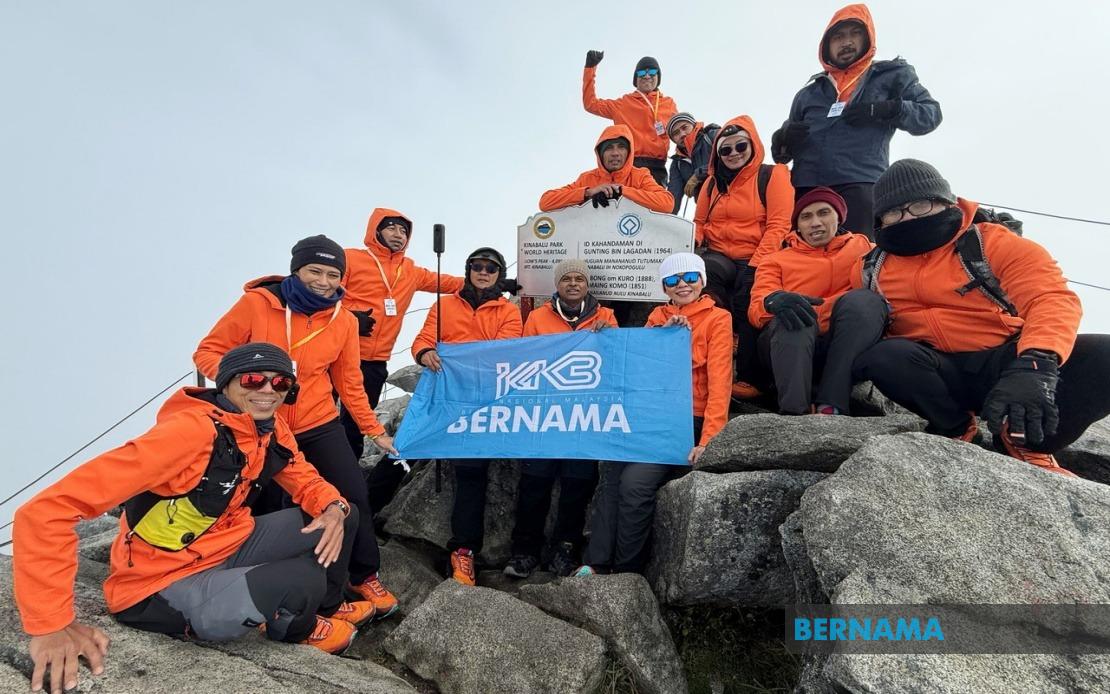
Twenty-three journalists and staff from Bernama, Malaysia's national news agency, reached the summit of Mount Kinabalu on July 1 in a commemorative expedition marking the HAWANA 2026 celebration of National Journalists' Day. The successful ascent represents a significant milestone for the organisation, combining professional achievement with institutional symbolism as Bernama seeks to inscribe two notable records into the Malaysia Book of Records.
Bernama Editor-in-Chief Arul Rajoo Durar Raj spearheaded the expedition, which aimed to establish the organisation as the largest group of media practitioners from a single entity to successfully climb Southeast Asia's highest peak. The team's composition reflected the breadth of Bernama's operations, drawing from newsrooms, photography departments, television production units, editorial sections, and administrative divisions. This cross-functional participation underscored the expedition's purpose as a team-building exercise extending beyond the newsroom floor to encompass the entire institutional ecosystem.
The second record pursuit centered on an innovative approach to journalism itself. Bernama's team planned to produce and transmit news reports simultaneously in four languages from the 4,095.2-metre summit, a feat no media organisation has previously accomplished from that elevation. This objective reflects the agency's multilingual mandate in serving Malaysia's diverse population and its position as a regional news provider. The technical and logistical challenges of maintaining broadcast capacity at such altitude, combined with the physical demands of the climb, amplified the achievement's significance.
The ascent proved arduous despite meticulous planning. The expedition commenced at Timpohon Gate at 10 am on June 30, with climbers traversing to Panalaban accommodation at mid-elevation before resuming their push towards the summit at 2.30 am on July 1. The team confronted formidable conditions including heavy rain, dense fog that severely limited visibility, and powerful wind gusts that tested both physical endurance and mental determination. The team ultimately crested the summit at approximately 7.20 am, completing what Sabah Parks records indicate as one of the larger single-organisation expeditions in recent years.
For Arul Rajoo personally, the achievement carried additional weight. He became the first Editor-in-Chief in Bernama's institutional history to successfully summit Mount Kinabalu, a symbolic gesture reinforcing the organisation's commitment to pushing boundaries and embodying the resilience and determination expected of its personnel. This personal milestone extended the expedition's significance beyond its record-seeking dimensions into the realm of institutional leadership and corporate culture.
The Bernama Staff Club, organising the expedition for its maiden endeavour, conceptualised the climb as a multifaceted initiative advancing several institutional objectives simultaneously. Beyond the tangible goal of setting Malaysia Book of Records entries, the exercise aimed to strengthen interpersonal bonds across departmental lines, enhance physical conditioning among staff who often maintain sedentary newsroom routines, and reinforce mental resilience in a profession frequently confronting demanding deadlines and complex subject matter. The climb's alignment with HAWANA 2026 celebrations positioned the endeavour within the broader recognition of journalism's role in Malaysian society.
Mount Kinabalu's significance extends beyond its status as Malaysia's and Southeast Asia's highest mountain. The peak sits within Kinabalu Park, a 754-square-kilometre protected area designated a UNESCO World Heritage Site and anchoring the Kinabalu UNESCO Global Geopark. This environmental and geological importance adds contextual weight to the expedition, as Bernama's presence at the summit underscores the intersection between media institutions and natural heritage preservation.
The expedition's execution benefited from substantial corporate backing, reflecting the perceived value of such endeavours within Malaysia's business community. International sportswear manufacturer BMAI provided technical apparel support, while Batik Air and 100PLUS offered logistical and nutritional assistance. Domestic entities including EHH Food Industry, Saloma Bistro, Malaysia Airports, Malaysia Insight, UFL, Sabah Parks, and Marathon Baker contributed resources ranging from provisions to ground support. This constellation of partners suggests growing recognition within the corporate sector of institutional climbs as platforms for brand alignment and community engagement.
The expedition arrives at a moment when Malaysian media institutions face intensifying scrutiny regarding their operational relevance and capacity to innovate. Bernama's initiative demonstrates one institution's approach to maintaining morale, fostering institutional cohesion, and generating distinctive content in competitive digital environments. The multilingual reporting dimension particularly positions the agency to serve regional audiences across linguistic divides, a capability becoming increasingly valuable as Southeast Asian integration deepens.
For the broader Malaysian journalistic community, the Bernama expedition establishes a precedent that may inspire similar institutional exercises combining professional development with outdoor challenge. The successful execution of multilingual reporting from extreme altitude opens technological and editorial possibilities for environmental journalism and disaster reporting from inaccessible locations. Additionally, the initiative demonstrates how institutional celebrations can transcend traditional ceremonial formats, embedding professional objectives within experiential activities that generate both content and institutional memory.
The achievement also carries implications for Sabah's tourism and environmental sectors. Bernama's expedition generates international media attention to Mount Kinabalu's accessibility and facilities, potentially influencing travel patterns and environmental stewardship awareness. The involvement of Sabah Parks in the expedition reflects collaborative relationships between media institutions and conservation authorities, suggesting emerging partnerships in promoting sustainable mountain tourism across the region.
As Bernama awaits Malaysia Book of Records verification of its two record claims, the expedition's legacy extends beyond formal recognition. The climb produced original multilingual content from an altitude few journalists have reported from, created institutional bonds across departmental divisions, and established physical and professional benchmarks for staff resilience. Whether or not the records materialise, the expedition demonstrates how media organisations can evolve beyond content-creation functions to embody the values they report on: perseverance, diversity, excellence, and commitment to reaching audiences across linguistic and geographical boundaries.

