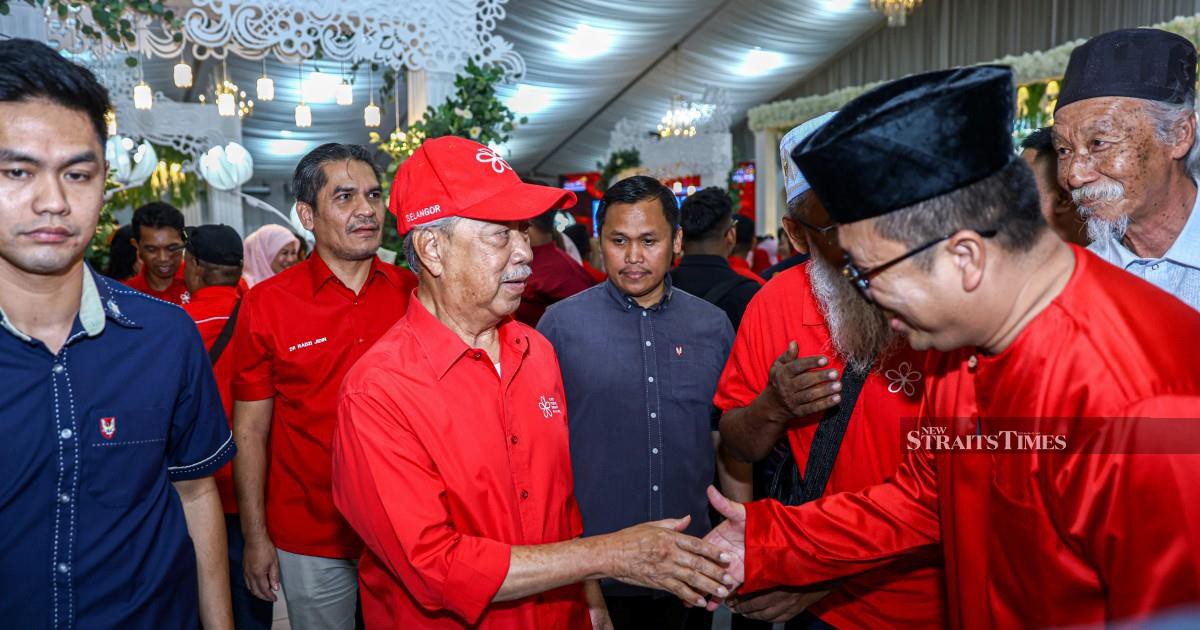
Bersatu president Tan Sri Muhyiddin Yassin has declared the party's readiness to forge a new political alliance with select partners following the Negri Sembilan election, marking a significant shift in Malaysia's fractious coalition politics. The announcement signals deepening tensions within Perikatan Nasional and underscores the instability characterising the nation's political landscape since the 2022 general election. Muhyiddin's statement reflects growing frustration among Bersatu leadership over the direction and governance of the current alliance arrangement.
The decision to explore alternative coalition structures represents a major realignment in Malaysian politics at a critical juncture. Over the past two years, PN has served as a bulwark against Anwar Ibrahim's administration, but internal contradictions between its components—particularly Bersatu and the Islamist PAS—have increasingly surfaced. For regional observers watching Malaysia's political stability, this development underscores how quickly alliances can fracture when ideological and strategic interests diverge among member parties.
Muhyiddin's characterisation of PN as "toxic" under PAS leadership points to fundamental disagreements about the coalition's strategic direction and public positioning. PAS, which has emerged as the strongest single party within PN following the 2022 election, has pursued an uncompromising Islamist agenda that may not align with Bersatu's broader appeal and centrist positioning. This philosophical divergence has created operational friction, with decisions on parliamentary support, policy priorities, and candidate selection becoming flash points for internal conflict.
For Bersatu, the calculation appears pragmatic rather than ideologically motivated. As a mid-sized party without the grassroots infrastructure of either PAS or UMNO, Bersatu relies on strategic positioning to maintain relevance and bargaining power. Remaining tethered to PN under PAS dominance risks marginalising the party's voice in major decisions, particularly if the coalition fragments or PN's electoral prospects dim heading into the next general election cycle.
The Negri Sembilan election serves as a natural inflection point for Bersatu's strategic recalibration. State elections frequently function as testing grounds for coalition arrangements and provide opportunities for parties to reassess partnerships without the full implications of a general election. A poor showing in Negri Sembilan by PN could accelerate Bersatu's departure timeline and validate the party's concerns about the viability of the current arrangement.
Muhyiddin's statement also reflects calculations about potential coalition partners. In Malaysian politics, the pool of feasible partners is limited but not negligible. Bersatu may be exploring realignment with moderate UMNO figures, independent-minded MPs, or smaller component parties seeking an alternative to both the government and a PAS-dominated opposition. Any such arrangement would require delicate negotiations to avoid appearing opportunistic while demonstrating credible policy differences from existing coalitions.
The implications for the government led by Prime Minister Anwar Ibrahim remain uncertain but potentially consequential. If Bersatu departs PN with other partners in tow, the parliamentary arithmetic could shift significantly. The government's current slim majority depends on stability among opposition parties; any fracturing of PN could paradoxically improve government prospects by reducing cohesion among critics. Conversely, if Bersatu forms a coalition large enough to challenge both the government and a remnant PN, Malaysia could enter a three-bloc system that further complicates governance.
Regionally, Malaysia's coalition realignments continue to attract attention as neighbouring democracies grapple with their own multi-party challenges. Thailand, Indonesia, and the Philippines all feature complex coalition politics where parties regularly shift allegiances. Malaysia's experience demonstrates how difficult it is to maintain principled coalition arrangements when electoral incentives encourage defection and repositioning.
For ordinary Malaysians, the constant reshuffling of political alliances raises questions about continuity in policy and representation. Voters who supported Bersatu expecting PN governance face uncertainty about the party's future direction. Business communities, particularly those dependent on government contracts or policy certainty, must now recalibrate their understanding of political dynamics and future coalition possibilities.
The Negri Sembilan election outcome will likely clarify Bersatu's timeline for departure. A strong performance could embolden the party to accelerate coalition-building efforts, while a disappointing result might temporarily delay the transition as party leaders reassess overall viability. Either way, Muhyiddin's public statement has essentially closed the door on PN's internal reformation, signalling that he views the partnership as fundamentally incompatible with Bersatu's long-term interests.
Looking ahead, Bersatu's coalition-building exercise will test whether credible alternatives to both the government and a PAS-led opposition can gain traction in Malaysian politics. The success of any new arrangement will depend on whether Bersatu can identify partners with complementary voter bases and shared policy objectives. The coming months will reveal whether Muhyiddin's ambitions for a fresh political partnership represent genuine political renewal or merely another chapter in Malaysia's perpetual cycle of coalition instability.

