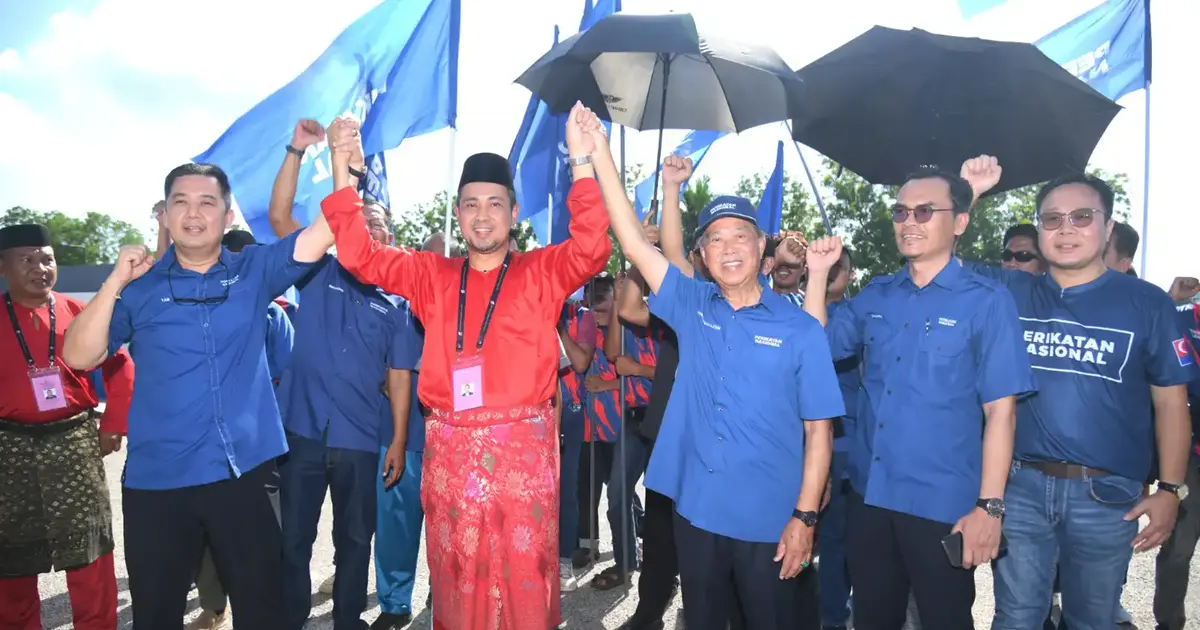
Bersatu's leadership has moved swiftly to ease tensions following PAS's rejection of a request to deploy party machinery for the coalition partner's activities, with President Muhyiddin Yassin adopting a measured stance that underscores the limits of what can be demanded within alliance politics. The decision by PAS to withhold its organizational resources represents a notable moment in the relationship between the two pillars of the Perikatan Nasional (PN) bloc, yet Muhyiddin's response signals a pragmatic acceptance that voluntary cooperation forms the only sustainable foundation for inter-party arrangements.
Muhyiddin's characterization of the situation reflects a broader principle he has repeatedly articulated regarding coalition dynamics. Within the PN framework, both cooperation and reciprocal backing are understood as essential operational values that strengthen the alliance's overall cohesion and electoral prospects. However, the Bersatu president has been explicit in clarifying that these ideals cannot function under compulsion. The distinction matters considerably in Malaysian coalition politics, where multiple parties with distinct constituencies and organizational interests must navigate complex terrain without a formal hierarchical structure that would allow unilateral demands.
The machinery question touches upon a sensitive area within alliance management. Party machinery encompasses the organizational infrastructure—local leadership networks, volunteer coordinators, grassroots activists—that proves invaluable during election campaigns and in consolidating political presence across constituencies. When one partner seeks to utilize another partner's machinery, it involves more than logistical cooperation; it touches questions of resource allocation, strategic deployment, and ultimately the distribution of political credit. PAS, as an established political force with substantial organizational depth, has made clear that its machinery serves PAS interests primarily.
This friction between Bersatu and PAS reveals underlying fault lines within the PN coalition that have periodically surfaced since the bloc's formation. Both parties compete for Malay and Muslim voter support, though with different emphases and regional concentrations. Bersatu has positioned itself as a nationalist party appealing to broad Malay-Muslim constituencies, while PAS maintains its identity as an Islamic-oriented party with particular strength in specific states. The machinery dispute implicitly concerns questions about which party's organizational model should take precedence in joint operations, an issue that defies simple resolution.
Muhyiddin's public handling of the rebuff demonstrates political maturity and awareness of audience sensitivities. By accepting the outcome without public acrimony, he avoids transforming a tactical disagreement into a broader coalition crisis that could provide ammunition to opposition parties. His rhetoric emphasizing voluntary participation also serves to protect Bersatu's autonomy and dignity—suggesting that his party made a request rather than received a command, and that rejection of such requests falls within normal political boundaries. This framing prevents the narrative from portraying Bersatu as subordinate or dependent.
The incident also illuminates the structural reality that the Perikatan Nasional, despite holding significant electoral weight and currently anchoring Malaysia's federal government arrangement, operates without the institutional consolidation that typifies ruling coalitions in other democracies. Barisan Nasional in its heyday developed mechanisms and protocols for managing such inter-party disputes, including formalized consultation bodies and power-sharing arrangements. The PN, being newer and comprising parties that joined from different circumstances, has not yet institutionalized comparable mechanisms, leaving relationship management largely to personal negotiations between party presidents.
For Malaysian political observers, particularly those tracking the stability of the current government, this development carries subtle implications. Strong coalitions require both formal agreements and informal goodwill. When machinery disputes emerge and require direct public statements from top leaders, it suggests the informal layer may be thinning. Conversely, Muhyiddin's measured response and apparent acceptance indicate neither party is prepared to escalate the disagreement into existential coalition warfare. The situation reflects normal coalition friction rather than imminent breakage.
Regionally, the Bersatu-PAS dynamic commands attention because both parties have ambitions extending beyond current power arrangements. PAS has consolidated significant control in several states and maintains aspirations for expanded federal influence. Bersatu, under Muhyiddin's leadership, similarly seeks to expand its organizational capacity and electoral relevance. These competing growth trajectories inevitably create moments of tension over resource-sharing and strategic alignment, particularly when one party perceives that assisting its coalition partner might dilute its own competitive position.
The machinery question also intersects with broader questions about campaign strategy and resource efficiency in Malaysia's political environment. As election cycles approach, parties must decide whether to invest in their own organizational development or to seek economies of scale through coalition partnerships. Bersatu's apparent request for PAS machinery assistance might reflect calculations that external support would prove more cost-effective than independent development, while PAS's refusal suggests confidence in its own organizational sufficiency or reluctance to become entangled in another party's campaign mechanics.
Muhyiddin's articulation that cooperation must remain voluntary, while maintaining that it remains a core PN principle, represents an attempt to hold two competing truths simultaneously. Coalition partners can and should assist one another, yet such assistance cannot be extracted through pressure or hierarchy. This formulation preserves both the coalition's theoretical unity and the practical autonomy of member parties—a delicate balance that requires constant calibration. Whether PN's informal coordination mechanisms prove sufficient to manage accumulating tensions remains a question for Malaysia's evolving political landscape.

