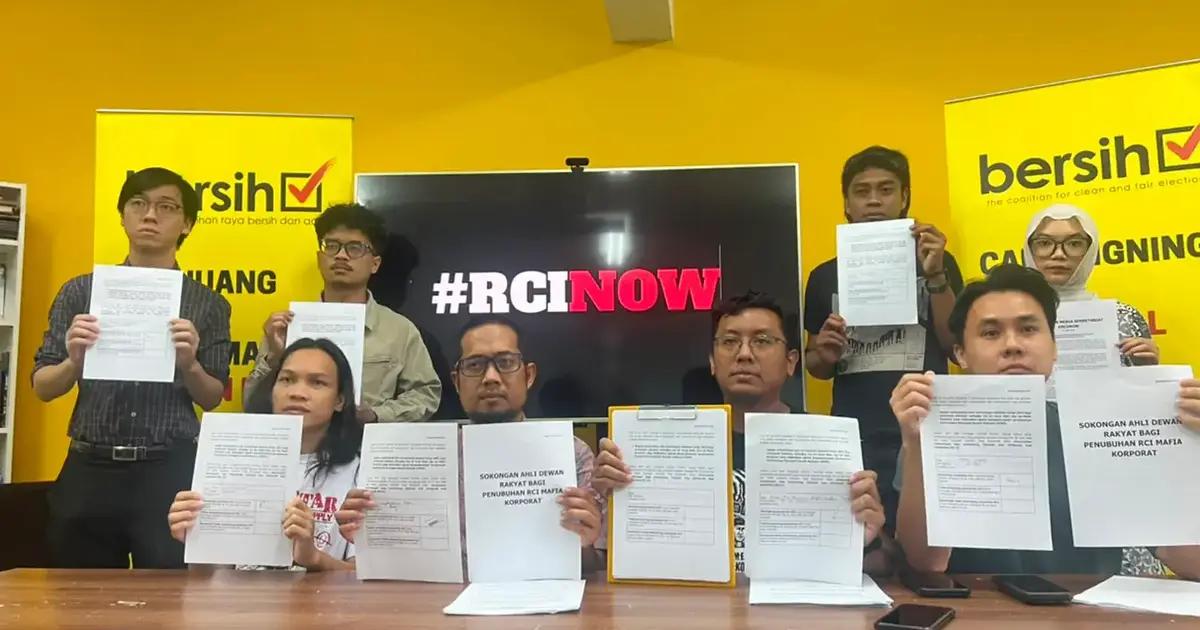
The Coalition for Clean and Fair Elections (Bersih) has announced that 34 members of parliament representing parties spanning the political spectrum—including PKR, PAS, DAP and Umno—have pledged support for establishing a Royal Commission of Inquiry into what the watchdog characterises as 'corporate mafia' activities. This assertion of widespread parliamentary backing underscores growing concern among lawmakers about the integrity of Malaysia's business and political systems, and suggests that fears about illicit corporate influence transcend traditional party divisions.
The identification of cross-party parliamentary support represents a significant development in Malaysia's ongoing accountability debate. When legislators from ideologically divergent camps converge around a single investigative mechanism, it typically reflects deeper public anxiety that transcends the usual left-right or government-opposition dynamics. The fact that governing and opposition parties alike have endorsed this initiative indicates that corporate governance failures and their intersection with political decision-making affect constituencies across the entire parliamentary spectrum.
Bersih's invocation of 'corporate mafia' terminology warrants careful interpretation within the Malaysian context. Rather than suggesting organised crime in the traditional sense, the electoral watchdog appears to be referencing networks of well-connected business interests that leverage political connections to secure contracts, influence policy, and circumvent regulatory oversight. Such arrangements, while sometimes legally opaque, have long been a feature of Southeast Asian capitalism, where kinship networks and political proximity often determine corporate advantage more decisively than competitive merit.
The appeal for a Royal Commission specifically reflects Bersih's assessment that existing institutional mechanisms—regulatory bodies, parliamentary committees, and enforcement agencies—lack either the independence or the comprehensive investigative scope necessary to address systemic patterns of corporate-political entanglement. A Royal Commission carries greater prestige and broader investigative authority than ordinary parliamentary inquiries, and its findings carry substantial moral weight even if they lack direct legislative enforcement capacity.
For Malaysian readers, understanding the significance of this claim requires appreciating the recurring pattern of corporate scandals that have shaped public discourse. High-profile cases involving questionable share acquisitions, government procurement irregularities, and the relationship between major donors and policy beneficiaries have eroded public confidence in institutional impartiality. Bersih's mobilisation of parliamentary support appears designed to translate fragmented public concern into coordinated pressure on the executive branch to accede to a formal investigation.
The involvement of PAS, historically associated with Islamic governance principles emphasising transparency and accountability, alongside DAP with its reform credentials and PKR's positioning as a reform-oriented coalition component, creates an unusual alignment. Even Umno's reported participation suggests that segments within the traditionally dominant party recognise political costs to being perceived as obstructing corporate governance scrutiny. This multi-party positioning complicates simple narratives about who benefits from opacity and who advocates for institutional strengthening.
From a regional perspective, Malaysia's grappling with corporate governance intersects with broader Southeast Asian challenges. Thailand, Indonesia and the Philippines have all experienced cycles of anti-corruption initiatives that initially generated enthusiasm but subsequently encountered resistance from entrenched interests. Malaysia's cross-party initiative, if pursued seriously, could establish precedent for how ASEAN economies might institutionalise corporate accountability beyond rhetorical commitment.
However, scepticism remains warranted. Parliamentary pledges of support do not automatically translate into executive action, particularly when business interests connected to government officials face potential exposure. Previous investigations that threatened powerful figures have encountered delays, resource constraints, or procedural obstacles that effectively limited their impact. The distance between announcing parliamentary backing and actually establishing a functioning Royal Commission with genuine investigative autonomy represents a substantial political terrain where momentum can dissipate.
The implications for Malaysian business extend beyond the specific individuals who might face scrutiny. Corporations that have built competitive advantages on relationships rather than operational excellence may face pressure to demonstrate legitimate business fundamentals. Conversely, companies with transparent governance structures and merit-based advancement might view a rigorous investigation as an opportunity to demonstrate their compliance. The uncertainty surrounding what 'corporate mafia' activities precisely encompass means that many ordinarily legitimate arrangements—board interlocks, revolving-door employment between government and industry, consulting relationships—could face closer examination.
Bersih's role in crystallising parliamentary support also reflects the electoral watchdog's evolution beyond its original mandate centred on electoral reform. The organisation has increasingly positioned itself as a general accountability advocate, and this expansion speaks to public pressure for watchdog bodies to address governance questions beyond narrow procedural concerns. Whether this represents appropriate institutional mission-creep or necessary responsiveness to citizen concerns depends substantially on one's assessment of existing institutions' capacity to address corporate governance questions independently.
The path forward depends significantly on how the government responds to what appears to be genuine legislative interest. Dismissing the proposal risks appearing defensive about corporate accountability. Establishing a commission, conversely, requires confidence that an investigation will not reveal inconvenient connections between sitting officials and controversial corporate arrangements. The political calculation underlying executive response will likely determine whether Bersih's reported parliamentary consensus translates into meaningful institutional action or becomes another initiative that accumulates support in principle while struggling for realisation in practice.

