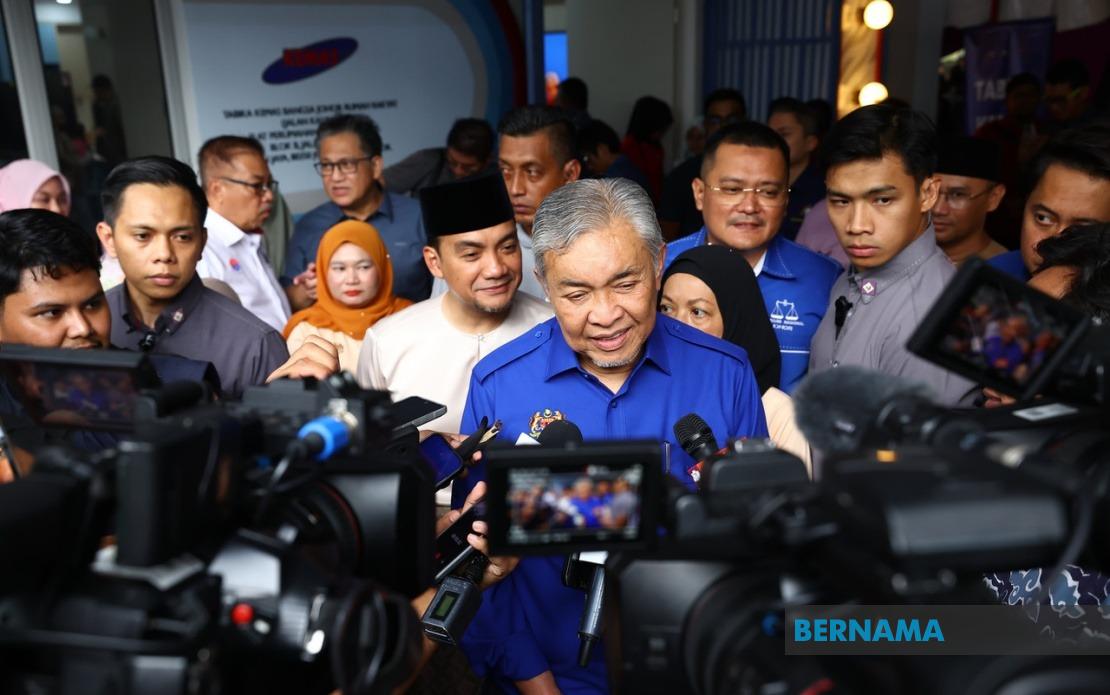
Barisan Nasional's top leadership has publicly acknowledged the electoral proposals presented by Pakatan Harapan in the run-up to the Johor state election, signalling a degree of civility amid the intensifying campaign season. Speaking in Johor Bahru on July 3, BN Chairman Datuk Seri Dr Ahmad Zahid Hamidi remarked that his coalition respects the rival coalition's platform, a gesture that underscores the country's commitment to democratic pluralism even as the two major political blocs prepare for a contest that will determine the direction of Malaysia's most economically significant state.
Ahmad Zahid, who also serves as Deputy Prime Minister and Rural and Regional Development Minister, made his remarks following a community engagement event at Larkin Court 1 flats. He indicated that BN welcomes the substantive proposals being circulated by opposition parties, viewing such contributions to public discourse as a hallmark of Malaysia's democratic framework. The acknowledgment comes as both coalitions intensify their ground operations with only days remaining before the July 11 polling date, making the election one of the most closely watched contests in recent Malaysian politics.
Pakatan Harapan's manifesto, unveiled on the same day, centres on ten major pledges designed to address immediate concerns among Johor voters. The proposals include a dedicated Johor Health Scheme intended to strengthen healthcare access and affordability, a deposit assistance programme targeting first-time property buyers seeking to enter the residential market, and a RM500 million youth development fund aimed at creating economic opportunities and skills training for younger Malaysians. Additionally, the manifesto commits to substantial investments in the education sector, reflecting recognition that schooling quality remains a top priority for families across the state.
BN's counter-positioning rests substantially on its administrative record during the preceding term. Ahmad Zahid highlighted that the outgoing state government achieved a fulfilment rate exceeding 90 per cent of its previous election promises, a metric the coalition intends to leverage as evidence of reliable governance and follow-through. This emphasis on delivery represents a calculated strategy to differentiate BN from opposition claims of unfulfilled commitments and bureaucratic inertia. For Malaysian voters accustomed to election cycles where promises often evaporate once polls close, documented performance records carry considerable weight in shaping electoral calculations.
The BN manifesto itself, according to Ahmad Zahid, has been constructed with comprehensive coverage spanning multiple demographic segments. He stressed that the coalition's proposals benefit citizens across all life stages, beginning with expectant mothers and extending through childhood, schooling, tertiary education, and into family structures including single-parent households. This cradle-to-grave approach reflects sophisticated political messaging designed to demonstrate that BN policies embrace societal diversity and avoid favouring particular ethnic or social categories. Such framing proves especially significant in multiethnic Johor, where appeals to cross-community unity carry particular resonance.
A recurring theme in Ahmad Zahid's remarks centred on the concept of "Bangsa Johor," a nationalist formulation that transcends ethnic boundaries to encompass all state residents as equal beneficiaries of government programmes. This rhetorical framework suggests that any person domiciled in Johor, regardless of background, qualifies for equivalent treatment under the BN policy framework. The invocation of shared Johor identity represents an attempt to sidestep perceptions that BN operates along communal lines, a persistent challenge for the coalition among younger and more cosmopolitan voters sceptical of identity-based politics.
Ahmad Zahid also provided personal assurances regarding his ministry's continued prioritisation of Johor's infrastructure and development agenda, positioning himself as a stakeholder invested in the state's long-term prosperity. This commitment carries political significance given his elevated status within federal government structures; his presence in Johor and explicit support for state-level development initiatives signal that a BN victory would secure preferential access to federal resources and ministerial attention. For state governments, such assurances from powerful federal figures can translate into tangible advantages in securing funding allocations and policy support.
The election itself encompasses 56 state seats across Johor, with a total of 172 candidates representing various parties competing for these positions. Early voting has been scheduled for July 7, allowing certain categories of voters to cast ballots ahead of the main polling day. This logistical framework creates an extended campaign period during which both BN and PH will continue mobilising supporters and refining messaging around their respective visions for state governance.
Johor's political significance extends beyond state boundaries. As Malaysia's second-largest state by population and a major economic hub spanning manufacturing, petrochemicals, agriculture, and tourism sectors, the state election carries implications for national politics. A decisive BN victory would reinforce the coalition's position ahead of any potential federal elections, while significant PH gains would demonstrate that opposition momentum persists despite recent electoral setbacks in other contexts. Investors and business observers are equally attentive, given that state elections frequently signal shifts in investor confidence and broader economic sentiment.
The mutual respect expressed by Ahmad Zahid toward PH's manifesto proposals, while perhaps seeming perfunctory, reflects an unspoken acknowledgment that Malaysian electoral contests increasingly turn on policy substance and delivery records rather than purely on communal mobilisation or patronage networks. Both coalitions recognise that contemporary voters, particularly urban and younger demographics, expect detailed policy platforms addressing healthcare, education, housing affordability, and youth employment. This evolution in electoral dynamics suggests that Malaysian politics continues gradual transformation toward more policy-centric competition, even as traditional political identities and structures retain considerable organisational significance.
With polling day approaching rapidly, the substantive debate between BN's emphasis on proven track record and PH's forward-looking policy agenda will intensify across Johor's diverse constituencies. The election outcome will provide crucial data regarding voter preferences in a critical state and may foreshadow broader political realignments at the national level. Both coalitions appear committed to conducting their campaigns within democratic parameters while vigorously contesting for voter allegiance and the mandate to govern Malaysia's economically vital Johor state.

