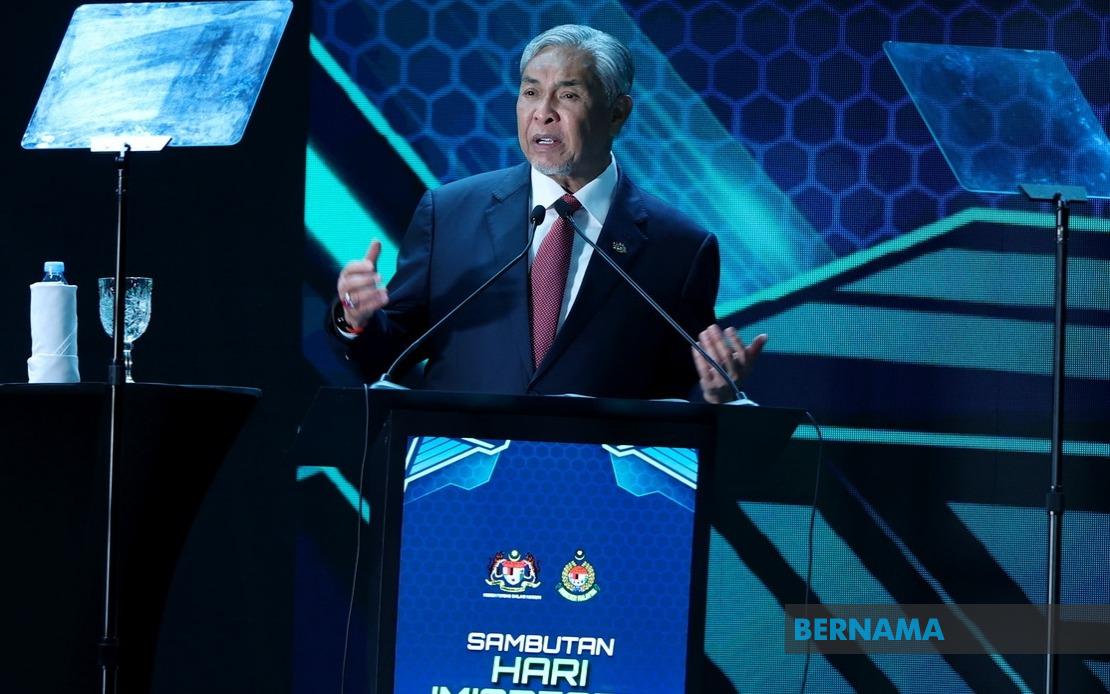
Barisan Nasional has reaffirmed its commitment to maintaining its position within Malaysia's Unity Government framework, a pledge made in line with resolutions adopted at UMNO's most recent General Assembly. The commitment came from BN chairman Datuk Seri Dr Ahmad Zahid Hamidi, who holds concurrent appointments as UMNO president and Deputy Prime Minister, during remarks delivered following the 2026 Immigration Day celebration in Cyberjaya.
The statement represents a formal endorsement of the coalition's ongoing participation in the federal government structure, underscoring the fact that such positions have been decided at UMNO's highest decision-making level. Ahmad Zahid's emphasis on respecting General Assembly determinations reflects the party's hierarchical governance structure, where such assemblies carry ultimate authority on major strategic questions. By framing the issue around this institutional respect, he sought to reassure members and external observers that the party's direction has been democratically established through its formal processes.
Ahmad Zahid explicitly requested that all stakeholders respect the decisions reached at the General Assembly level, suggesting there may have been previous uncertainty or speculation about BN's future role in the federal coalition. His appeal for public confidence in the party's commitment addresses potential concerns that might have arisen among coalition partners or the broader political establishment. The Deputy Prime Minister's framing of the decision as emanating from the party's supreme body lends weight to claims that this represents genuine party consensus rather than leadership preference alone.
In a related development during the same event, Ahmad Zahid addressed the broader question of ministerial appointments and dismissals, clarifying that such decisions rest entirely with Prime Minister Datuk Seri Anwar Ibrahim. This statement came in response to earlier reports indicating that Anwar had issued warnings to cabinet members, deputy ministers, and government agency officials against leveraging their positions to criticise Unity Government coalition partners during state-level election campaigns.
The Prime Minister's directive reflects tensions that can emerge when multiple political parties operate within a single government formation, each with distinct organisational interests and electoral ambitions. State elections present particular challenges to coalition cohesion, as individual parties may prioritize local electoral advantage over broader government unity. Anwar's warning, therefore, represents an attempt to maintain governmental discipline and prevent ministers from undermining coalition partners at a critical juncture when multiple state elections are scheduled or anticipated.
Ahmad Zahid's characterisation of the Prime Minister's appointment authority as absolute and exclusive underscores the constitutional and governmental reality that ministers serve at the pleasure of the head of government. This clarification may have been necessary to address any perception that BN leaders might seek to protect party members from dismissal or that UMNO's participation in government grants it veto power over ministerial changes. By explicitly acknowledging Anwar's unilateral authority, Ahmad Zahid effectively constrained expectations within his own party regarding which of its members could be shielded from executive action.
The timing of these statements carries significance for Malaysian coalition politics. Maintaining unity within a multi-party government requires constant attention to power-sharing agreements, ministerial portfolios, and collective discipline. BN's reaffirmation of its commitment, following a General Assembly where the matter was apparently discussed, suggests that the party had addressed internal questions about the wisdom of continued participation in the current government structure. Such discussions are routine in coalition governments, where individual parties periodically reassess whether remaining in government serves their interests better than moving to opposition.
For Southeast Asian observers, Malaysia's Unity Government represents an important experiment in coalition governance, bringing together parties that have historically competed fiercely. BN's continued participation is essential to the government's numerical strength in parliament and its political legitimacy, given that the coalition commands substantial representation from Malaysia's largest states and among crucial constituencies. Any departure by BN would fundamentally alter the government's character and viability.
The emphasis on respecting General Assembly decisions also speaks to internal party dynamics within UMNO. By stressing that the party's supreme body had determined the course of action, Ahmad Zahid provided a framework through which party members must understand BN's ongoing coalition participation as a matter of party discipline rather than elite preference. This approach helps forestall the emergence of factions within UMNO that might prefer to withdraw from government or pursue alternative political arrangements.
The Prime Minister's authority over ministerial appointments, as acknowledged by Ahmad Zahid, creates an important check on coalition tensions. If individual parties perceived they could insulate their members from dismissal, they might be emboldened to engage in behaviour that undermines overall government cohesion. Anwar's willingness to remove ministers and his signalling of this capacity sends a clear message that coalition discipline has consequences and that the government will enforce standards of conduct expected of those holding public office.
Looking forward, these statements establish parameters for how the Unity Government's coalition partners will interact during the election season. BN's renewed commitment provides stability for the government's broader agenda, while the clarification regarding ministerial authority establishes mechanisms through which coalition discipline can be maintained. For Malaysia's political system, such clarity is valuable in preventing the kind of ministerial misconduct or coalition-undermining behaviour that could precipitate broader governmental instability.
The statements also reflect evolving expectations about ministerial responsibility and coalition conduct in Malaysia's contemporary political landscape. Where previous coalitions might have tolerated considerable cross-party criticism during election campaigns, the current government is attempting to establish higher standards for collective responsibility. Whether such standards can be maintained across a diverse coalition of parties with different electoral bases and constituencies remains an open question that will test the Unity Government's durability throughout the coming election cycle.

