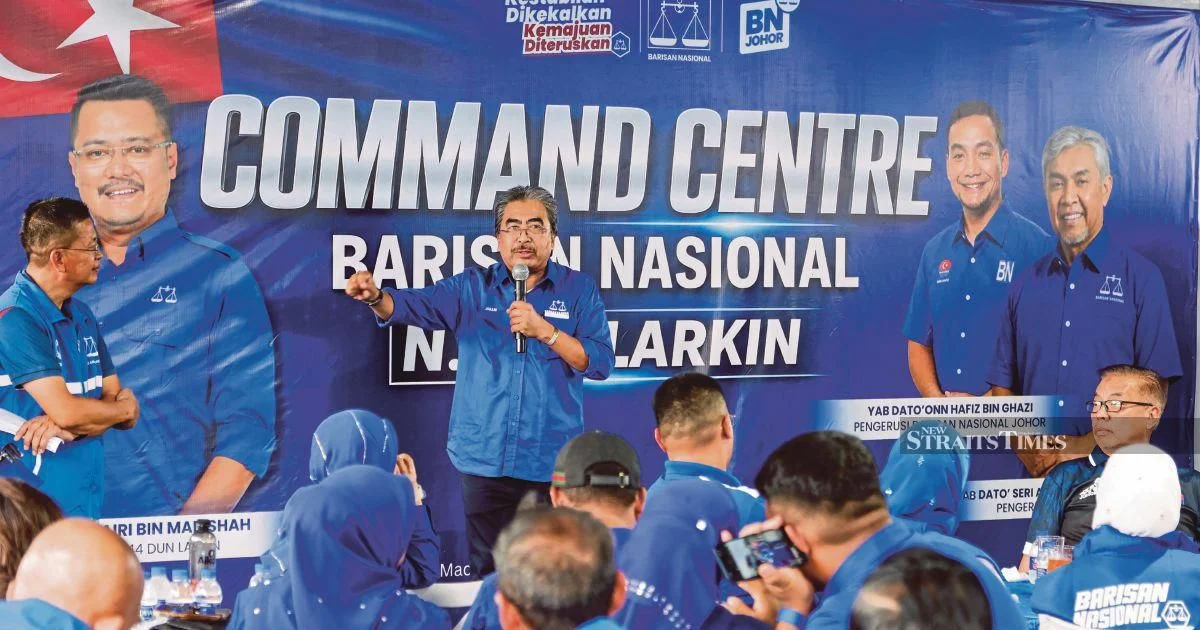
Barisan Nasional must shift its campaign strategy in the Johor state election to emphasise direct engagement with voters rather than allowing its machinery and candidates to become embroiled in disputes with political opponents, according to Datuk Seri Johari Abdul Ghani. The directive underscores growing concern within the coalition about maintaining disciplined messaging during what promises to be a competitive electoral contest in the key southern state.
Johari's counsel reflects a broader strategic calculation within BN's leadership that unfocused infighting and personality-driven controversies can dilute the coalition's substantive policy messaging and alienate swing voters who increasingly view destructive political rhetoric with scepticism. Political analysts have long noted that Malaysian voters, particularly in economically significant states like Johor, tend to reward coalitions that demonstrate internal cohesion and voter-centric platforms over those that appear consumed by internal rivalry or external antagonism.
The emphasis on voter centrality rather than adversarial positioning carries particular weight in Johor, where the electorate has demonstrated volatility in recent elections. The state has served as a barometer for broader national political trends, and its electoral behaviour has shifted markedly over the past decade. A campaign that prioritises substantive engagement with constituent concerns—ranging from economic opportunities and infrastructure to education and social services—typically performs more effectively than one premised on attacking opponents or managing internal party tensions.
Johari's guidance suggests that BN strategists have identified a pattern where candidates who become distracted by exchanges with rival campaigners risk losing momentum on positive messaging about the coalition's record and vision. This is particularly relevant in an era where voter attention spans are fragmented across multiple media platforms, and maintaining a coherent, positive narrative requires disciplined coordination across dozens of candidates and party operatives operating simultaneously across different constituencies.
The coalition's machinery in Johor comprises multiple component parties—including UMNO, MCA, and MIC—each with their own organisational structures and candidate rosters. Coordinating these diverse elements to maintain unified campaign discipline represents a perpetual challenge, especially when individual candidates feel compelled to respond to criticism or engage in point-scoring with opposition representatives. Johari's intervention signals that the coalition's central leadership believes such individual responses, however satisfying in the moment, ultimately weaken BN's collective electoral position.
Voter research consistently demonstrates that Malaysian electorates increasingly prioritise tangible policy commitments and demonstrated competence over rhetorical attacks on opponents. Johor voters specifically have shown preference for candidates and coalitions that articulate clear visions for economic development, job creation, and improved governance. A campaign narrative dominated by disputes and counter-accusations obscures these substantive messages and provides opposition parties with opportunities to claim the moral high ground.
The timing of Johari's statement reflects the coalition's preparation for what internal BN assessments likely indicate will be a closely contested election. Johor's demographic composition—encompassing urban, suburban, and rural constituencies with varying economic interests and priorities—demands sophisticated, targeted campaigning that addresses specific community concerns rather than broad-brush partisan attacks. Candidates who become mired in public disputes with opponents inevitably deviate from this careful voter segmentation approach.
Furthermore, excessive internal or external bickering can depress turnout among BN supporters who view such conduct as unpresidential or unbecoming. Voter enthusiasm and willingness to turn out on election day remains critical to coalition success, particularly in constituencies where voting margins have historically been tight. Campaigns that present BN as united, focused, and oriented toward governing rather than scoring points tend to generate the positive emotional responses necessary to activate supporter participation.
Johari's position also carries implicit acknowledgment that modern elections are increasingly determined by perceptions of competence and stability rather than partisan loyalty alone. Younger voters and floating voters—precisely the demographics BN must win in Johor—evaluate political parties based on whether they appear capable of managing state affairs effectively and whether party candidates seem serious about addressing community needs. Campaign conduct that seems petty or conflict-driven inevitably undermines these perceptions.
The coalition's strategic direction in Johor will likely emphasise achievements in infrastructure development, economic stimulus measures, and social programmes. These narratives require sustained, detailed explanation and repeated articulation across multiple constituencies—resources that are necessarily diluted when candidates redirect energy toward responding to opposition provocations. By instructing the machinery to maintain campaign discipline and avoid adversarial entanglement, BN leadership is essentially prioritising resource allocation efficiency.
Looking ahead, the effectiveness of Johari's guidance will depend significantly on whether BN's candidate selection in Johor includes individuals with sufficient political maturity and message discipline to resist the temptation to engage in public disputes. Training and continuous communication from the coalition's central leadership regarding campaign messaging and appropriate boundaries will also prove essential. The stakes in Johor are substantial enough that the coalition cannot afford the luxury of unfocused, undisciplined campaigning.
Ultimately, Johari's call for voter-focused engagement over internal and external disputes reflects fundamental truths about contemporary Malaysian electoral competition: that coalitions win by connecting authentically with voter concerns, that discipline amplifies campaign effectiveness, and that public perception of political seriousness increasingly depends on how politicians conduct themselves during campaigns. In Johor, where BN's dominance cannot be taken as automatic, these principles may prove decisive.

