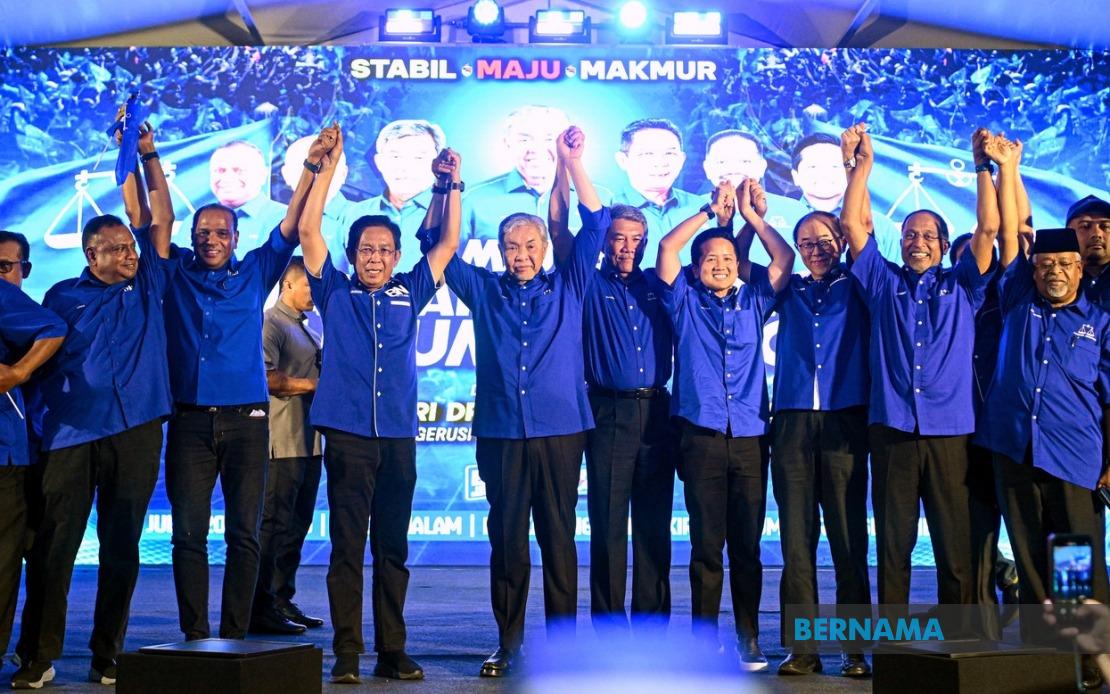
Barisan Nasional has formally presented its 25-strong candidate roster for the 16th Negeri Sembilan state election, signalling a strategy that blends political continuity with selective new blood across the state's contested constituencies. The unveiling took place at Tuanku Abdul Rahman Stadium in Paroi, with Negeri Sembilan BN chairman Datuk Seri Mohamad Hasan presiding over the announcement that reflected both party confidence and lingering uncertainty over final seat allocations.
The retention of Mohamad Hasan himself in the Rantau seat underscores his entrenched position within BN's hierarchy. Having represented the constituency since 2004, the BN deputy chairman secured the nomination with backing from UMNO president Datuk Seri Dr Ahmad Zahid Hamidi, cementing two decades of continuous electoral success in a state where political fortunes have shifted dramatically in recent years. His defence of Rantau signals party resolve to maintain strongholds in the central regions where BN has historically dominated.
Equally significant is the confirmation that Jalaluddin Alias will pursue another term in Pertang, a seat he has commanded since 2013. Jalaluddin's position as Negeri Sembilan UMNO Liaison Committee chairman and his parallel role as Jelebu Member of Parliament demonstrate the cross-pollination of state and federal representation that remains characteristic of BN's organisational structure. His continued candidacy reflects confidence that his federal profile and state roots provide electoral resilience.
The coalition has preserved several other sitting representatives, including Mohd Faizal Ramli in Linggi and Mustapha Nagoor in Palong, both seeking fresh mandates. This pattern of incumbency retention suggests BN views these seats as secure enough to warrant continuity, a calculation that carries particular weight given Negeri Sembilan's political volatility. The state has experienced significant swings in recent election cycles, making the choice to retain experienced legislators a calculated hedge against anti-incumbent sentiment.
Yet the announcement's incompleteness warrants serious examination. BN has yet to finalise candidates for eleven state seats—Klawang, Serting, Lobak, Sikamat, Ampangan, Bukit Kepayang, Mambau, Paroi, Lukut, Bagan Pinang, and Gemas—a substantial gap representing nearly one-third of contested constituencies. This delay suggests internal negotiations remain unresolved, possibly reflecting tension between UMNO, MCA, and MIC over seat allocations and the balance between incumbent renewal and new candidacies. For Malaysian observers, such delays are rarely merely administrative; they typically indicate deeper coalition friction.
The incomplete slate also leaves Negeri Sembilan voters in suspense regarding the full competitive landscape. In a state where opposition momentum has periodically challenged BN's dominance, delayed candidate announcements create uncertainty that can dampen campaign momentum and voter engagement. Regional competitors, particularly Pakatan Harapan and Perikatan Nasional, gain tactical advantage when BN's full roster remains obscure, allowing them to campaign against perceived incompleteness and organisational disorder.
Negeri Sembilan's electoral dynamics carry implications extending beyond the state's boundaries. As a central-region state with mixed urban and rural constituencies, it serves as a bellwether for broader Peninsular Malaysia political trends. BN's approach here—retaining trusted incumbents while deliberating over competitive seats—mirrors uncertainty visible across multiple state administrations. The question of whether experience-based retention translates to electoral success remains contested, particularly among younger voters sceptical of long-tenured representatives.
The strategy also reflects BN's resource constraints. Unlike previous election cycles when the coalition commanded overwhelming organisational capacity, contemporary BN operates with reduced machinery in several states, necessitating careful deployment of proven candidates in contested terrain. Mohamad Hasan's retention in Rantau and Jalaluddin's in Pertang represent investments in seats deemed defensible, whilst uncertainty over remaining constituencies suggests either genuine difficulty identifying credible candidates or coalition partners insisting on multiple seat options before settling on final nominees.
For Malaysian observers tracking post-2018 political realignment, Negeri Sembilan represents a microcosm of BN's broader recalibration. The coalition's return to governance in Putrajaya has restored resources and confidence, yet state-level electoral contests reveal persistent vulnerabilities and internal coordination challenges. Candidate selection—ostensibly technical—becomes a window onto coalition health, alliance tensions, and confidence in various constituencies.
The upcoming weeks before final nominations will prove instructive. Whether BN resolves the outstanding eleven seats through consensus or compromise, and whether those decisions subsequently translate into voter enthusiasm, will offer early indicators of the coalition's electoral prospects in the next cycle of state contests. For now, the partial announcement preserves flexibility whilst generating questions about organisational readiness—precisely the impression BN would prefer to avoid as it rebuilds from recent electoral reversals.

