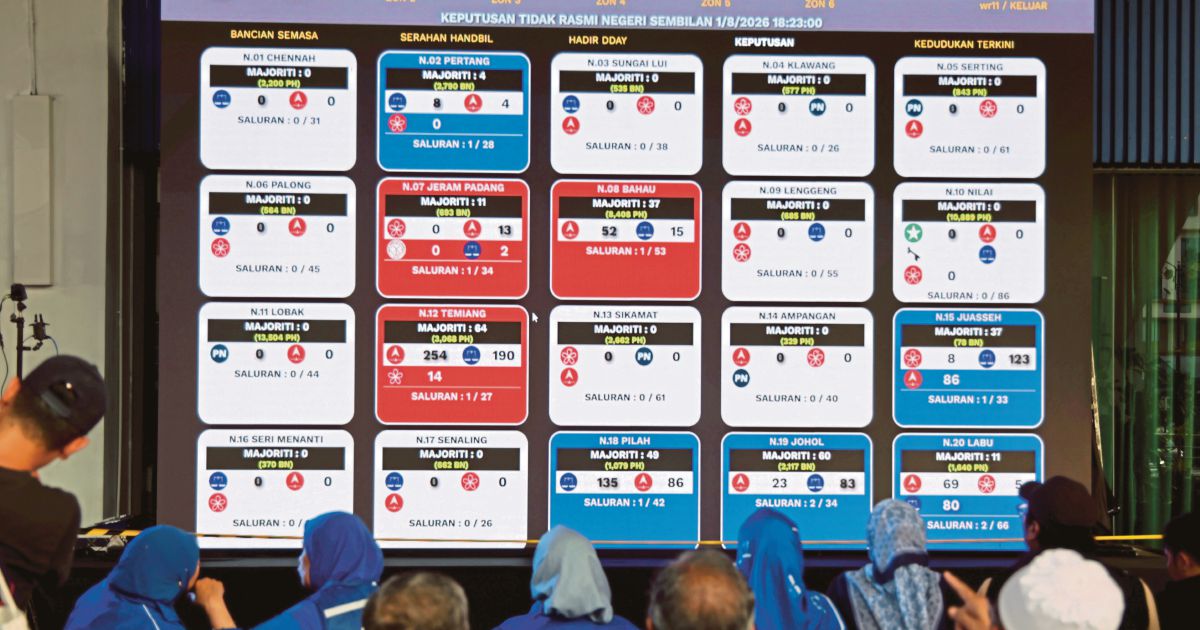
Datuk Dr Asyraf Wajdi Dusuki, a prominent United Malays National Organisation (UMNO) leader, has declared that the combined Barisan Nasional (BN) and Perikatan Nasional (PN) coalition has captured 23 state assembly seats in Negri Sembilan, a figure he says provides a sufficient mandate to govern the state. The claim, made in Seremban, reflects confidence among the traditional ruling coalition and its newer ally regarding their electoral performance, though the announcement remains unofficial pending official confirmation from the Election Commission.
The assertion represents a significant moment in Negri Sembilan's political landscape, where control of the state government has traditionally rested with BN, the long-standing ruling alliance that dominated Malaysian politics for decades. The inclusion of PN, the newer coalition that rose to prominence during the recent period of political volatility and realignment, signals how the Malaysian political ecosystem has shifted substantially. The cooperation between BN and PN indicates strategic partnership between UMNO-led BN and PAS-anchored PN, two forces that have competed fiercely in certain contexts while seeking collaboration in others.
Negri Sembilan, with its predominantly Malay-Muslim population and historical dependence on BN-aligned politics, represents territory where the coalition has traditionally performed well. The state's political dynamics reflect broader patterns seen across peninsular Malaysia, where rural and semi-rural constituencies tend toward more conservative voting blocs. However, the need for BN to ally with PN to secure governance suggests that neither force commands an overwhelming majority on its own, and that electoral mathematics in the state have become more competitive than in previous cycles.
The claim of 23 seats carries particular weight in understanding the state assembly's composition and threshold for government formation. If the state assembly comprises fewer than 46 total seats, then 23 would represent a clear majority. This indicates the coalition believes it has crossed the mathematical requirement to form an administration independently, without requiring additional support from independent candidates or other parties. Such calculations remain crucial in Malaysian state politics, where slim majorities can create governance challenges and vulnerability to defections.
The informal nature of Asyraf's announcement underscores how Malaysian election results often emerge through political claims before official validation. This pattern has become increasingly common as major coalitions position themselves advantageously during the counting and verification process. The Election Commission's formal declaration typically follows such preliminary assertions, though occasionally discrepancies emerge between claimed and official tallies, particularly when results remain close or when subsequent recounts occur.
For Malaysian political observers, the BN-PN cooperation in Negri Sembilan reflects a broader phenomenon reshaping the country's political architecture. The rise of PN as a significant force, particularly through PAS's expansion beyond its traditional strongholds, has forced BN component parties to recalibrate their strategies. Rather than contest PN directly across all constituencies, BN has in certain electoral contexts preferred partnership over confrontation, a pragmatic adjustment to the new political reality. This shift differs markedly from the monolithic BN dominance that characterized Malaysian politics through most of the post-independence era.
The implications for Negri Sembilan extend beyond immediate government formation to questions of policy direction and state governance. A BN-PN administration would likely reflect the policy preferences and ideological orientations of both partners, potentially creating tensions between UMNO's traditional approaches and PN's more Islamically-oriented positions. Such coalitions, while electorally successful, sometimes encounter friction during governance when partners' priorities diverge on matters such as religious policy, education, economic development, or social issues.
From a Southeast Asian perspective, Negri Sembilan's election contributes to understanding Malaysia's continuing political evolution. Unlike neighbouring countries with more entrenched ruling parties, Malaysian politics have shown increasing fluidity, with coalitions shifting, parties realigning, and previously unthinkable partnerships materializing. This dynamism reflects democratic vitality but also generates uncertainty for investors, policymakers, and citizens seeking stability. The region watches Malaysian developments closely, as the country often serves as a bellwether for political trends in Southeast Asia.
The timing of such coalition claims also matters strategically. By publicly asserting victory through multiple voices across different parties, the BN-PN coalition establishes narrative dominance and discourages any potential attempts to form alternative governments or negotiate with independent candidates. This political theatre, common in Malaysian elections, shapes perceptions and public discourse around legitimacy and mandate before official results confirm the claims. Should the Election Commission later validate Asyraf's assertion, the coalition will have successfully controlled the narrative from announcement through confirmation.
Looking ahead, attention will focus on how the BN-PN coalition translates its claimed electoral success into effective governance. State governments in Malaysia hold significant powers over land administration, Islamic affairs, and local economic development, making them consequential for residents' daily lives. Whether a BN-PN partnership in Negri Sembilan can govern cohesively or whether coalitional tensions emerge will offer insights into the sustainability of such arrangements. If successful, the model could shape similar arrangements in other Malaysian states during future electoral cycles.

