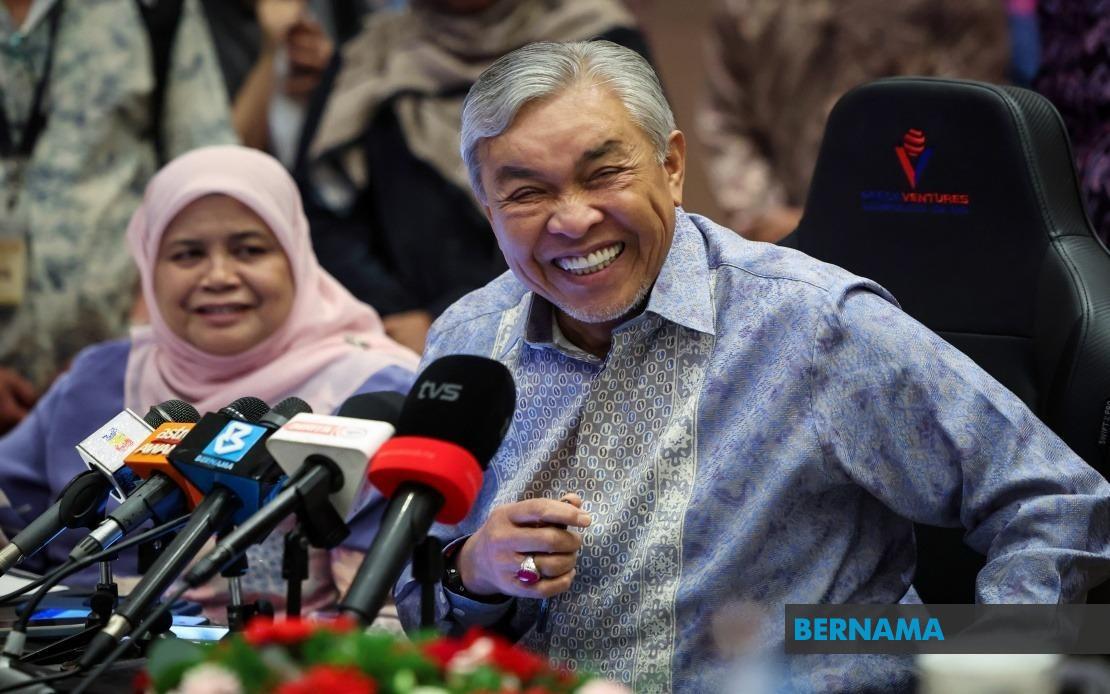
Barisan Nasional has doubled down on its pledge to sustain the Unity Government framework through the conclusion of the 15th Parliament, firmly rejecting persistent whispers of internal instability or attempts to unseat Prime Minister Datuk Seri Anwar Ibrahim. Deputy Prime Minister and BN chairman Datuk Seri Dr Ahmad Zahid Hamidi made this unambiguous declaration in George Town during remarks following the 61st Coordination Meeting between the Minister of Rural and Regional Development and State Executive Councillors for Rural Development. The emphatic statement arrives amid recurring conjecture about potential fractures within Malaysia's governing coalition and speculation about power consolidation moves.
Ahmad Zahid framed BN's political posture as fundamentally rooted in respect for constitutional monarchy and the Yang di-Pertuan Agong's directive to establish the Unity Government in the aftermath of the 2022 General Election. He underscored that the coalition's alignment with this arrangement has remained consistent and unwavering since its inception, reflecting institutional deference to the Crown's constitutional role in guiding formation of governing coalitions. This framing positions BN's commitment as a matter of monarchical fidelity rather than mere political pragmatism, lending it a dimension beyond electoral calculation or temporary convenience.
In categorical language that left little room for ambiguity, Ahmad Zahid explicitly disavowed involvement in the type of destabilization tactics that have historically plagued Malaysian politics. He rejected any connection to hypothetical "Bangkok Move" or "Dubai Move" scenarios, employing colloquialisms associated with previous instances of parliamentary maneuvers conducted on foreign soil. Such references carry particular resonance in Malaysian political discourse, evoking memory of high-drama episodes that shook government stability in prior administrations. By invoking and explicitly renouncing these frameworks, Ahmad Zahid sought to preempt speculation before it could gain traction in media or opposition narratives.
The BN chairman and UMNO president asserted that once his coalition committed to participating in the Unity Government following the Yang di-Pertuan Agong's constitutional guidance, that commitment extended through to the natural conclusion of the parliamentary term. He characterized this as a definitive, unchangeable position—"Full stop"—signaling that further discussion of the matter would be redundant or unwelcome. This rhetorical firmness may serve multiple audiences: reassuring coalition partners of BN's reliability, signaling institutional stability to domestic and international observers, and cautioning any internal party factions contemplating alternative political arrangements.
Ahmad Zahid acknowledged that external commentary and public skepticism would inevitably circulate regardless of his statements, but urged that BN remain unified for the paramount objective of ensuring political stability. He connected this imperative to sincerity of commitment, suggesting that maintaining the Unity Government required not merely formal adherence but genuine conviction. This appeal to internal party discipline and organizational cohesion reflects awareness that BN's coalition role depends substantially on its members viewing the arrangement as legitimate and worthwhile, not merely as a temporary tactical necessity.
Separately, Ahmad Zahid addressed operational challenges facing BN's Negeri Sembilan state branch, which has encountered friction following the coalition's strategic electoral choices. A BN polling district centre in Klawang suspended operations reportedly in protest after the party declined to field a candidate for a particular state seat, instead allowing a three-way contest between Pakatan Harapan's Bakri Sawir, Perikatan Nasional's Danni Rais, and Bersatu's Muhammad Adib Musa. Such internal dissatisfaction, though localized, can signal broader organizational discontent if not managed carefully. Ahmad Zahid indicated he had already engaged with Negeri Sembilan UMNO leadership to resolve the grievance, expressing confidence that resolution would occur within the nine-day window before polling.
Questions regarding potential political realignment between BN and Perikatan Nasional under a proposed "Perikatan Barisan Nasional" (PBN) alliance elicited a notably circumspect response from the Deputy Prime Minister. Ahmad Zahid characterized such proposals as rhetorical flourishes deployed during campaign speeches rather than substantive political initiatives subjected to formal inter-party deliberation. He suggested that any genuine exploration of such an arrangement would necessitate serious, measured consideration by relevant party leadership. This measured language neither wholly dismisses the possibility nor embraces it, preserving strategic flexibility while avoiding commitment to a potentially controversial realignment.
The careful distinction Ahmad Zahid drew between campaign oratory and formal political negotiation reflects the delicate position Malaysia's major coalitions occupy. BN's integration into the Unity Government, while intended to promote stability after the fractious 2022 election outcome, creates competing pressures—maintaining coherence within the governing coalition while acknowledging BN's substantial parliamentary representation and organizational capacity. Any suggestion that BN might recalibrate its political partnerships could destabilize the entire arrangement, yet dismissing such possibilities entirely strains credibility given Malaysian political history and the opportunistic nature of coalition politics.
The Deputy Prime Minister responded to Prime Minister Anwar Ibrahim's recent pantun—a traditional Malay poetic form that emphasized unity and discipline in political cooperation—with verse of his own, a gesture that conveyed personal rapport despite the two leaders representing different parties competing in simultaneous state-level elections. Ahmad Zahid characterized his relationship with Anwar as cordial, demonstrating that Unity Government participants can maintain collegial personal dynamics while pursuing competing electoral interests at subsidiary levels. This theatrical exchange, conducted through traditional literary forms rather than confrontational political rhetoric, illustrates how Malaysia's establishment political culture operates simultaneously on multiple registers.
The event hosting Ahmad Zahid's remarks—the MEXCLUB coordination meeting—itself reflects the institutional infrastructure supporting the Unity Government's functioning. These inter-governmental forums bring together federal and state-level officials across party lines to coordinate policy implementation and resource allocation for rural development. Such mechanisms, ostensibly technocratic and apolitical, fundamentally require the underlying political coalition to remain operative. Their continuation thus represents not merely administrative routine but implicit vindication of the Unity Government framework itself.
For Malaysian readers, Ahmad Zahid's emphatic restatement of BN's coalition commitment carries implications extending beyond immediate political theater. The stability of the Unity Government directly affects Malaysia's economic policy direction, investment climate, and regional standing. International observers and foreign investors closely monitor whether Malaysia's governing arrangements appear durable or subject to imminent upheaval. A perception of instability—whether grounded in reality or manufactured through speculation—can influence currency valuations, foreign direct investment decisions, and diplomatic relationships. Ahmad Zahid's forceful language serves partly to shore up confidence in governmental continuity.
The persistence of speculation about BN's intentions, despite repeated official denials, suggests deeper anxieties within Malaysian politics about coalition durability and incentive structures. BN's historic dominance, its current secondary status within the governing coalition, and the substantial parliamentary representation it commands create inherent tension. The coalition accepted a junior partnership role in the Unity Government in service of political rehabilitation and the prevention of what many establishment figures viewed as radical policy experiments. Yet maintaining that posture indefinitely requires sustained discipline from a party accustomed to leading governments. Ahmad Zahid's rhetoric attempts to normalize BN's subordinate role as a matter of principle rather than circumstance, though observers will inevitably continue monitoring whether commitment matches rhetoric as Malaysia progresses toward the next general election.

