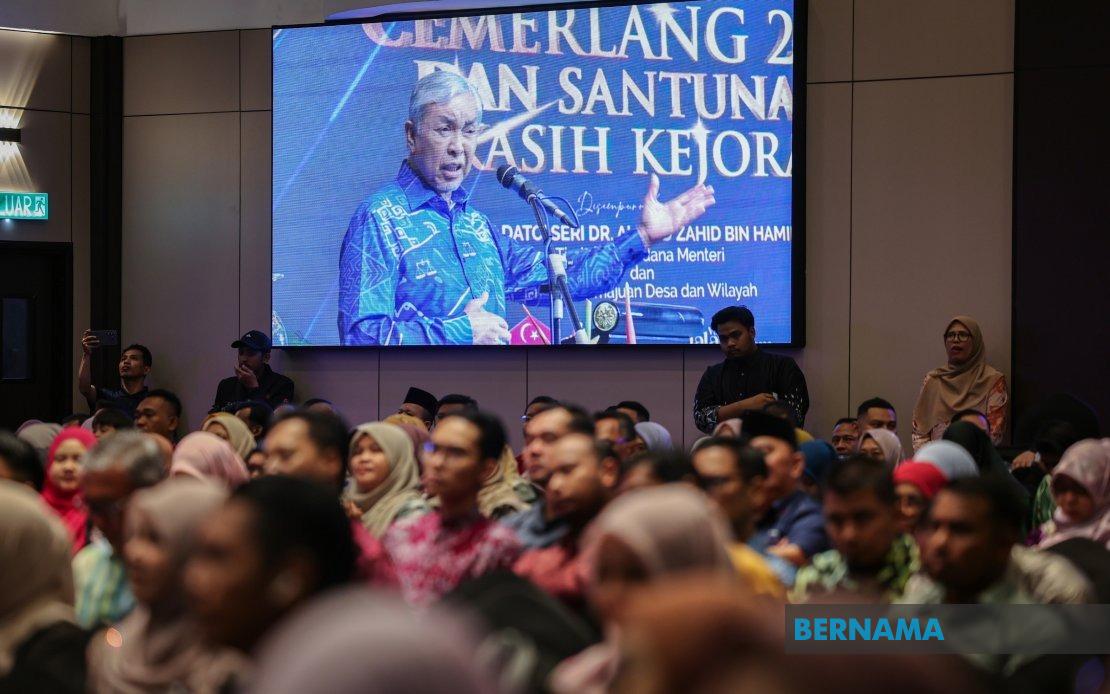
Deputy Prime Minister Ahmad Zahid Hamidi has pushed back against suggestions that Barisan Nasional's campaign machinery is operating below par as the Johor state election enters its final stretch. Speaking in Kota Tinggi after an official function, the BN chairman characterised such assessments as merely interpretive readings rather than factual observations of the ground situation. He emphasised that the coalition's extensive campaign operations tell a different story, one of sustained effort and engagement with voters across the state.
Zahid's remarks come as the electoral contest heats up ahead of the July 11 polling day, with various political actors offering competing narratives about campaign momentum and voter sentiment. The coalition leader suggested that rival parties and observers outside BN's structure inevitably bring their own perspectives to the campaign narrative, whether favourable or otherwise. He indicated that BN views such commentary as part of the normal political discourse rather than anything warranting serious concern about the coalition's electoral prospects or campaign efficacy.
The BN chief expressed gratitude for support flowing from multiple quarters and indicated optimism that this backing would manifest as electoral gains for the coalition's candidates. He framed victory on July 11 as both a validation of public confidence in BN's record and a mandate to pursue further development initiatives. This focus on translating perceived popular backing into concrete electoral results underscores BN's strategy of emphasising continuity and proven administrative performance rather than engaging extensively in rebuttals of external criticism.
A particular challenge facing the coalition stems from its close partnership with Pakatan Harapan at the federal level through the Unity Government arrangement. Critics have suggested this cooperation might disorient traditional BN supporters in Johor who have historically viewed the two blocs as antagonists. However, Zahid moved to neutralise this potential weakness by pointing out that Johor's state government was firmly established before the Unity Government took shape at federal level. This temporal distinction, he argued, removes any contradiction or confusion that might otherwise arise from the simultaneous operation of BN and PH in different governmental spheres.
Zahid further noted that the federal Unity Government itself operates on the basis of professional cooperation and clear working relationships between all participating parties. This framing attempts to normalise what might otherwise appear paradoxical to voters: the coexistence of competitive state elections alongside collaborative federal governance. By emphasising professionalism and functional effectiveness rather than ideological unity, the BN chairman sought to reassure voters that the two governments operate without friction or contradiction.
The Johor state government's financial performance features prominently in BN's campaign narrative. Under Chief Minister Onn Hafiz Ghazi's leadership, the state generated revenue of RM2.26 billion in the preceding year, positioning Johor as the highest revenue-generating state in Peninsular Malaysia. This metric provides tangible evidence of fiscal management and economic dynamism that BN argues should feature prominently in voters' calculations. The coalition projects that a strengthened mandate from the July 11 election would enable the state administration to intensify implementation of its five-year development agenda, linking electoral success directly to future policy delivery.
BN's contest spans all 56 state seats, representing a comprehensive engagement with voters across every electoral division in Johor. This saturated campaign approach reflects confidence in the coalition's organisational capacity and electoral appeal, contrasting with the more selective contestation strategies adopted by rival coalitions. Pakatan Harapan fields an equivalent 56 candidates, while Perikatan Nasional contests 33 seats, Bersama puts forward 15, and smaller parties and independent candidates account for the remaining positions in a fragmented electoral landscape.
When pressed on PAS president Tan Sri Abdul Hadi Awang's explicit calls for voters to reject Pakatan Harapan entirely, including in direct contests against BN candidates, Zahid adopted a measured response. Rather than reciprocating with aggressive rhetoric, he characterised PAS's approach as one valid perspective whilst positioning BN as adhering to professional electoral conduct. This tonal difference between coalitions may prove significant in shaping how undecided voters perceive the respective contenders, with professionalism potentially appealing to pragmatic electors focused on governance effectiveness rather than ideological purity.
Zahid's framing of campaign dynamics reflects broader calculations about the electoral environment. By dismissing criticism as matters of perception rather than substance, he attempts to inoculate BN against narratives that might undermine confidence in the coalition's campaign. Simultaneously, by highlighting concrete achievements like fiscal performance and pointing to professional governance, he directs voter attention toward tangible record rather than engaging opponents on their rhetorical terrain. The strategy implicitly suggests that electoral outcomes will ultimately validate which coalition's characterisation of reality more accurately reflects voter preferences.
Early voting is scheduled for July 7, providing an opportunity to gauge campaign effectiveness through turnout and early returns. This compressed timeframe intensifies campaigning across the final days before the main polling date. The multiplicity of candidates contesting—with seven parties and independent candidates competing across 56 seats—creates a complex electoral dynamic where strategic voting calculations and coalition preferences may prove decisive in determining final outcomes across different constituencies. For Malaysian observers, the Johor election serves as a significant barometer of voter sentiment and coalitional viability heading into what may be consequential national electoral contests.

