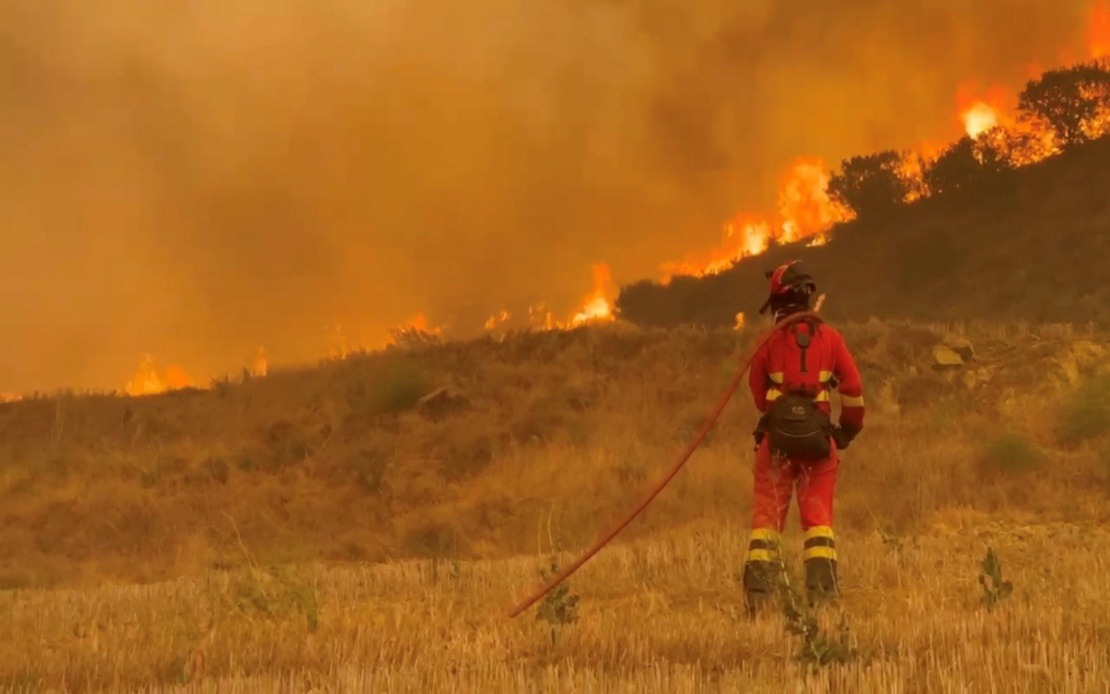
Britain's government is convening an emergency meeting this Wednesday to tackle the mounting crisis posed by extreme heat, uncontrolled wildfires and widespread drought across the nation. The COBRA meeting—a mechanism reserved for national emergencies—will be chaired by Andy Burnham as the country grapples with increasingly dangerous weather patterns that threaten multiple critical sectors simultaneously. The convergence of these climate-driven challenges has created a perfect storm of stress on emergency services, agricultural communities and the healthcare system, each already operating under considerable strain.
The government spokesperson acknowledged that firefighters, farmers and NHS personnel are confronting serious difficulties directly linked to the current meteorological conditions. These three groups represent the frontline of Britain's response infrastructure, and their simultaneous struggle underscores the systemic nature of the crisis. Firefighters are battling significant wildfires, including a major incident in the New Forest in Hampshire that has consumed vast areas. Farmers are contending with severe water shortages and parched land affecting food production. Healthcare workers, meanwhile, are managing surge demand from heat-related illnesses and deaths, a burden that compounds the already stretched services across the National Health Service.
The timing of this emergency convocation reflects a deteriorating situation that has unfolded over recent weeks. On Monday, additional areas across England were formally designated as drought zones, marking an expansion of water stress across the country. Wales had already declared drought status on July 30 as sustained high temperatures depleted water reserves. Earlier in the summer, drought was declared across half of England following unprecedented rainfall deficits and prolonged heat. These successive designations reveal a pattern of cascading climate impacts rather than isolated weather events.
The meteorological situation has become increasingly grave. Britain's Met Office, the national weather authority, issued a rare amber extreme heat warning for Thursday—a classification reserved for conditions posing genuine danger to public health. More significantly, the Met Office announced that the UK is tracking toward recording its hottest summer on record when measured by average temperature. Such records carry profound implications for how climate change is materialising across the British Isles, moving from theoretical projections to lived experience affecting millions.
The human cost of these conditions is already evident in mortality figures. During the May and June heat waves, the UK Health Security Agency documented 2,877 excess deaths attributable to the extreme temperatures. This figure nearly doubles the 1,504 excess deaths recorded during the previous summer of 2025, demonstrating an alarming acceleration in heat-related mortality. These statistics translate into thousands of vulnerable individuals—the elderly, the chronically ill, the socially isolated—whose lives were cut short by temperatures their bodies could not withstand. The projection for the full summer season remains uncertain but potentially catastrophic.
Political responses have begun coalescing around different visions for action. Zack Polanski, leader of the Green Party, has been vocal in demanding that the government move beyond reactive management toward systemic solutions. His statement that "we cannot negotiate with the science" reflects frustration with what environmentalists perceive as inadequate governmental response to a predictable crisis. Polanski has articulated a four-point agenda: taxation of major fossil fuel corporations to fund emergency firefighting resources including helicopters; establishment of public cooling centres in every community to provide refuge during dangerous heat; implementation of maximum working temperature thresholds to protect workers; and cessation of new petroleum and gas exploration in the North Sea.
Polanski's proposals reveal fundamental disagreements within British political discourse about the appropriate response to climate-driven emergencies. His emphasis on fossil fuel taxation positions the crisis as fundamentally a consequence of continued reliance on carbon-intensive energy sources. The call for community cooling spaces addresses immediate vulnerability, particularly among populations lacking air conditioning. Maximum working temperature limits would protect workers from heat stress but raise complex questions about economic productivity and enforcement. The North Sea drilling ban represents the most overtly political demand, directly challenging the government's current energy strategy.
For Malaysian and Southeast Asian observers, Britain's experience offers instructive parallels and contrasts. The region's tropical climate means extreme heat is endemic rather than anomalous, yet the cascading impacts visible in Britain—simultaneous fire, drought and health crises—reflect possibilities that intensify with climate change. Malaysia's monsoon patterns and higher rainfall normally provide protection against the severe drought conditions affecting Britain, yet the emergency preparedness frameworks being tested in the UK have relevance across the equatorial region. The willingness of British authorities to convene emergency meetings at the highest level demonstrates recognition that climate impacts now qualify as genuine national security concerns requiring whole-of-government response.
The underlying scientific reality driving Britain's crisis is unambiguous: sustained high temperatures create conditions for multiple hazards to emerge simultaneously. Heat waves drive evaporation that deepens drought. Drought creates fuel for wildfires that consume vegetation at unprecedented rates. The atmospheric conditions enabling these phenomena—associated with climate change—are expected to intensify rather than stabilise. Britain's emergency meeting on Wednesday represents an implicit acknowledgment that adaptation and resilience-building must now become central to governance, not peripheral concerns addressed during calm periods.
The immediate outcomes of Wednesday's COBRA meeting remain to be seen, but the very convocation signals that British policymakers are treating the intersection of heat, fire and drought as a systemic challenge requiring integrated solutions. Whether the government will adopt suggestions like Polanski's fossil fuel taxation or instead pursue more conventional disaster management approaches will reveal the political appetite for transformative climate action versus incremental adaptation. The weeks ahead will test whether emergency-level meetings translate into emergency-level policy changes, or whether Britain's response remains constrained by institutional inertia and political calculation even as the climate continues its unstoppable transformation.

