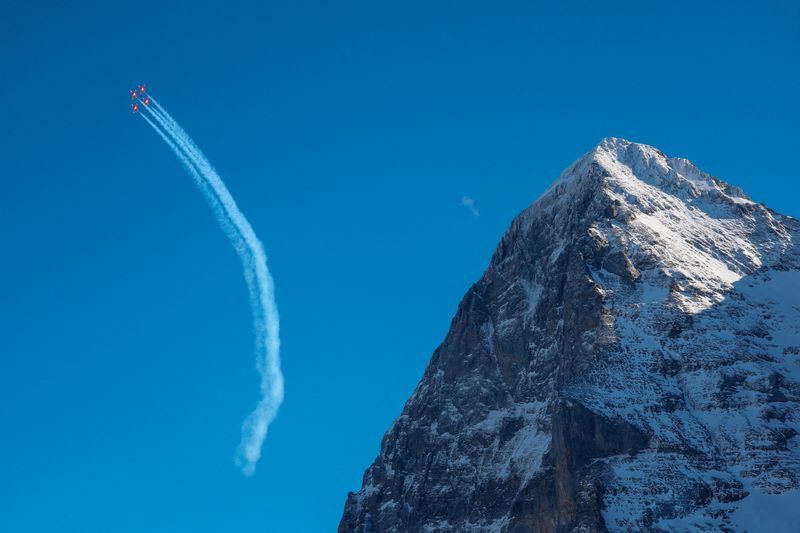
Fay Manners, a 39-year-old British alpinist, has etched her name into mountaineering history by becoming the first British woman to forge a new route on the Eiger North Face. Working alongside Swiss climbing partner Roger Schaeli, Manners spent 13 days this summer establishing "Solar Eclipse," a technically demanding 900-metre route comprising 33 pitches on one of Europe's most formidable mountain faces. The accomplishment stands out not merely as a personal triumph but as a symbolic breakthrough in a sport long dominated by male names on guidebook entries.
The Eiger North Face represents one of mountaineering's most intimidating challenges. Rising 1,800 metres above the Swiss Alps, the face exposes climbers to treacherous combinations of rock, ice, severe weather, and rockfall hazards. Its fearsome reputation was forged through decades of tragedy before a German-Austrian team achieved the first successful ascent in 1938. Today, the face remains a proving ground for elite alpinists, drawing adventurers who seek to test themselves against one of nature's most unforgiving vertical environments. The sheer scale and danger of the North Face make any new route a significant undertaking, demanding not just technical proficiency but resourcefulness, courage, and the capacity to innovate under extreme conditions.
Manners herself had previously climbed the Eiger via the established Heckmair Route four years earlier. That experience fundamentally changed her perspective on the mountain. Rather than viewing the Eiger as a destination to be conquered through known pathways, she became obsessed with studying the face, imagining untried lines through its exposed walls. The shift from repetition to creation represents a profound change in mountaineering aspiration. Following an existing route provides climbers with known variables—established difficulty ratings, predictable protection placements, and confirmed summit feasibility. By contrast, establishing a new route means venturing into completely uncharted terrain where every technical decision carries genuine uncertainty.
The difference between these two approaches extends beyond mere logistics. When Manners undertook the "Solar Eclipse," she and Schaeli could not consult guidebooks or previous ascenders. They did not know the exact technical difficulty they would encounter, could not predict what protection equipment they would need to install, and held no guarantees they could reach the summit. As Manners explained to Reuters, this uncertainty fundamentally changes the psychological and technical dimensions of the climb. The creative element—deciding where the route should go, how to overcome obstacles, and how to link rock features into a coherent pathway—demands a different mindset than following someone else's predetermined line.
Beyond the personal achievement lies a deeper significance that resonates through mountaineering culture. Manners points to a critical issue affecting how women perceive their place in climbing: representation in historical records. When women open guidebooks to study established routes, they encounter predominantly male names attached to first ascents. This pattern, however unintentionally, communicates a subtle but powerful message that route-finding and creative climbing belong to the male domain. For Manners, the act of women engaging in this creative process—conducting the research, undertaking the risk, investing the labour—becomes as important as the physical accomplishment itself. Representation and action become inseparable.
Women have nonetheless left their mark on Eiger climbing history. In 1964, Daisy Voog became the first woman to successfully climb the North Face, a milestone achieved despite facing explicit discrimination. Historical accounts reveal that Voog had previously attempted to join a mountaineering club dedicated to extreme climbing but was rejected solely because the membership admitted only men. Five years later, Japanese climber Michiko Imai participated in establishing the "Japanese Summer Direttissima" route, serving as the sole woman on a six-person team. These achievements, though scattered across decades, demonstrate that women's participation in elite mountaineering is neither new nor incidental.
Manners reflects deeply on how gendered assumptions shape women's self-perception within sport, even when not explicitly stated. She considers how apparently minor messages—a parent suggesting that a woman cannot carry as much weight, an assumption that women lack capacity for certain activities—accumulate into internalized doubt. These messages, she argues, operate so subtly that people often fail to recognize them. They become invisible filters through which women evaluate their own potential. Manners wonders whether she might have pursued climbing differently had she grown up in an environment where equality was simply assumed rather than a goal to be argued for.
Her own journey illustrates how these systemic assumptions channel talented individuals away from their aspirations. Growing up in England, Manners excelled at sports and imagined a professional athletic career. However, people around her—well-meaning adults including family and mentors—suggested that women could not build viable careers in sports. This messaging discouraged her from pursuing her passion directly. Instead, she studied data science and chose a conventional professional path, eventually relocating to Chamonix, France, where she worked as a data consultant while climbing recreationally. Her professional trajectory seemed set on a course toward corporate stability rather than athletic pursuit.
A turning point arrived when The North Face, the outdoor apparel company, approached Manners about becoming a sponsored athlete. Initially, the sponsorship allowed her to balance climbing with her data science work, maintaining the safety net of conventional employment. Approximately one year into this arrangement, she made the decisive leap to abandon her data career entirely and commit fully to mountaineering. Remarkably, Manners acknowledges that she scarcely believed such a path was possible. Even as she pursued it, she carried internalized doubts that women simply could not sustain careers in professional sports. Only as she actually lived the experience did she recognize that the barriers were not inevitable but constructed.
The implications of Manners' accomplishment extend beyond the Eiger's rocky face. Her success demonstrates that women possess not just the physical capability but the creative intelligence to innovate at mountaineering's highest levels. She challenges the narrative that women serve as secondary participants in climbing narratives, following routes established by more capable male pioneers. Instead, Manners insists that women must occupy roles as creative agents, decision-makers, and route-founders. When women establish new routes, they reshape the landscape both literally and symbolically, creating pathways that future climbers—male and female—will follow.
Manners plans to return to "Solar Eclipse" in the future, viewing her initial ascent not as a completed project but as an opening chapter. Her stated ambition reflects a visionary understanding of legacy: she hopes that all-female teams will tackle her route, repeat it successfully, and in doing so, claim ownership of the mountain alongside her. This vision extends beyond individual accomplishment into collective advancement. By creating a route that other women can pursue, Manners provides both a literal pathway up the mountain and a metaphorical one through mountaineering culture. She transforms herself from a lone pioneering voice into a bridge connecting women climbers across generations and national borders. For Manners, true success means seeing her work inspire others, particularly women who might otherwise assume that such heights—literal and aspirational—remain forever out of reach.

