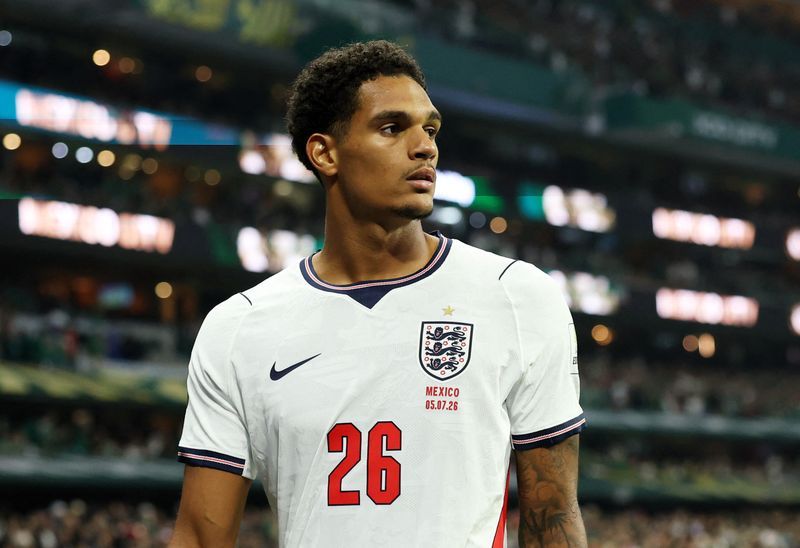
The controversy surrounding Folarin Balogun's suspension has spilled dramatically into the diplomatic arena, with British politicians now invoking the striker's case to press FIFA for a similar disciplinary concession for England defender Jarell Quansah. The intervention by Labour MPs Noah Law and Melanie Onn marks an unprecedented attempt to weaponise FIFA's own precedent against its own rulings, forcing the world governing body to confront questions about whether special treatment granted to one player will now be extended systematically across the tournament.
Quansah received a red card during England's thrilling 3-2 victory over Mexico at the Azteca Stadium, triggering an automatic one-match ban that would sideline him from crucial knockout stages. Both Balogun and Quansah face identical disciplinary circumstances—automatic suspensions following dismissals—yet the striker has already secured a reprieve through FIFA's Article 27 provision, which allows postponement of penalties under specific conditions. The mathematical symmetry of their situations has given Law and Onn powerful rhetorical ground to demand consistency, arguing that FIFA risks exposing its disciplinary framework as arbitrary and subject to external pressure if it applies different standards.
The elephant in the room remains Donald Trump's acknowledged conversation with FIFA president Gianni Infantino regarding Balogun's case. The American president's public admission that he contacted the FIFA chief has transformed what might have remained a routine disciplinary matter into a tournament-defining scandal questioning the independence of football's judicial processes. While Infantino insisted that FIFA's courts would operate without interference, the timing and nature of the presidential intervention have created an indelible perception of political leverage being exercised at the highest levels. For British politicians, this context makes the demand for Quansah's reprieve not merely about sporting fairness but about holding FIFA accountable to its stated principles of neutrality and impartiality.
Caroline Dinenage, chair of the House of Commons Culture, Media and Sport Committee, has escalated the political pressure by demanding urgent clarification from FIFA about its reasoning in the Balogun decision. Her intervention carries institutional weight, positioning parliamentary scrutiny as a tool to pressure the international body into transparent accountability. Dinenage framed the issue in terms that resonate beyond football, emphasising that sport's legitimacy fundamentally depends on equitable application of rules. The shadow being cast over the tournament, in her assessment, stems not from the disciplinary decisions themselves but from the perception that political influence might determine their outcomes—a far more corrosive problem for the integrity of international competition.
The English Football Association has indicated it is considering its options regarding potential appeals, though it has not yet formally requested a reprieve for Quansah. This cautious stance reflects the organisation's delicate position: too aggressive an appeal risks appearing opportunistic or politically motivated, yet inaction invites accusations that the FA is failing to advocate for its players when precedent exists. The FA's deliberation occurs against a backdrop where other European football authorities and politicians are watching closely, aware that FIFA's handling of consistency questions could establish templates for future disciplinary disputes throughout the tournament.
What distinguishes this moment in World Cup history is the explicit linkage between political intervention and sporting outcomes. Previous tournaments have witnessed disciplinary controversies, but rarely has a sitting head of state's direct communication with FIFA leadership become public knowledge and weaponised as evidence of systemic bias. The Balogun case has transformed FIFA's disciplinary procedures from technical matters handled by judicial panels into subjects of parliamentary inquiry and international diplomatic concern. Should FIFA grant Quansah's reprieve, it validates the argument that political pressure works; should it refuse, it exposes the appearance of selective application of its own precedents.
The consistency argument deployed by British MPs carries particular force because it relies entirely on FIFA's own framework rather than external standards. By citing Article 27 and the Balogun decision, Law and Onn are not asking FIFA to change its rules but to apply them uniformly. This rhetorical strategy makes FIFA's position increasingly untenable: the governing body cannot easily refuse without appearing to admit that criteria beyond the sporting merits influenced the Balogun decision, yet granting the request effectively validates the notion that political intervention shaped the original ruling. Either outcome reinforces problematic narratives about FIFA's autonomy and impartiality.
England's quarter-final fixture against Norway in Miami on Saturday provides an imminent deadline that intensifies the pressure on FIFA to respond. Should Quansah be forced to miss that match while bearing the knowledge that comparable political pressure secured relief for another player, the psychological and diplomatic fallout would extend far beyond the immediate sporting outcome. The timing creates a crucible where FIFA must either demonstrate consistent application of its rules or transparently acknowledge the differential treatment, neither of which presents an attractive option for an organisation already beleaguered by integrity questions.
For Malaysian and Southeast Asian audiences, this controversy illuminates broader questions about international governance and the vulnerability of supposedly independent institutions to political pressure. FIFA's struggles with maintaining judicial independence mirror challenges faced by other international bodies, raising concerns about whether transparent rules-based systems can survive when powerful actors engage directly with decision-makers. The Balogun-Quansah situation becomes a test case for whether international sport can credibly claim neutrality when politics infiltrates its highest levels, a question particularly resonant in regions where sovereignty and non-interference in domestic affairs remain foundational principles.
The controversy also reveals football's unique position as a domain where national pride, diplomatic relationships, and international law intersect. Unlike purely commercial or technical disputes, football decisions carry emotional significance and national implications that create incentives for political engagement. FIFA's judicial bodies face unprecedented pressure to demonstrate independence precisely when political actors are most motivated to intervene, creating a structural contradiction that no amount of procedural reform can easily resolve. The question becomes whether FIFA possesses the institutional strength to resist pressure or whether its authority ultimately derives from the acquiescence of powerful nations rather than inherent legitimacy.
As this tournament unfolds, the Balogun-Quansah matter may come to define debates about FIFA's future. Progressive reform advocates will cite it as evidence that the organisation requires genuinely independent, insulated disciplinary chambers protected from political influence. Defenders of FIFA's current structure will argue that the system functioned as intended, with Balogun's reprieve emerging from proper judicial assessment rather than external pressure. However, the very fact that such fundamental questions about FIFA's institutional integrity remain unresolved after Trump's acknowledged intervention suggests the governing body faces deeper legitimacy challenges extending far beyond two suspension decisions.

