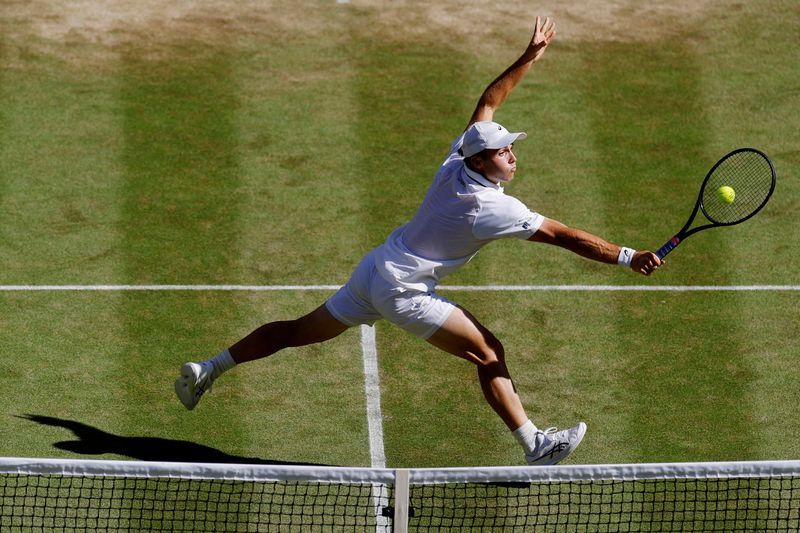
Arthur Fery's improbable journey at Wimbledon has reached an extraordinary crescendo, with the British wildcard now positioned to potentially celebrate his 24th birthday on Centre Court during the men's singles final on Sunday. The France-born player raised in London made his tournament debut on the famous grass court on Monday, continuing an unlikely run that has captivated audiences and offered British tennis fans a rare bright spot during this year's Championships.
Fery's progression through consecutive five-set thrillers has been nothing short of dramatic. His most recent triumph came against fellow wildcard and former world number three Grigor Dimitrov, secured 7-5 3-6 4-6 6-4 7-6(7) in a match that will be remembered as much for its intensity as for the star-studded audience in the Royal Box, including tennis legend Roger Federer. The contest unfolded against an unusual backdrop: the Royal Box appeared to function as something of a sporting amphitheatre on a day when England's football team defeated Mexico in the World Cup last-16 tie in Mexico City. The roar that erupted when Fery clinched match point reportedly rivalled anything heard at the prestigious venue in recent memory.
The journey to the quarter-finals has not been straightforward. In his third-round encounter with Zizou Bergs on Saturday, Fery found himself facing a seemingly insurmountable deficit, trailing by two sets to one while facing a double break down in the fourth. Playing through physical adversity that included successive nosebleeds, he nonetheless fought back to secure the longest match recorded at this year's tournament. His ability to remain composed under such pressure speaks to both his mental resilience and technical proficiency on the grass surface.
Fery's emergence as a serious contender becomes even more striking when viewed against the broader context of British participation at Wimbledon. Of the 19 British singles players competing in the tournament, 15 exited in the opening round, leaving Fery as an almost solitary standard-bearer for home hopes. This concentration of British fortunes upon a single player has transformed what might ordinarily be an interesting wildcard story into something approaching a national narrative, albeit one tinged with the poignancy that comes from single-country representation.
His next opponent will be world number ten Flavio Cobolli of Italy, though the two have already crossed paths recently. Fery defeated the Italian at this year's Australian Open, suggesting he possesses both the tactical knowledge and recent confidence to compete at the highest level. This prior encounter adds another layer to what promises to be a compelling quarter-final clash.
Fery's trajectory from outside the conventional tournament framework offers insights into contemporary professional tennis structure. Making his Stanford University education a springboard into global competition, he entered Wimbledon ranked 114th in the world. The two significant victories have already propelled him inside the top 70, demonstrating how elite performances at prestigious venues can rapidly reshape player rankings and international standing. His rise has not gone unnoticed by fellow professionals, particularly those who have trained alongside him.
American sixth seed Taylor Fritz offers an outsider's perspective on Fery's capabilities, having practiced extensively with the British player before last year's World Tour Finals. Fritz recalled being consistently beaten during baseline sessions and sets, leading him to conclude that Fery possessed substantial professional-level potential. He specifically praised Fery's forehand technique, describing his serve as exceptional for his physical frame. Fritz's observations came before Fery began competing regularly at tour level, suggesting that his current performances represent the emergence of capability that was already evident to astute observers within professional circles.
The emotional dimension of Fery's run deserves consideration alongside its competitive aspects. Having never previously played on Centre Court until this tournament, the magnitude of the occasion—combined with the stage being set for a potential final appearance—creates a narrative texture that extends beyond typical sporting achievement. Fery himself acknowledged this, suggesting that the memory of playing before such crowds in such circumstances may prove irreplaceable regardless of his ultimate fate in the tournament.
For Malaysian and Southeast Asian tennis enthusiasts, Fery's story holds particular resonance in demonstrating how international tennis competition remains accessible to players from diverse backgrounds and routes into professional sport. His wildcard status, combined with his unconventional path through Stanford rather than through traditional tennis academies, illustrates the expanded opportunities available in modern tennis. Furthermore, his performances highlight the continued importance of grass court specialisation—a surface where preparation and tactical acuity can sometimes outweigh raw rankings.
The broader implications for British tennis extend beyond individual matches. While the dominance of overseas players in British tournaments has long been a source of discussion within domestic sporting circles, Fery's presence demonstrates that home players can still capture significant stages when they combine preparation, resilience, and the crucial element of opportunity. His journey from ranked 114th to legitimate quarter-final contender within a single week exemplifies the compressed timescales and dramatic reversals possible in professional sport at its highest level.

