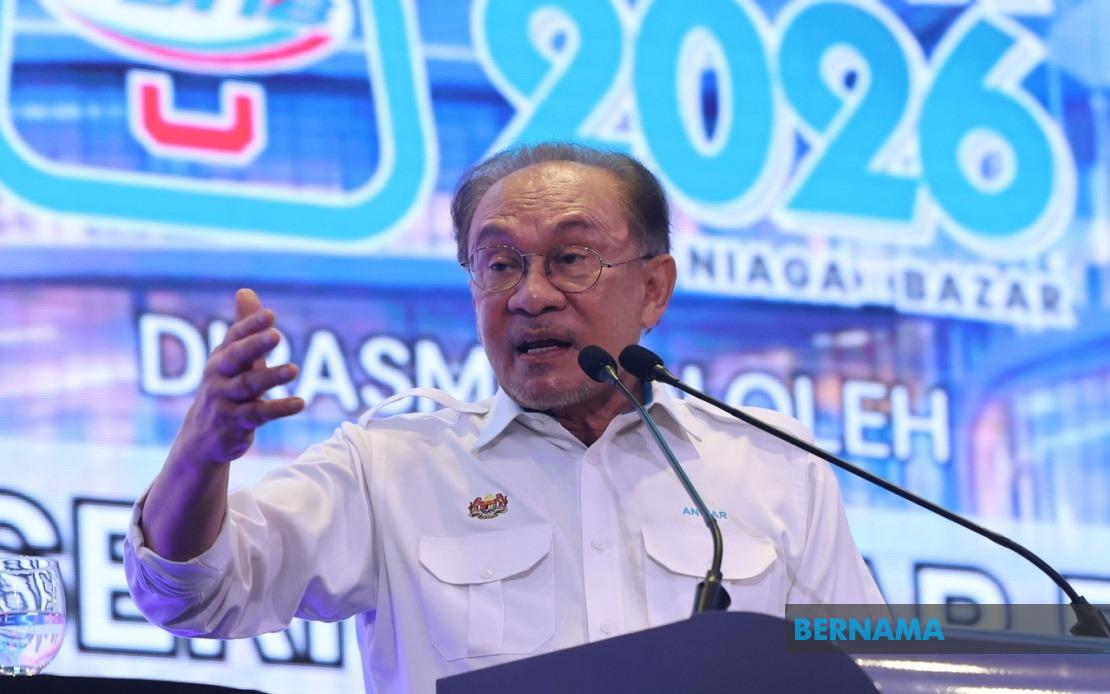
Prime Minister Datuk Seri Anwar Ibrahim has fundamentally reframed the approach to Bumiputera empowerment, declaring it no longer the exclusive domain of dedicated institutions but a comprehensive national mandate that demands coordinated action across the entire government machinery. Speaking at the SPaRK 2026 Business Transformation programme organized by Perbadanan Usahawan Nasional Bhd in Putrajaya, Anwar emphasized that every ministry, government agency, and government-linked company must actively contribute to advancing the Bumiputera development agenda. This represents a significant shift in governance strategy, moving away from compartmentalized responsibility towards integrated policy implementation.
The Prime Minister outlined the Bumiputera Economic Transformation Plan 2035, commonly abbreviated as PuTERA35, as the framework guiding this coordinated effort. Unlike previous approaches that often scattered related initiatives across multiple agencies, the new plan requires systematic monitoring and regular progress reporting from all participating government entities. This centralized tracking mechanism aims to ensure accountability while maintaining flexibility for individual agencies to tailor implementation strategies according to their operational mandates and sectoral priorities.
Critically, Anwar rejected suggestions to establish yet another dedicated Bumiputera agency, a position that carries significant implications for how Malaysia's bureaucratic structure evolves. The creation of new agencies, while ostensibly streamlining focus, often creates overlapping jurisdictions, duplicated efforts, and bureaucratic turf wars that ultimately slow down policy delivery. By choosing instead to fortify existing institutions, the government signals confidence in current structures while acknowledging that the bottleneck lies not in organizational design but in commitment and coordination across the administrative system.
The Prime Minister, who simultaneously holds the Finance Ministry portfolio, articulated a clear diagnosis of governance failure: continuing with traditional approaches while anticipating different outcomes represents an exercise in futility. This candid assessment suggests frustration with incremental reforms that leave underlying power structures and incentive systems unchanged. Strengthening existing agencies requires meaningful resource allocation, clearer performance metrics, and genuine empowerment for these institutions to execute Bumiputera objectives without seeking approval from a new central authority.
For Malaysian business communities and Bumiputera entrepreneurs, this shift carries substantial practical consequences. Rather than navigating a complex ecosystem of specialized agencies, stakeholders will theoretically interface with their respective sector ministries, which now bear explicit responsibility for integrating Bumiputera empowerment into their operational planning. This streamlined approach could accelerate access to support programmes, reduce administrative friction, and create clearer lines of accountability when promised initiatives fail to materialize.
Anwar's dual emphasis on economic growth and equitable wealth distribution reflects a delicate political and economic balancing act that dominates contemporary Malaysian policymaking. The government neither restricts ambitious entrepreneurs nor retreats from protecting those economically vulnerable, instead pursuing what the Prime Minister characterized as "raising the ceiling" while simultaneously "raising the floor." This framework acknowledges that inclusive growth requires both creating opportunities for wealth generation across society and ensuring safety nets for vulnerable populations.
The inclusivity imperative extends beyond traditional Bumiputera considerations to encompassing emerging economic frontiers. Anwar explicitly referenced cutting-edge sectors including artificial intelligence, quantum computing, digital economy transformation, and energy transition initiatives. Rather than viewing Bumiputera empowerment as confined to conventional businesses, the government evidently envisions indigenous entrepreneurs participating meaningfully in tomorrow's technology-driven economy. This forward-looking stance suggests recognition that leaving Bumiputera participation concentrated in mature sectors would entrench economic marginalization as global competition intensifies.
Yet translating this aspirational framework into consistent implementation across a sprawling bureaucracy presents formidable challenges. Individual ministries must reconcile competing priorities, budget constraints, and established relationships with incumbent players while suddenly prioritizing Bumiputera integration. Without enforcement mechanisms, performance incentives clearly linked to Bumiputera outcomes, and resources matched to ambition, ministries may pay lip service to the agenda while continuing existing practices. The success of Anwar's approach ultimately hinges on whether the Finance Ministry leverages budget allocation, monitoring systems, and political pressure to transform rhetorical commitment into measurable action.
From a Southeast Asian perspective, Malaysia's experience offers instructive lessons for nations grappling with similar tensions between growth maximization and inclusive development. Thailand, Indonesia, and the Philippines all struggle with analogous challenges regarding indigenous entrepreneurship, regional economic disparities, and fair opportunity distribution. Malaysia's pivot towards whole-of-government Bumiputera responsibility, if successfully implemented, could demonstrate that systemic coordination generates better outcomes than institutional proliferation.
The PuTERA35 framework also reflects underlying economic anxieties within Malaysia's policymaking circles. Global economic disruption, technological displacement, and intensifying regional competition have created urgency around ensuring that Bumiputera communities remain economically relevant and resilient. Simply maintaining historical arrangements while the global economy transforms would accelerate relative decline for those communities. Accordingly, the government's insistence on Bumiputera participation in high-technology and emerging sectors represents prudent long-term positioning rather than tokenistic inclusivity.
Implementation mechanisms remain crucial to assess the genuine transformative potential of this approach. Anwar's emphasis on regular monitoring and progress reporting suggests the government recognizes that aspirational statements without tracking systems remain mere rhetoric. Whether reporting requirements generate meaningful consequences for underperforming agencies, how performance metrics adapt to changing economic conditions, and whether political will remains constant across multiple electoral cycles will determine whether PuTERA35 represents sustainable reorientation or another initiative subsequently superseded by successor administrations.

