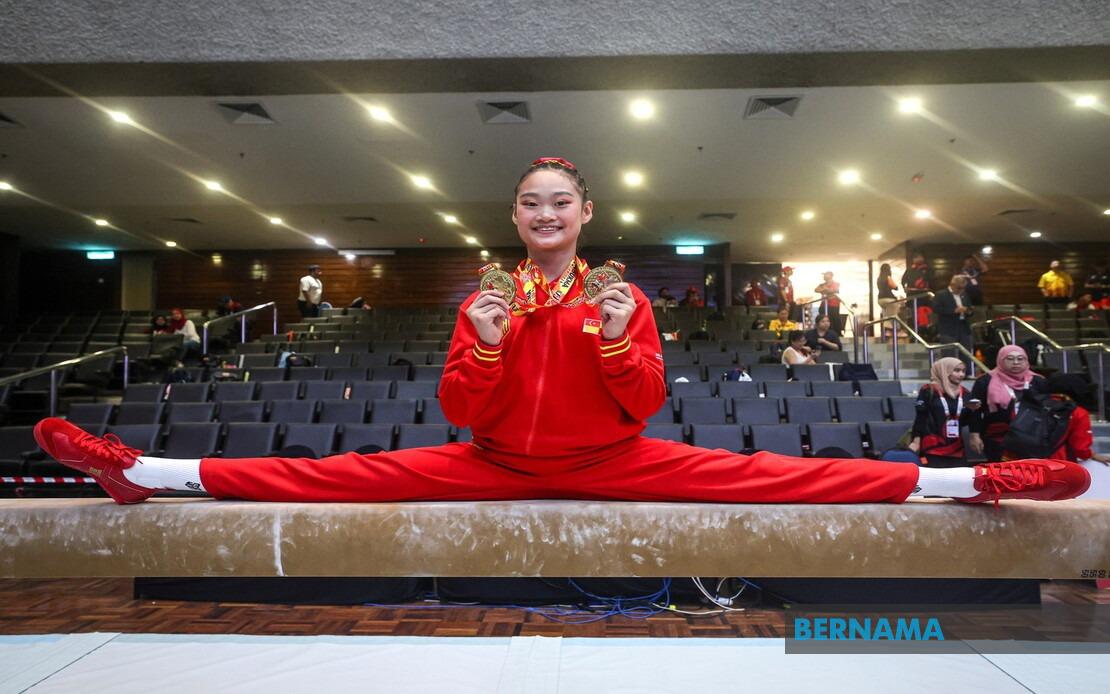
The Selangor artistic gymnastics contingent delivered a commanding performance at the Malaysia Games (SUKMA) 2026 when 17-year-old Cadence Teh Zi Qi secured back-to-back gold medals at the competition held at Dewan Canselor Tun Abdul Razak (DECTAR), Universiti Kebangsaan Malaysia (UKM) in Bangi. Teh's dominant display on Monday saw her successfully retain the women's individual all-around title with a score of 48.550 points, whilst simultaneously helping Selangor capture the team gold with a collective score of 169.300 points across six competitors. The dual triumph underscores the depth of artistic gymnastics talent emerging from Malaysia's most developed state and highlights Teh's trajectory as one of the nation's premier gymnasts.
Teh's all-around victory was built on a well-rounded performance across the four apparatus disciplines. She posted 12.050 points in vault, 11.400 on uneven bars, 13.350 on balance beam, and 11.750 in floor exercise. Notably, her balance beam performance of 13.350 was the standout achievement, suggesting particular strength in the apparatus that demands both technical precision and psychological composure. The vault score reflected a deliberate tactical choice rather than a technical limitation, a decision that would later inform her own analysis of the competition. Her overall margin of superiority was substantial, with nearest rival Aurin Zulkarnain of Sarawak finishing significantly behind on 44.500 points. Third place was jointly contested between Federal Territories' Annabelle Ho Syin Yee and Penang's Amanda Ching Lee Wern, both recording 42.250 points.
Beyond the individual accolade, Teh's integration into Selangor's team squad proved equally influential. Paired with teammates Nicole Wong Ziyi, Airisha Zuraidi, Wong Zi Qi, Leong Yee Shean and Haifa Izzazi Mohd Faizul, the group accumulated the commanding team total that positioned Selangor well ahead of competitors. Federal Territories mounted a respectable challenge with 166.300 points, whilst Johor claimed the bronze medal position with 157.000 points. The 3.000-point differential between Selangor and Federal Territories represents a considerable advantage in team gymnastics, where margins tend to compress across high-performance units.
Teh's own candid post-competition assessment revealed the psychological dimensions of elite gymnastics competition. She disclosed that her opening apparatus rotation on uneven bars proved unsettling, resulting in a fall that could have derailed her entire championship pursuit. Rather than allowing that early setback to compound through subsequent rotations, she demonstrated considerable mental resilience by compartmentalising the error and refocusing her concentration on the remaining three apparatus. This ability to reset and recover is often the differentiating factor between medal-winning performances and disappointing finishes in all-around formats, where fatigue and mental fatigue accumulate across a full session of four events.
Teh explained to reporters that her nerves during the uneven bars segment prevented her from achieving the bodily awareness and kinesthetic feedback necessary for flawless execution. Once she transitioned to balance beam, her performance trajectory shifted markedly upward. She credited her beam routine as being "a lot better" and acknowledged that floor exercise unfolded largely as anticipated, suggesting neither surprise nor disappointment in that segment. Her approach to vault reflected deliberate strategic calibration rather than avoidance of difficulty; she specifically decreased her intended vault difficulty to execute a Tsukahara pike, a decision that prioritised a more reliable execution over higher technical value.
Looking ahead to the apparatus finals scheduled for Tuesday and Wednesday, Teh faces competing programmes across uneven bars, balance beam and floor exercise. These finals events offer additional opportunities for medal accumulation and provide a window into her developmental trajectory ahead of higher-stakes international competition. The continuation of her campaign over the coming days will furnish insight into whether Monday's performance represented her peak output during SUKMA 2026 or whether she can sustain and potentially elevate her standards across the specialist events.
Teh's developmental ambitions extend beyond the immediate SUKMA platform. She disclosed that she has specifically elevated the difficulty of her balance beam routine to align with the technical specifications she intends to employ at the 2026 Asian Games. This forward-planning approach suggests a coaching structure that integrates SUKMA 2026 as a meaningful development checkpoint within a broader competitive calendar rather than treating the Games as an isolated destination. By intentionally pushing her beam complexity at SUKMA, she gains valuable competition experience with advanced routines before the more prestigious Asian Games environment.
The gymnast identified areas requiring continued refinement, particularly emphasising the importance of improved nerves management and sustaining concentration through extended competition sessions. For Malaysian gymnastics, which has historically produced solid performers at regional level but has struggled to penetrate elite international standings, the emergence of athletes demonstrating both technical capability and psychological awareness represents a positive trend. Teh's willingness to discuss her vulnerabilities—the uneven bars fall, the nervousness that affected her performance—suggests a coaching philosophy that emphasises continuous improvement rather than concealing struggles.
The Selangor artistic gymnastics programme's dual-medal performance at SUKMA 2026 carries implications for the state's sporting investment strategy and talent pipeline development. Producing competitors capable of simultaneous excellence in both individual all-around and team contexts requires comprehensive coaching infrastructure, access to quality training facilities, and sustained financial commitment. DECTAR at UKM provides a suitable competitive venue, but the underlying development system that produces athletes of Teh's calibre involves years of foundational training, competition experience, and psychological preparation.
For Malaysian gymnastics more broadly, performances such as Teh's gold medal retention and team victory at SUKMA 2026 establish benchmarks against which future editions can be measured. The sport's marginal profile within Malaysia's broader sporting consciousness means that SUKMA remains one of the primary platforms for generating domestic interest and supporting talent development infrastructure. Teh's trajectory—from emerging competitor to defending all-around champion within the SUKMA cycle—demonstrates that genuine sporting progression is occurring within the discipline, even as the sport remains substantially underfunded relative to mass-participation activities.

