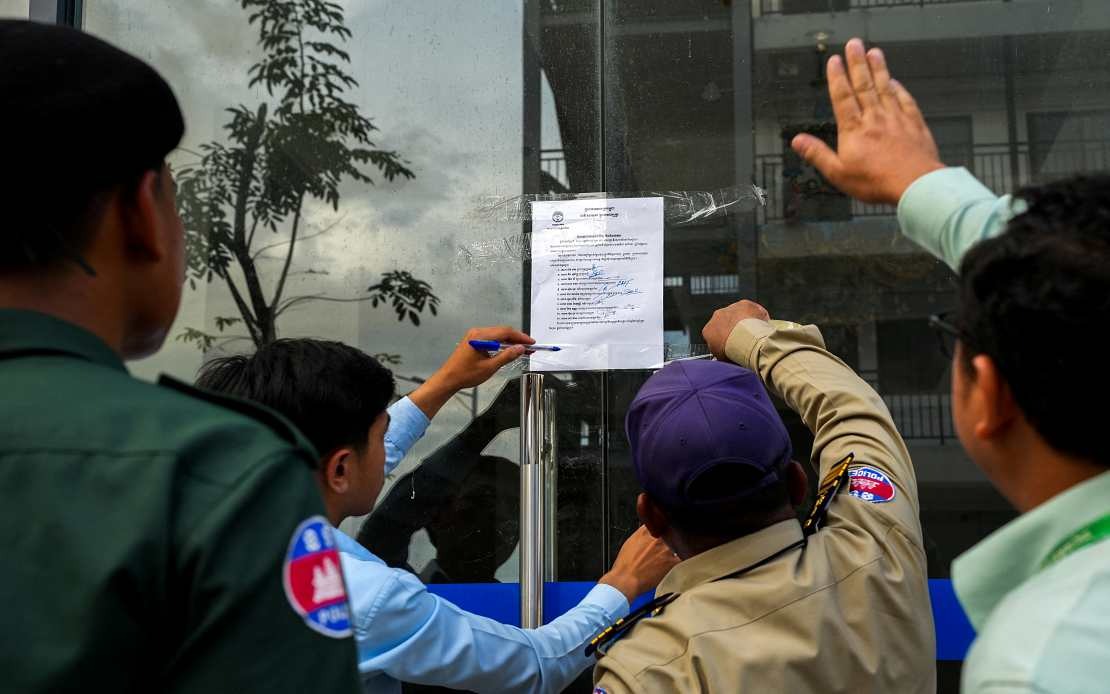
Cambodia has expelled more than 16,000 foreigners suspected of orchestrating online fraud schemes during the opening six months of 2026, marking a significant escalation in the Southeast Asian nation's fight against cybercriminal networks. Police Lieutenant General Sok Veasna, who leads the General Department of Immigration, disclosed this figure at a mid-year review session on Tuesday, revealing that the deportation campaign forms part of a broader enforcement initiative launched in January targeting internet-based criminal activity across the kingdom.
The scale of deportations underscores Cambodia's determination to address a problem that has severely tarnished its international standing. In total, more than 45,000 foreign nationals were removed from Cambodia during this six-month window, with cyber-scam suspects constituting roughly one-third of that figure. All individuals subject to deportation have been permanently barred from re-entering the country, establishing a deterrent mechanism intended to discourage future criminal elements from exploiting Cambodia's territory as an operational base.
The enforcement push reflects mounting regional and global pressure on Southeast Asian governments to dismantle sophisticated scam networks that have victimised citizens across Asia, North America, and Europe. These operations, frequently staffed by foreign nationals working under local criminal syndicates, utilise digital infrastructure to perpetrate romance scams, investment fraud, and cryptocurrency theft on an industrial scale. The economic losses attributable to such schemes have risen dramatically, prompting diplomatic complaints from several nations and becoming a priority security concern for ASEAN member states.
Cambodia's legislative response has paralleled its enforcement actions. In April, the kingdom enacted the Law on Combating Online Scams, a comprehensive statute that introduces severe penalties for online operators, ringleaders, and organisational hierarchies involved in digital fraud. This legal framework signals the government's intent to prosecute not merely foot soldiers within these networks but the architects and managers who coordinate operations across borders and orchestrate the movement of personnel and illicit proceeds.
However, observers caution that deportations alone cannot solve the underlying structural vulnerabilities that make Cambodia attractive to criminal enterprises. Thong Mengdavid, deputy director at the China-ASEAN Studies Centre of the Cambodia University of Technology and Science, characterises the mass removal of suspected scammers as a necessary but insufficient intervention. While welcoming the step as overdue and valuable for restoring Cambodia's tarnished reputation internationally, he emphasises that temporary removals of frontline operatives do little to dismantle the sophisticated infrastructure supporting these criminal organisations.
According to Mengdavid's analysis, genuine progress requires targeting the upper echelons of these networks—the kingpins and masterminds who finance, coordinate, and profit from large-scale operations. Equally critical is dismantling the local protection apparatus that permits scam networks to establish themselves in the first place. Corruption among Cambodian officials, inadequate cybercrime investigation capacity, and weak legal enforcement have historically created safe havens for foreign criminal syndicates seeking jurisdictions with limited capacity or will to interrupt their activities.
The human trafficking dimension further complicates Cambodia's response. Many foreigners implicated in cyber-scam operations have themselves been drawn into criminal networks through coercion, debt bondage, or deception regarding employment terms. These individuals arrive in Cambodia under false pretences, only to find themselves compelled to participate in fraud schemes under threat. Addressing the supply of labour to these networks therefore requires tackling trafficking routes, organised crime groups facilitating movement, and the documentation fraud that enables international transit.
For regional observers, Cambodia's campaign carries implications extending well beyond Phnom Penh. The concentration of cybercriminal infrastructure in Southeast Asia has become a competitive advantage for criminal organisations operating globally. Other nations in the region, alongside international law enforcement agencies, have expressed concern that disruption in one location may simply displace operations to alternative jurisdictions. This suggests that lasting solutions require coordinated regional approaches, intelligence sharing, and harmonised legal standards across ASEAN.
The deportation strategy also raises questions about the sustainability and equity of enforcement. While removing foreign operatives addresses visible manifestations of organised cybercrime, the absence of parallel prosecutions and asset recovery targeting local complicit officials and business partners may create perceptions of selective justice. Building public confidence in Cambodia's anti-scam campaign requires demonstrating that domestic elites facilitating these networks face accountability equivalent to that imposed on foreign workers.
Malaysia and other Southeast Asian nations have watched Cambodia's response closely, recognising that cybercriminal networks frequently operate across borders. Victims in Malaysia have suffered significant losses to scam operations headquartered or managed from Cambodia, making bilateral cooperation essential. Cambodia's Law on Combating Online Scams and its enforcement actions create potential frameworks for enhanced information sharing and joint investigations, though practical collaboration remains dependent on sustained political will and adequate resource allocation.
Moving forward, Cambodia faces the challenge of maintaining momentum in its anti-cybercrime campaign while addressing the structural factors that permitted criminal networks to establish themselves. The distinction between temporary deportations and permanent dismantling of criminal infrastructure will ultimately determine whether the current crackdown represents a turning point in restoring Cambodia's international reputation or merely a cyclical enforcement spasm.

