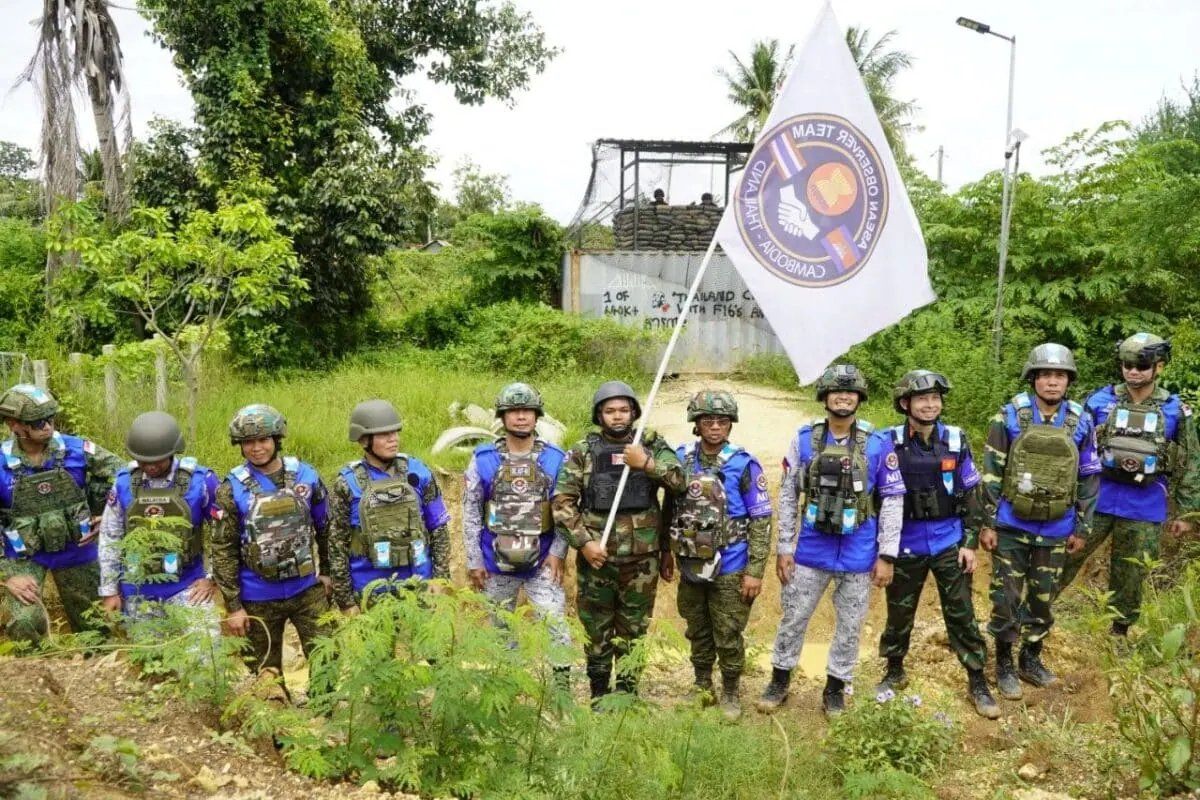
The diplomatic tension between Cambodia and Thailand over their contested border has evolved into a battle over who controls the narrative of ground reality. Cambodia's Information Minister Neth Pheaktra moved this week to reframe the dispute by emphasizing that international observers are now documenting the physical conditions both nations claim represent either legitimate security measures or unlawful occupation. His statement directly challenged Air Chief Marshal Prapas Sornchaidee's assertion that Thailand is merely protecting troops and civilians in territory Bangkok considers its own, not encroaching on Cambodian land.
The fundamental disagreement hinges on how territorial sovereignty should be established and what role military deployment plays in that determination. Thailand's position, articulated through its Joint Information Center, maintains that security infrastructure and troop presence do not constitute boundary demarcation, and that questions of sovereignty must instead be resolved through legal mechanisms including maps, documentary evidence, and the Joint Boundary Commission (JBC). On the surface, this principle aligns with Cambodia's own stated preference for resolving the border through agreed technical and legal processes rather than military fait accompli. However, Cambodia contends that Thailand is precisely establishing such facts on the ground by maintaining military fortifications, constructing roads, and erecting physical barriers in areas Phnom Penh claims as Cambodian territory.
What marks a significant shift in this decades-long dispute is the expanded cast of external witnesses. Cambodia's strategic move involves citing the observations of the Asean Observer Team in Cambodia (AOT-KH), UN officials, and accredited diplomats as independent verification of the contested conditions. This transforms what might otherwise remain a bilateral dispute characterized by competing assertions into an issue with documented, third-party evidence. Pheaktra's emphasis on "the eyes of third parties" signals recognition that international credibility increasingly depends on whether neutral observers can independently confirm or refute claims made by either side.
The Asean Observer Team recently completed inspections of three affected areas in Banteay Meanchey province, led by its Philippine mission head. At Boeung Trakuon in Kouk Romiet commune, the observers documented forty-four shipping containers positioned across fourteen locations, behind which Cambodia maintains that 7,873 residents from 1,869 families remain displaced and unable to return home. The team also inspected Chouk Chey and Prey Chan villages, where seventy-two additional containers were catalogued across ten locations. In total, these three sites contain 116 containers spread across 24 positions, with Cambodia asserting that 13,259 people, including 3,416 children, cannot access their homes. These are not merely Cambodian government statistics but independently observed configurations that external monitors have now placed on record.
The presence of such documentation carries diplomatic weight in Southeast Asian forums precisely because Asean consensus-building typically depends on establishing shared factual bases. However, the limitations of these observations merit consideration. The Asean Observer Team's mandate is to monitor ceasefire compliance, not to determine sovereignty or adjudicate territorial claims. Similarly, UN Special Rapporteur on human rights in Cambodia Tom Andrews, who visited the border region in July and subsequently reported that approximately 650,000 Cambodians were displaced during the conflict with more than 20,000 remaining unable to return, operates within a human rights framework rather than a territorial law framework. Andrews documented accounts from civilians claiming they cannot safely return to homes in areas controlled by Thai security forces, but his authority extends to human rights documentation, not boundary determination.
Cambodia nevertheless leverages these observations strategically to establish that the situation is not simply a matter of competing Cambodian and Thai versions of events. Pheaktra's statement that "shipping containers are not border markers, barbed wire is not a treaty, trenches are not boundary maps, and planting a flag is not a title deed to territory" articulates the philosophical position underlying Cambodia's argument. The government contends that whatever security justification Thailand may cite, unilateral alteration of conditions in territory Cambodia claims cannot be reconciled with the principle that boundaries must be determined through legal mechanisms, not military control.
Thailand's response, predictably, maintains that neither country can determine sovereignty through declarations alone and that Bangkok will continue protecting what it considers Thai territory and troops. Prapas's acknowledgment that security infrastructure cannot determine boundaries appears to provide common ground, yet the two nations apply this principle diametrically. Cambodia interprets it as meaning Thailand should not establish military positions and infrastructure in disputed zones, while Thailand interprets it as meaning that Thai security measures in areas Bangkok considers its own do not prejudice a future technical boundary determination. This fundamental disagreement over which nation's interpretation of "its territory" is correct remains unresolved and represents the core of the dispute.
The legal basis for Cambodia's territorial claims rests on a framework of colonial-era treaties and modern agreements. Cambodia points to the Franco-Siamese treaties and conventions that historically delimited the border, historical maps and boundary documents, the 2000 Cambodia-Thailand Border Memorandum of Understanding, the 2003 Terms of Reference, and the ongoing JBC process as the appropriate mechanisms for final determination. This construction reflects the principle that land boundaries in Southeast Asia, particularly in regions colonized or influenced by European powers, derive legitimacy from documented agreements and cartographic evidence rather than from military occupation or administrative practice.
The intersection of the territorial dispute with humanitarian concerns adds another dimension to the conflict. Cambodia links the disputed border areas to Point 4 of the December 27 ceasefire agreement, which stipulates that affected civilians must be able to return to their homes on their respective sides "without obstruction and in safety and dignity." From Phnom Penh's perspective, the continuing displacement of thousands of Cambodians behind shipping containers and barriers represents not merely a territorial issue but a violation of ceasefire commitments. The government argues that a ceasefire agreement does not grant either party license to create new facts on the ground or to maintain populations in permanent displacement.
For Malaysian and broader Southeast Asian audiences, this dispute carries significance beyond Cambodia-Thailand bilateral relations. The case illustrates how Asean states navigate disputes involving competing sovereignty claims without mechanisms for authoritative third-party adjudication. The emphasis on independent observation and documentation reflects the broader difficulty that Asean faces in addressing internal conflicts: member states resist external intervention while disputes fester. The reliance on Asean Observer Teams and UN human rights rapporteurs as sources of legitimacy suggests that when bilateral mechanisms fail, regional organizations may gradually acquire quasi-judicial functions not formally granted to them.
Moreover, the dispute underscores how military presence and infrastructure gradually establish de facto control that becomes difficult to reverse, regardless of ultimate legal determination. Thailand's argument that current activities do not prejudice boundary determination provides diplomatic cover for establishing physical facts that future boundary commissions will inherit as givens. Cambodia's counter-strategy of invoking external witnesses aims to create pressure against further consolidation of Thai control while reserving legal claims for future resolution. Neither strategy appears likely to produce resolution in the near term, as fundamental disagreements over which nation controls specific territories remain unresolved despite decades of negotiation.
The role of international observation, as emphasized by Pheaktra, may gradually strengthen Cambodia's diplomatic position by creating documented records that regional organizations and UN bodies can reference. However, such observation falls short of enforcement mechanisms that would compel Thai withdrawal or prevent further Thai military consolidation. The dispute thus remains frozen in a state where both sides maintain mutually incompatible claims, external monitors document conditions that each side interprets to support its position, and the legal machinery of boundary determination remains stalled. Cambodia's strategy of bringing third-party witnesses into the narrative represents an evolution in tactics rather than a breakthrough toward resolution.

