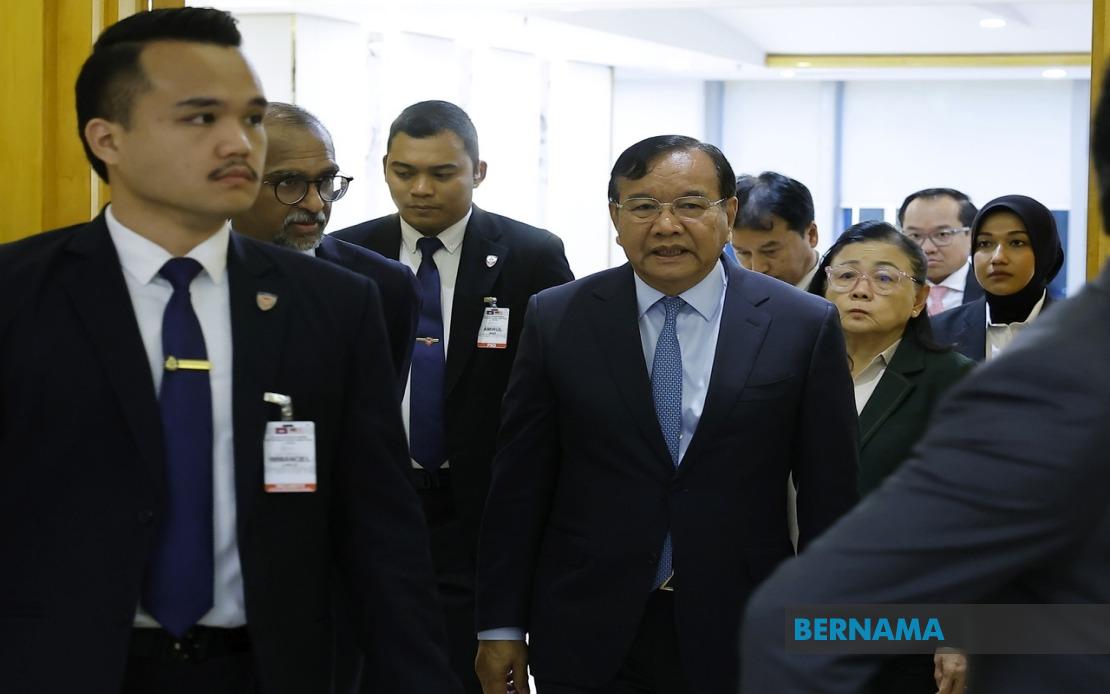
Cambodian Deputy Prime Minister and Foreign Minister Prak Sokhonn departed Malaysia on Sunday afternoon, concluding a two-day official visit that yielded significant developments in bilateral relations between the two Southeast Asian neighbours. Sokhonn and his accompanying delegation left Kuala Lumpur International Airport's Terminal 1 at 4.45 pm aboard a commercial flight returning to Phnom Penh, with Malaysian Government protocol officer Datuk Rozainor Ramli attending the farewell ceremony.
The timing of Sokhonn's visit carried symbolic importance, as it took place amid preparations for the landmark 70th anniversary celebration of Malaysia-Cambodia diplomatic relations scheduled for 2027. This milestone underscores the depth of institutional ties spanning seven decades, a relationship that has weathered regional political changes and emerged as a cornerstone of Southeast Asian stability. The visit represented both a celebration of historical bonds and a forward-looking effort to deepen contemporary cooperation across multiple domains.
During his stay, Sokhonn met with Prime Minister Datuk Seri Anwar Ibrahim at the Prime Minister's Office, a high-level engagement that signals the priority both governments place on their bilateral relationship. The two leaders took the opportunity to reaffirm Malaysia and Cambodia's longstanding partnership while charting pathways for expanded strategic cooperation. Their discussions ranged across emerging economic sectors including the digital economy and artificial intelligence, areas where both nations recognise competitive advantages and complementary strengths within the broader regional context.
Beyond technology, the bilateral agenda encompassed the halal industry, food security, and human capital development—issues reflecting shared vulnerabilities and mutual growth aspirations. The emphasis on halal commerce is particularly notable given Malaysia's established position as a global halal standards authority and Cambodia's growing interest in capturing halal market opportunities. Food security discussions acknowledge regional anxieties about supply chain resilience, while human capital development initiatives respond to both countries' labour market needs and demographic challenges.
The most consequential outcome of Sokhonn's visit was the co-chairing of the 3rd Malaysia-Cambodia Joint Commission for Bilateral Cooperation (JCBC) Meeting with Malaysian Foreign Minister Datuk Seri Mohamad Hasan. This event marked a watershed moment in bilateral institutional relations: the JCBC's resumption after a twenty-year dormancy signals a mutual commitment to formalised diplomatic coordination and demonstrates that both governments view the other as a priority partner worthy of sustained engagement mechanisms.
The revival of this commission represents more than ceremonial renewal. The two-decade gap in JCBC meetings reflects earlier periods when bilateral relations operated at a lower intensity, constrained by regional tensions, domestic political transitions, or competing regional priorities. Its reactivation suggests both nations have resolved to move beyond episodic engagement toward systematic coordination, creating structured forums for addressing shared challenges and pursuing joint opportunities.
Economic indicators validate this political momentum. Malaysia and Cambodia achieved remarkable trade growth in 2025, with bilateral commerce surging 27.4 per cent year-on-year to reach RM5 billion (USD1.17 billion). Malaysian exports to Cambodia accounted for RM4.13 billion (USD970 million) of this total, while Cambodian goods entering Malaysian markets totalled RM880 million (USD200 million). This trade expansion suggests increasing economic interdependence and demonstrates that institutional cooperation translates into tangible commercial benefits for businesses in both countries.
Malaysia's investment footprint in Cambodia further illustrates the depth of economic integration. As of 2024, Malaysia had accumulated USD3.20 billion (RM13.07 billion) in cumulative foreign direct investment across 162 registered projects, positioning Malaysia as Cambodia's third-largest foreign investor. This investment concentration reflects investor confidence in Cambodia's economic trajectory and the comparative advantage Malaysian enterprises perceive in the Cambodian market. The portfolio likely spans manufacturing, agriculture, services, and increasingly, technology sectors.
For Malaysian policymakers and business communities, this visit carries implications extending beyond bilateral relations. Cambodia represents both a market opportunity and a strategic anchor in mainland Southeast Asia. As Malaysia navigates regional geopolitical complexities and pursues its own economic transformation, deepening ties with Cambodia helps secure supply chains, diversify export markets, and establish Malaysia as a trusted development partner within ASEAN.
From Cambodia's perspective, the renewed bilateral focus with Malaysia offers access to capital, technology, and market expertise, while positioning the Kingdom as a credible regional actor capable of managing significant partnerships. The JCBC's revival signals to investors and regional peers that Cambodia maintains the institutional capacity for sustained international engagement.
Looking ahead toward 2027's anniversary celebrations, both governments face an opportunity to construct a forward-looking bilateral vision that transcends nostalgic commemoration. The economic momentum and revitalised institutional frameworks established during this visit provide a foundation for deepening integration across sectors, whether through expanded trade agreements, enhanced labour mobility protocols, or collaborative regional initiatives.
The visit also reflects broader Southeast Asian dynamics, where bilateral mechanisms between ASEAN members serve as vital counterweights to multilateral forums that sometimes move slowly. Malaysia and Cambodia's revival of their joint commission demonstrates that sub-regional partnerships remain relevant tools for advancing shared interests in an era of complex geopolitics and rapid economic change.

