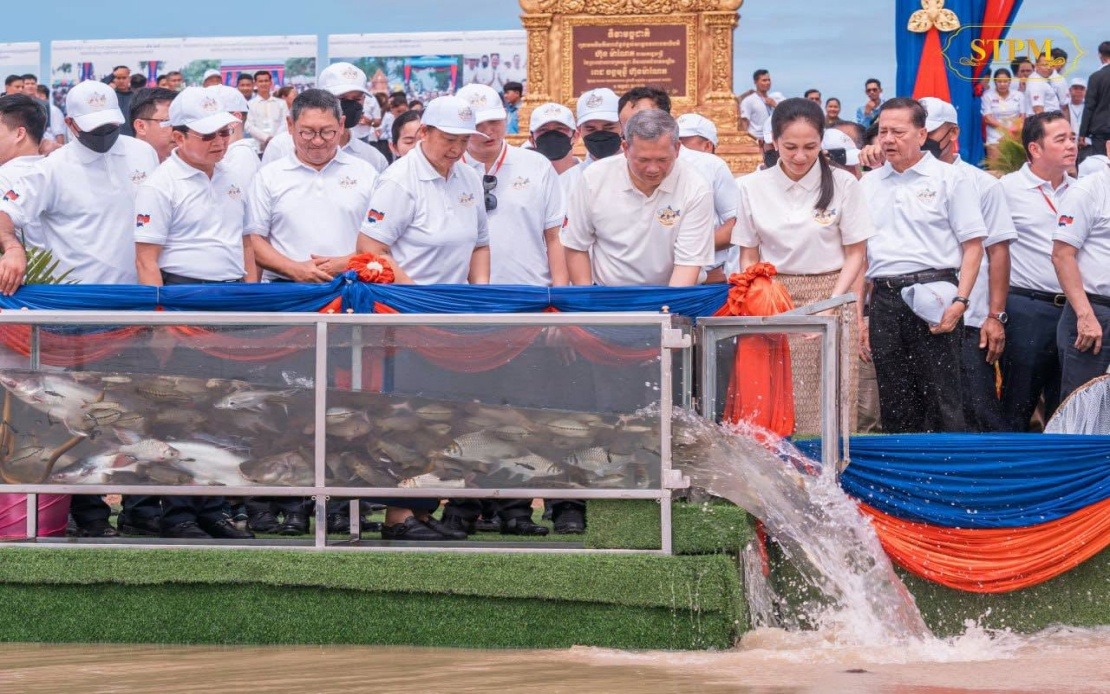
Cambodia's Prime Minister Hun Manet has issued a directive to strengthen enforcement against illegal fishing operations in designated fish spawning zones, marking an escalation in the government's efforts to safeguard the nation's aquatic resources. Speaking at the National Fish Day celebrations held in Svay Rieng Province on Wednesday, Hun Manet underscored the critical importance of protecting marine and freshwater ecosystems that form the backbone of Cambodia's food security and rural economies. The announcement reflects growing regional concern over unsustainable fishing practices that threaten fish populations across Southeast Asia, an issue particularly acute in the Mekong River system and surrounding waters that Cambodia depends upon.
The Prime Minister specifically tasked military units stationed around Tonle Sap, Southeast Asia's largest freshwater lake and a crucial fish habitat, with intensifying their operations against resource-related crimes. This reliance on armed forces stems from a systemic shortage of specialized law enforcement personnel trained specifically in natural resource protection and marine conservation. Hun Manet acknowledged this structural constraint, noting that Cambodia has historically lacked sufficient civilian officers with expertise in combating wildlife and resource trafficking. The military deployment represents a pragmatic interim solution, though the government hopes eventually to establish dedicated civilian enforcement agencies to reduce the burden on defence forces.
A particular concern highlighted by Hun Manet involves large-scale clam dredging operations that devastate seabed habitats and undermine the economic viability of traditional fishing communities. By ordering an immediate cessation of such destructive practices, the government signals a shift toward stricter environmental stewardship. These dredging activities have long been criticized by conservation groups as causing irreversible damage to aquatic ecosystems while generating minimal benefit for local populations. The Prime Minister's direct order reflects political will at the highest level to challenge economically powerful interests engaged in exploitative resource extraction.
Over the past two years, Cambodia's military has expanded its mandate beyond traditional security concerns to encompass environmental protection, operating enforcement campaigns both inland and in maritime zones. This broader role acknowledges that resource crimes—including illegal logging, wildlife trafficking, and unrestricted fishing—pose threats to national stability and economic resilience comparable to conventional security challenges. The integration of environmental enforcement into military operations is commonplace across Southeast Asia, where weak institutional capacity and porous borders make organized environmental crime difficult to combat through civilian agencies alone.
The government's strategic vision positions fisheries as providing essential protein for the nation's population while agriculture represents Cambodia's foundational food production. This dual-pillar approach to food security reflects the reality that roughly 75 percent of Cambodia's population relies directly or indirectly on fisheries, particularly in rural provinces where alternative livelihoods remain limited. Protecting fish stocks therefore extends far beyond environmental concerns, constituting a fundamental matter of national social stability and poverty reduction. Climate change and rising water demand upstream threaten fish populations independently, making illegal fishing control an increasingly pressing policy priority.
The timing of these directives at National Fish Day—an annual celebration of Cambodia's fishing heritage—carries symbolic importance beyond administrative functionality. By using the platform to announce enforcement measures, Hun Manet signals to fishing communities that their sector receives government protection and investment in sustainable management. Such messaging proves crucial in regions where informal economies and customary practices have historically operated outside formal regulatory frameworks. Fishermen who view themselves as stakeholders in resource protection become potential partners in enforcement rather than obstacles to it.
In a concrete demonstration of commitment, authorities released 1.5 million fish and other aquatic species into the Vai Ko River in Svay Rieng Province during the celebrations. Fish restocking initiatives serve multiple functions: they partially compensate for population depletion caused by overfishing, provide visible evidence of government action, and create renewed fish populations that enhance catch prospects for licensed fishermen. While restocking cannot substitute for enforcing harvest restrictions and habitat protection, it represents an acknowledgment that Cambodia's fish populations require active intervention and management rather than passive conservation alone.
The regional context amplifies Cambodia's policy significance. The Mekong River Commission, of which Cambodia is a member, has repeatedly warned that illegal fishing combined with dam construction and climate impacts threatens the livelihoods of millions across Southeast Asia. Cambodia's effort to strengthen domestic enforcement mechanisms may influence neighboring countries to intensify their own efforts, potentially creating a cascade of regional improvements. Conversely, if Cambodia's crackdown proves ineffective or inadequately resourced, it could validate arguments by fishing communities that protection measures cannot succeed without coordinated international cooperation.
Implementation challenges remain substantial. Corruption within enforcement agencies, inadequate equipment and training, and the economic desperation driving many illegal fishers all pose obstacles to success. Military units typically lack the specialized knowledge required for effective environmental protection, and their involvement occasionally results in heavy-handed responses that generate community resistance rather than cooperation. The sustainability of this approach depends on complementary investments in alternative livelihoods for vulnerable communities and institutional reforms that reduce opportunities for officials to collude with illegal operators.
Looking forward, Cambodia's fisheries policy will test whether military enforcement combined with symbolic political commitment can achieve meaningful conservation outcomes in developing nations where institutional capacity remains constrained. Success would demonstrate a viable model for other Southeast Asian countries facing similar pressures on marine resources. Failure could reinforce skepticism about enforcement-focused approaches, directing attention instead toward demand-side interventions such as market restrictions on illegally caught fish and international agreements limiting fishing access.

