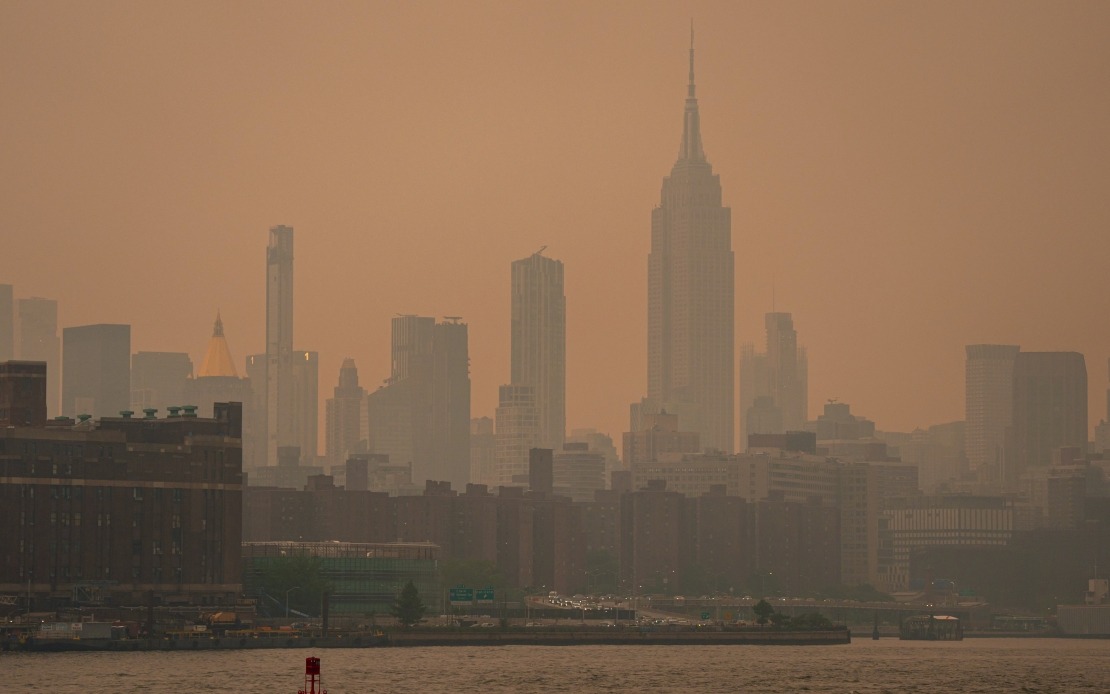
Mexican President Claudia Sheinbaum's journey to attend the Argentina-Spain World Cup final in East Rutherford, New Jersey, ran into unexpected turbulence on Saturday when deteriorating air quality forced cancellation of her scheduled flight from Cancún. The disruption underscored the far-reaching consequences of the Canadian wildfire crisis that has blanketed much of eastern North America in haze and smoke over recent days, creating hazardous conditions for aviation and public health across the region.
The president's initial itinerary called for departure from Cancún on Saturday with arrival in New York in time for Sunday's match. However, poor visibility and air quality measurements made the commercial route untenable, prompting a two-hour delay that eventually gave way to complete cancellation. Rather than abandon her attendance at what would be a historic multilateral occasion, Mexican authorities pivoted to alternative arrangements, ultimately deploying an aircraft from Mexico's Defence Ministry to transport Sheinbaum overnight into Sunday morning, ensuring her presence at the stadium.
The last-minute logistical shuffle highlights the broader environmental crisis gripping North America. Canadian wildfires have generated smoke plumes visible from space and measurable air pollution across major American cities from the Midwest to the Atlantic seaboard. New York, despite being hundreds of kilometres from the fire zones, experienced air quality indices rating among the worst globally on several days during the smoke event, prompting health warnings and disruptions to outdoor activities and travel.
Sheinbaum's attendance itself carried diplomatic significance beyond sporting spectacle. US President Donald Trump had extended a surprise invitation to the Mexican leader to join him at the final, a gesture that, on its surface, suggested willingness for engagement between the two nations. The event would bring together the leaders of all three World Cup host nations—the United States, Canada, and Mexico—in a rare moment of continental convergence at the world's most-watched sporting competition.
Yet beneath the ceremonial optics lie substantive tensions that have marked recent Mexico-US relations. Trade disputes and security concerns, including issues related to drug trafficking and migration, have strained the bilateral relationship considerably. These frictions form the backdrop against which Sheinbaum's acceptance of Trump's invitation should be understood—as a calculated diplomatic move to maintain working channels despite disagreements.
The pair's prior interaction proved limited in scope. Their only documented meeting had occurred in Washington during the World Cup draw in December, suggesting that personal rapport between the two leaders remains underdeveloped. An appearance together at the final, broadcast to billions globally, would provide both leaders opportunity for public visibility and potential one-on-one conversation, even if only during match sidelines or pre-game protocols.
Canadian Prime Minister Mark Carney would complete the trilateral leadership presence at the stadium, representing the third co-hosting nation. His attendance alongside Trump and Sheinbaum would symbolically emphasise the continental cooperation underlying the tournament, though notably Canada itself hosted no matches in the final round, having hosted only group-stage games.
The wildfire-induced travel disruption, while ultimately surmountable through military airlift, illustrates growing climate-related vulnerabilities affecting governance and international affairs. As environmental challenges intensify, government operations increasingly face unpredictability from phenomena like smoke, extreme weather, and air pollution. Mexico's swift adaptation—deploying Defence Ministry resources to ensure presidential attendance—demonstrates operational flexibility, yet also reflects the increasing costs of climate volatility on routine governmental functions.
For Malaysian and Southeast Asian observers, the incident carries resonance given the region's own experience with transboundary smoke from forest fires, particularly during the burning seasons in Indonesia. The Mexico scenario mirrors challenges Southeast Asian nations have confronted when environmental degradation originating beyond borders disrupts neighbouring countries' activities and operations. The hemispheric scale of North American smoke demonstrates that air pollution respects no frontier, a lesson particularly pertinent to Southeast Asian nations sharing airsheds with major fire sources.
Sheinbaum's determination to attend despite logistical obstacles signals her view of the event's importance to Mexican interests and her own presidency. The World Cup, as the first hosted conjointly by three nations and across the Americas, held particular symbolism for Mexico's role in continental affairs. Presidential attendance at the final, particularly alongside the American and Canadian leaders, carried weight beyond athletics.
The air quality crisis also briefly overshadowed the sporting achievement itself. Argentine and Spanish football federations, supporters, and players had focused months of preparation toward this final, yet the environmental conditions in the stadium region threatened to diminish the experience for those present. Ultimately, while the smoke presented genuine challenges to transportation and safety, it did not prevent the match's completion or major leaders' attendance.
Sheinbaum's successful arrival, achieved through modified travel methods, ensured Mexico maintained its diplomatic presence at a significant moment of continental visibility. The incident, while logistically awkward, resolved without fundamental disruption to either the tournament's conclusion or high-level diplomatic engagement—a testament both to crisis management and to the priority assigned to this particular moment of tripartite leadership convergence.

