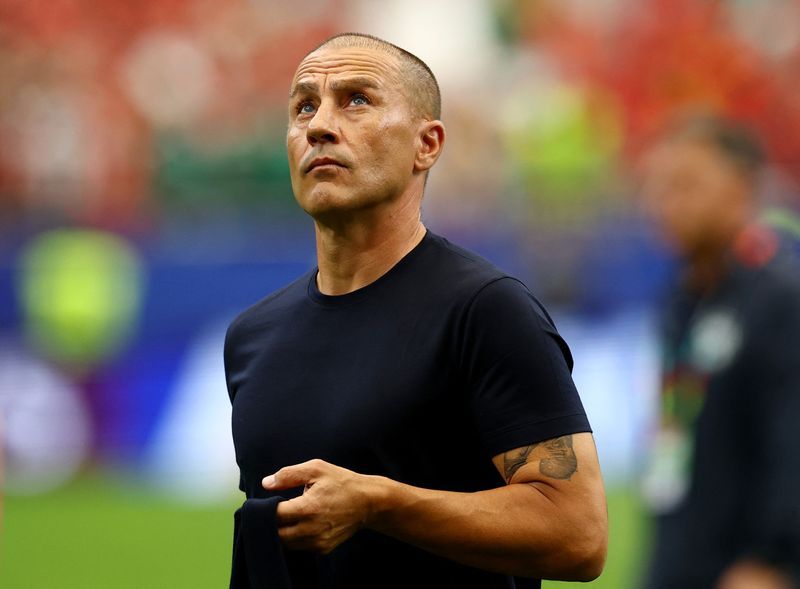
Uzbekistan's maiden World Cup campaign has become a sobering education in international football, with coach Fabio Cannavaro accepting full accountability for the team's devastating 5-0 loss to Portugal in Houston on Tuesday. The result leaves the Central Asian nation on the precipice of early elimination from Group K, having now suffered two consecutive defeats since beginning their World Cup journey just days earlier. Despite the magnitude of the defeat, Cannavaro maintained a measured perspective about the broader development trajectory of his squad.
The former Italy captain and 2006 World Cup winner acknowledged to reporters that the responsibility for such a comprehensive defeat must rest with the coaching staff rather than the players themselves. Cannavaro's philosophy, forged through decades of experience at the elite level, reflects a commitment to creating an environment where young footballers can develop without the paralysing fear of making mistakes in moments that matter. He emphasised that his job as coach demands he shoulder the tactical and strategic failures, allowing his players the psychological freedom necessary to grow as competitors on a global stage.
Uzbeki football now faces a critical juncture. Following their opening 3-1 reversal against Colombia and the subsequent hammering by Portugal, Cannavaro's team must overcome the Democratic Republic of Congo on Saturday to harbour any mathematical chance of reaching the round of 32. Victory in that fixture becomes not merely desirable but essential, transforming what began as an exploratory tournament into a last-stand scenario where everything Uzbekistan has worked for since qualifying will be decided by a single match.
The manager identified a pivotal moment that he believes contributed to the psychological collapse during the Portugal encounter. Azizjon Ganiev's goal was disallowed in the second half under controversial circumstances when referees ruled a foul in the build-up, denying Uzbekistan a crucial foothold in the contest when Portugal led 2-0. Cannavaro reflected that this decision fundamentally shifted his team's mentality, draining confidence at a moment when maintaining belief might have altered the trajectory of the entire match. The impact of such marginal decisions at tournament level cannot be understated, particularly for a squad making their debut on sport's grandest stage.
Cannavaro's insistence on encouraging his players to play with boldness and courage reveals his conviction that the young Uzbek footballers possess untapped potential that fearfulness would constrain. He explicitly instructed the squad to embrace football as an expression rather than a defensive exercise, contrasting sharply with the conservative approach some inaugural World Cup teams adopt. This philosophy demands technical quality and individual bravery, qualities that cannot flourish in an atmosphere of blame and recrimination when mistakes occur at high speed against elite opponents.
The coach's framing of the tournament as a learning experience, regardless of whether Uzbekistan advances, reflects realism about the developmental stage of Central Asian football on the world stage. Qualifying for the World Cup represented a seismic achievement for a nation with limited recent pedigree in global competition, yet the tournament itself has exposed significant gaps between Uzbekistan's regional dominance and the standards required to compete consistently at the highest level. These gaps will only be remedied through accumulated experience, tactical sophistication, and the maturation of a player pool still finding its identity at international level.
The parallel to Colombia's experience proves instructive. Uzbekistan began their campaign against the South Americans and suffered a 3-1 defeat, yet Cannavaro noted that his team played with the same enterprising approach against that opponent as they initially attempted against Portugal. The consistency of Uzbekistan's ambition across these matches suggests that the core tactical framework remains sound, even when opponents possess superior execution and greater tournament experience. The disallowed goal merely crystallised a disparity that was always present rather than creating it from nothing.
Cannavaro's background provides context for his measured response to adversity. A footballer and leader accustomed to winning at the highest level, he has learned that World Cup campaigns contain moments of humiliation even for accomplished teams. His willingness to absorb blame rather than deflect it demonstrates maturity and an understanding that public confidence in the coaching staff translates directly into player confidence on the field. Scapegoating individuals or external circumstances would further destabilise a squad already processing the shock of successive heavy defeats.
The road ahead demands that Uzbekistan rediscover the resilience and attacking intention they displayed despite losing to both Colombia and Portugal. The Democratic Republic of Congo presents an opponent against whom Uzbekistan's superior technical quality should theoretically manifest, yet in a World Cup context where margins are razor-thin and psychological fragility can amplify, no outcome is guaranteed. If Cannavaro's team can produce a performance combining courage with clinical finishing, they may yet extend their tournament stay and validate the coach's faith in a process oriented towards long-term development rather than immediate results.