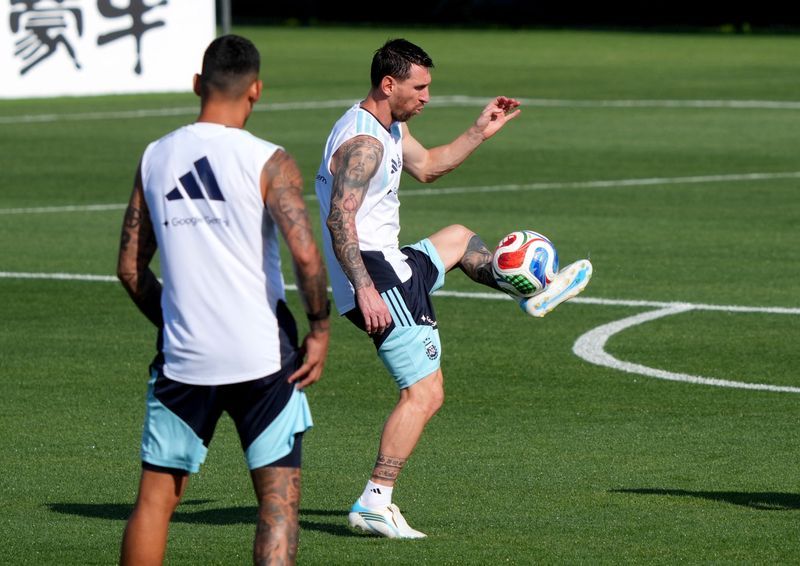
Cape Verde's emergence as a genuine threat in the World Cup knockout rounds represents one of football's most improbable storylines, yet the island nation's delegation shows no sign of intimidation ahead of their meeting with reigning champions Argentina on Friday. By conventional standards, the African outsiders possess virtually no realistic pathway to eliminating Lionel Messi and his star-studded teammates, but their progression through the group stage has instilled a belief that transcends statistical probability.
The Cape Verdean outfit's journey to this juncture defies the narrative typically reserved for World Cup minnows. Rather than suffering the expected heavy defeats, they drew with former champions Spain and Uruguay, results that not only secured their passage to the knockout round but fundamentally challenged preconceptions about their footballing capabilities. These performances emerged from a nation with just over half a million inhabitants—fewer than any other country to reach a World Cup's round of 32—transforming a relatively unknown squad into symbols of possibility for smaller footballing nations.
Assistant coach Humberto Bettencourt articulated his team's philosophical approach to their David-versus-Goliath encounter with characteristic conviction. Speaking from their training base in Tampa, he dismissed the relevance of statistical forecasts that had Cape Verde's chances rated at a mere one to four percent before the tournament commenced. His framing suggested that quantitative analysis obscures the unpredictable nature of football, where outcomes depend ultimately on execution and collective performance rather than pre-match projections. This perspective allows the underdog contingent to disregard the weight of expectation and concentrate on implementing their footballing principles without distraction.
The tactical dimension of Cape Verde's challenge requires navigating Argentina's attacking prowess whilst maintaining their offensive identity. Bettencourt confirmed that his coaching staff would not fundamentally alter their playing style to accommodate the threat posed by Messi and his supporting cast. The decision to avoid direct man-marking of Messi, instead focusing on collective organisation and defensive spacing, suggests a calculated risk—recognising that attempting to nullify Argentina's principal creative force through conventional defensive suffocation would likely leave gaps elsewhere in the formation. This approach demands discipline and positional awareness from every player on the pitch.
Messi's role in Argentina's group stage dominance cannot be overstated, yet Cape Verde's analytical framework positions him as one component within a larger tactical puzzle rather than an insurmountable individual obstacle. The seven-time Ballon d'Or recipient had been benched for Argentina's final group match against Jordan, a decision reflecting head coach Lionel Scaloni's squad rotation strategy. His introduction as a substitute yielded immediate impact, with Messi scoring his sixth tournament goal to secure a 3-1 victory that maintained Argentina's perfect group stage record. The prospect of facing a fully committed Messi adds another layer of difficulty to Cape Verde's already formidable assignment.
Cape Verde's player composition reflects the complex migration patterns that characterise smaller island nations. The squad contains individuals born across multiple continents—the Netherlands, Portugal, France, the United States, and Ireland—representing diaspora communities that have established themselves throughout the world over decades. A significant contingent boasts connections to Argentina itself, lending an additional poignancy to the encounter. These biographical details underscore how Cape Verde's World Cup campaign transcends pure sporting competition, functioning as a moment of collective pride for a nation whose citizens are geographically dispersed yet remain connected through cultural identity.
From a personnel standpoint, Cape Verde faces injury complications that could influence team selection. Midfielder Telmo Arcanjo, whose technical abilities have contributed meaningfully to the team's attacking play, remained uncertain for the Argentina fixture due to a leg injury sustained during training. His absence would deprive the African side of creative capacity during moments when possession and chance creation become critical. Conversely, combative left back Sidny Lopes Cabral returns to availability following completion of a one-match suspension incurred through accumulated yellow card accumulation in earlier group fixtures. Cabral's defensive intensity and left flank control could prove valuable when Argentina inevitably seeks to exploit wide areas.
Scaloni's selection considerations involve determining which of Argentina's abundant attacking talent offers optimal conditions for dismantling Cape Verde's defensive structure. The Argentina manager possesses multiple world-class options beyond Messi, necessitating strategic decisions about formation and personnel deployment. The prospect of committing a historic upset—an outcome that would rank among World Cup football's most dramatic achievements—injects genuine jeopardy into what superficially appears as a predetermined outcome. Argentina's dominance of their group stage matches, achieved through superior technical execution and ruthless finishing, establishes clear favouritism that Cape Verde must overcome through tactical discipline and clinical opportunism.
The broader significance of this encounter extends beyond the immediate knockout result. Cape Verde's participation in a World Cup knockout stage carries implications for African football's competitive trajectory and the capacity of smaller nations to compete with established powerhouses. Should they achieve the seemingly impossible, the ramifications would resonate throughout global football, challenging assumptions about meritocratic progression and resource-dependent success. Even in defeat, their presence at this level has already elevated the profile of Cape Verdean football internationally, attracting greater media scrutiny and potential investment in youth development infrastructure.
Scaloni appears prepared to implement full squad rotation from the Jordan fixture, with Messi's reinstatement into the starting formation almost inevitable given the elevated stakes. The Argentina manager must balance the need for genuine competitive intensity whilst managing player fitness across what could extend to three remaining matches. This calculus differs markedly from group stage football, where experimentation offered lower-consequence opportunities for assessment. Cape Verde's willingness to maintain their identity rather than adopt defensive surrender tactics suggests that regardless of ultimate outcome, this contest will provide entertaining football and authentic competitive spirit—precisely what elevates World Cup tournaments beyond bureaucratic national team obligations into genuine sporting spectacle.

