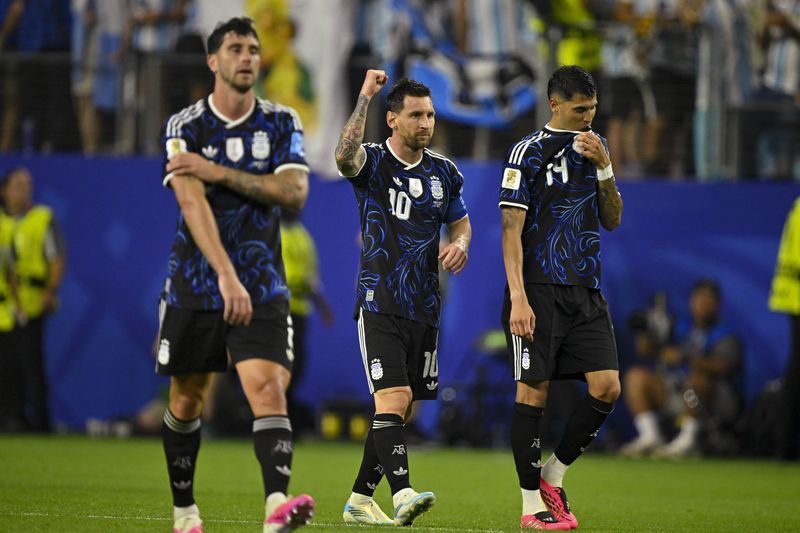
Cape Verde's improbable World Cup campaign takes its most defining test on Friday when the island nation confronts Argentina, the tournament's defending champions, in a knockout encounter that will determine who advances to the round of 16. The African outsiders, ranked 67th internationally at the competition's outset, have already defied expectations through a campaign that included draws against powerhouses Spain and Uruguay, establishing themselves as genuine competitors rather than mere World Cup participants. Head coach Bubista has maintained unwavering conviction in his team's approach throughout the tournament, a consistency that has proven vindicated by results on the pitch.
Bubista addressed the mounting pressure and intrigue surrounding Friday's fixture at Miami Stadium on Thursday, emphasizing that Cape Verde's fundamental playing philosophy would not shift regardless of their opponent's stature. The African contingent's qualification process and subsequent group-stage performances demonstrated they belong at football's highest level, a point the coach stressed repeatedly when asked about facing Lionel Messi and Argentina's star-studded lineup. Rather than view themselves as sacrificial lambs facing inevitable elimination, the Cape Verdean delegation approaches the Argentina match with genuine aspirations of progression, framed not as presumption but as earned confidence grounded in recent achievements.
What distinguishes Cape Verde's engagement with this World Cup is the absence of defensive resignation that typically characterizes underdog narratives in international football. Bubista's messaging to reporters revealed a team preoccupied entirely with advancement rather than moral victories or historical achievement merely by participation. The coach articulated that while respecting Argentina's credentials and those of manager Lionel Scaloni, his players demand reciprocal acknowledgment for having reached this stage on merit. This psychological stance—neither subservient nor arrogant—represents a crucial element of Cape Verde's positioning as they prepare for their most significant match in decades.
The qualification journey itself carries weight in this context. African nations have historically struggled to produce surprising World Cup runs, making Cape Verde's presence itself noteworthy. Yet Bubista grounds the team's confidence not in sentimental narratives but in concrete performances: three group matches played with intensity and tactical discipline, each providing genuine winning opportunities rather than mere participation exercises. The draws against Spain and Uruguay, opponents of vastly different styles and profiles, indicate Cape Verde has developed adaptability while maintaining organizational coherence—precisely the qualities necessary to trouble established nations.
Bubista's approach to neutralizing Messi proves particularly revealing about his tactical thinking. Rather than devising specific systems to contain the Argentine magician, the coach prefers addressing the collective challenge posed by Argentina as a unified force. This decision reflects both pragmatism and principle: attempting to isolate Messi through dedicated marking leaves gaps elsewhere against a team possessing multiple attacking weapons. Furthermore, maintaining tactical identity while adapting to different opponents represents a more sophisticated strategic framework than reactive, opponent-specific preparations. Cape Verde's consistency in this regard throughout the tournament suggests genuine conviction rather than convenient rhetoric.
For Malaysian and Southeast Asian audiences, Cape Verde's trajectory offers relevant perspective on tournament football's unpredictability. The Asian region, through teams like Japan and South Korea, has demonstrated capacity for surprising performances against established powers, yet such achievements require the combination of tactical coherence, psychological resilience, and legitimate competitive quality that Bubista's Cape Verde team appears to possess. The African nation's group-stage results validate the principle that tournament momentum and self-belief translate into tactical advantages regardless of historical standings or FIFA rankings.
Argentina enters this encounter as overwhelming favorites, their world championship status and attacking capabilities suggesting comfortable progression. Yet Bubista's conviction that Cape Verde can compete at this level rests on observable reality rather than unrealistic optimism. Teams ranked outside the global elite have increasingly produced competitive performances at World Cups, particularly when combining organizational discipline with attacking ambition. Cape Verde's refusal to adopt purely defensive positioning against superior opposition could prove either visionary or costly, but the commitment to their established approach demonstrates principled coaching rather than panic-driven tactical improvisation.
The significance of Friday's match extends beyond the immediate contest. African football's global profile remains constrained by limited representation among tournament favorites, yet Cape Verde's confident engagement with this World Cup—coupled with performances suggesting genuine competitive possibility—may influence how future African participants approach major tournaments. The precedent of a small-nation coach refusing deference while maintaining respect for established opponents creates space for tactical innovation and psychological positioning that transcends typical underdog narratives.
Bubista's repeated invocation of humility alongside courage and ambition encapsulates the fine balance his team must navigate. Overconfidence against Argentina risks catastrophic humiliation; excessive caution squanders the psychological momentum Cape Verde has accumulated through three group matches. The coach's emphasis on continuing their established approach rather than fundamentally restructuring against Argentina suggests confidence that their methods remain sound even against the tournament's elite. Whether this proves prescient or naïve will be determined on the pitch, but the coherence between messaging and tactical execution throughout Cape Verde's campaign suggests Bubista possesses genuine strategic conviction rather than merely motivational rhetoric designed for media consumption.
As Cape Verde prepares for their defining World Cup moment, the team's perspective challenges conventional hierarchies that characterize international football discourse. Achievement of knockout-stage advancement would constitute seismic achievement; even competitive defeat to Argentina would vindicate Bubista's methodical, principle-driven coaching approach and Cape Verde's earned right to World Cup participation. The Friday encounter represents far more than a mismatch between titans and minnows—it constitutes a genuine match between differing philosophies, experiences, and competing ambitions within the tournament's framework.

