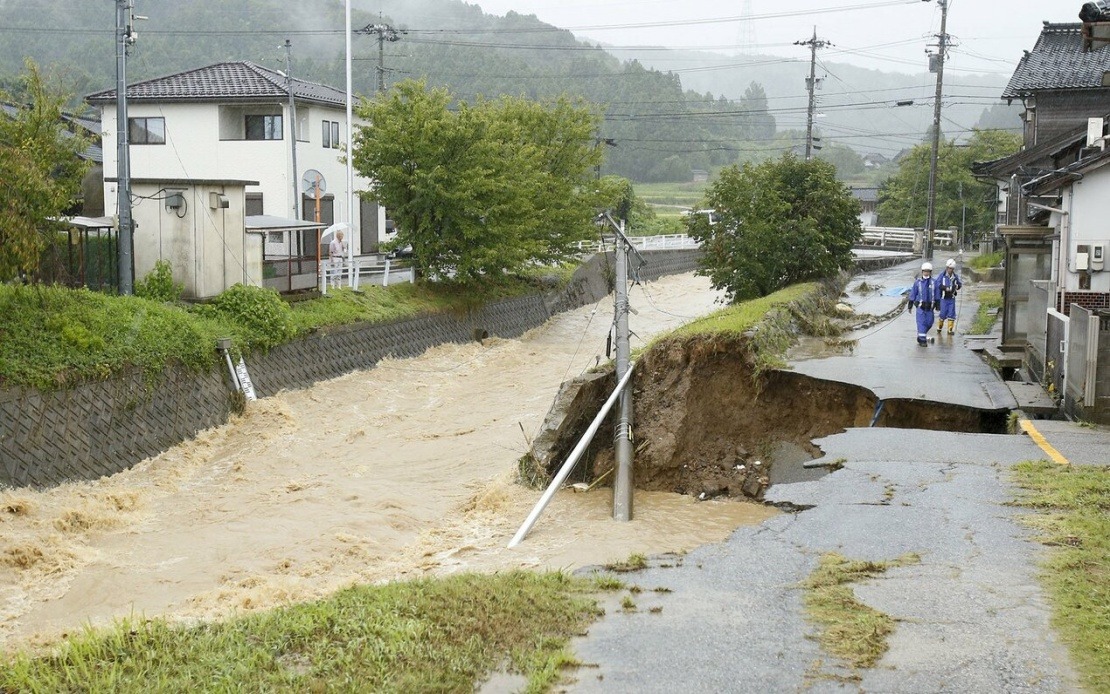
Intense rainfall swept across Japan's central regions on Thursday, creating hazardous conditions that forced mass evacuations and left vehicles submerged beneath floodwaters. The Japan Meteorological Agency activated its maximum alert level for multiple municipalities across Ishikawa and Toyama prefectures as the deluge threatened communities with life-threatening dangers. The alert system's Level 5 classification signals that a disaster has either already struck or is virtually certain to materialise imminently, representing the agency's gravest assessment.
The special heavy rain warning encompassed Himi in Toyama Prefecture alongside four Ishikawa municipalities: Hakui, Shika, Hodatsushimizu, and Nakanoto. Around 180,000 people across these five municipalities received instructions to evacuate immediately or secure themselves in place, heeding guidance from local authorities about the mounting risks from inundation and earth movement. Residents were specifically counselled to remain alert to the possibility of landslides, which frequently accompany extreme precipitation in Japan's mountainous terrain and hilly prefectures.
Precipitation records tumbled during the storm's initial phase. Within a twelve-hour window ending at 7:20 am, Himi and Hakui each received more than 300 millimetres of rain, whilst Hodatsushimizu absorbed over 200 millimetres. Each location registered its highest measured rainfall for the period in question, underscoring the event's exceptional intensity. A firefighter in his fifties from Himi described to journalists how a local river breached its banks, with numerous automobiles becoming submerged in the advancing waters—a scenario replayed across affected areas as drainage systems became overwhelmed.
The meteorological pattern driving this deluge involved an atmospheric front extending eastward from the Sea of Japan toward northern and eastern regions, with forecasters predicting its trajectory would shift southward as Friday progressed. The combination of a cold-air mass and a trough of low pressure was expected to generate markedly unstable atmospheric conditions throughout the period. The Japan Meteorological Agency projected rainfall accumulation of up to 200 millimetres across the Hokuriku region over the subsequent twenty-four hours, with the Kanto-Koshin and Tokai areas facing up to 150 millimetres.
Neighbouring Niigata Prefecture also experienced substantial precipitation as the weather system progressed across the region. Though less dramatically than its western neighbours, Niigata remained embedded within the hazardous atmospheric environment and faced ongoing precipitation risks. The spatial extent of the weather event—spanning multiple prefectures across central Japan—illustrated the scale of the meteorological disturbance affecting the nation.
As of Thursday evening, the Ishikawa prefectural government had reported no confirmed fatalities resulting from the flooding and landslides. However, the absence of immediate casualty reports could not be taken as conclusive given the ongoing emergency situation and the reality that search and recovery operations were still unfolding. The focus remained on preventing further loss of life through proactive evacuation and emergency positioning measures.
This episode arrived merely weeks after a comparable weather catastrophe had devastated Chiba Prefecture, situated closer to the capital Tokyo. That earlier incident had similarly triggered a Level 5 warning in certain Chiba municipalities, ultimately resulting in thirteen deaths. The flooding had immobilised thousands of vehicles, with approximately 2,500 automobiles abandoned simultaneously at one stage as transport networks became impassable. That recent tragedy provided grim context for current events and underscored the increasing severity and frequency of extreme weather events impacting Japan's densely populated regions.
For Malaysian observers, the sequence of major flooding events across Japan carries pertinent lessons regarding climate resilience and disaster preparedness. Japan possesses arguably the world's most advanced meteorological infrastructure and early-warning systems, yet continues experiencing substantial impacts from extreme precipitation. The nation's experience suggests that Southeast Asian countries, despite investments in early-warning capabilities, face mounting challenges in mitigating cascading hazards from atmospheric extremes. The convergence of mountainous terrain, concentrated populations, and intensifying rainfall patterns creates compound vulnerabilities.
The broader regional context reflects how climate patterns affecting Japan similarly influence circulation systems across Northeast Asia and can indirectly influence weather patterns affecting Southeast Asia. Extreme weather events in Japan often correlate with broader hemispheric patterns that subsequently drive precipitation anomalies across the wider Asian-Pacific region. Malaysia's own vulnerability to flooding, particularly during monsoon seasons, finds parallel expression in Japan's susceptibility to heavy rain episodes triggered by different meteorological mechanisms but producing analogous consequences.

