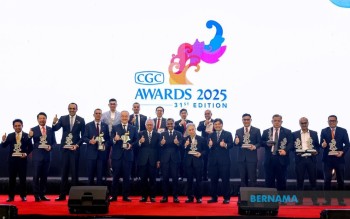
Credit Guarantee Corporation Malaysia Bhd (CGC) has recognised 32 outstanding achievements across the country's micro, small and medium enterprise sector at its 31st annual awards ceremony, underlining the critical importance of business resilience in Malaysia's broader economic development. The awards acknowledge both exemplary MSME performance and the financial ecosystem players that support their growth, reflecting the collaborative model that CGC views as essential to sustaining entrepreneurial dynamism in the region.
CGC Chairman Datuk Mohammed Hussein used the occasion to articulate a vision of resilience that extends well beyond conventional metrics. He emphasised that enterprise durability hinges not merely on access to credit facilities, but fundamentally on the character, discipline and adaptive capacity of business operators themselves. This framing carries particular significance for Malaysian entrepreneurs navigating an increasingly complex global trade environment characterised by supply chain volatility, shifting consumer preferences and technological disruption. The chairman's remarks suggest that institutional support mechanisms, while necessary, cannot substitute for the internal capabilities that enable businesses to pivot and survive under pressure.
The ecosystem perspective outlined by Hussein reflects a sophisticated understanding of MSME development challenges endemic to Southeast Asia. Rather than locating responsibility for SME resilience solely with financial institutions, he called for multidimensional engagement across government, academia, corporate partners and fintech providers. Government must establish regulatory frameworks and infrastructure that reduce entrepreneurial friction. Universities and research institutions ought to accelerate technology commercialisation pathways that could benefit smaller players lacking in-house R&D capacity. Large corporations should consider supply chain participation from SMEs rather than maintaining exclusionary procurement practices. Banks and alternative lenders must calibrate their risk appetite to match genuine MSME potential rather than defaulting to collateral-heavy lending models that exclude resource-constrained operators. This systems-level articulation resonates strongly with Malaysian policymakers focused on inclusive growth.
CGC's performance in supporting Bumiputera business enterprises demonstrates tangible progress on a longstanding policy objective. The corporation extended RM223 million in guarantees to 27 Bumiputera companies during the preceding year, a substantial commitment that reflects both institutional capacity and political commitment to ensuring that historically disadvantaged business communities gain meaningful access to credit. Beyond conventional lending, CGC facilitated RM1.2 billion in guarantees linked to environmental, social and governance considerations, exceeding its RM1 billion target and signalling the market's increasing alignment with sustainability imperatives that Malaysian investors increasingly recognise as essential to long-term competitiveness and risk mitigation.
The awards ceremony unveiled three distinct categories recognising excellence across different segments of the financial ecosystem. Financial institution partners and non-traditional finance providers both received recognition, acknowledging that Malaysia's credit architecture now extends beyond traditional banking into digital lending and alternative finance mechanisms. Citation of Merit awards honoured specific sectoral achievements, while dedicated SME awards celebrated entrepreneurs themselves. This categorical approach reflects evolved understanding that sustainable MSME development requires addressing multiple stakeholder capabilities simultaneously.
Alliance Bank Malaysia Bhd and CIMB Islamic Bank Bhd each secured Best Financial Partner designations, validating their market positioning and client service excellence. The recognition for both conventional and Islamic banking partners underscores Malaysia's dual-track financial system, where Islamic banking has achieved sophisticated product development and market penetration that positions it alongside conventional institutions. OCBC Al-Amin Bank Bhd's receipt of a dedicated Bumiputera SMEs Award acknowledges specialist banking's role in serving communities with distinctive requirements. Maybank Islamic Bhd's Special Recognition Bumiputera Award similarly validates increasingly sophisticated Islamic financing approaches tailored to Bumiputera entrepreneurs.
The awards spanned multiple institutional categories, recognising conventional financial institutions, Islamic banks, development finance specialised lenders, and innovative fintech platforms. Bank Simpanan Nasional's dual recognition as Top FI Partner across development finance and digital channels (imSME platform) demonstrates that public financial institutions retain strategic relevance despite competitive pressure from commercial lenders. Peoplender Sdn Bhd's recognition for its Fundaztic platform highlights how technology-enabled alternative finance is gaining institutional legitimacy and generating measurable MSME outcomes alongside traditional banking channels. This diversification of award categories reflects the broader transformation of Malaysia's SME financing landscape.
The ceremony's centrepiece was the launch of two new schemes totalling RM10 billion, jointly structured by Bank Negara Malaysia and CGC. The Portfolio Guarantee and Portfolio Guarantee-i mechanisms represent significant new capital mobilisation, with potential to facilitate guaranteed financing for approximately 12,100 MSMEs across priority economic sectors. The initial launch announcement from June 2026 indicated these schemes would employ risk-sharing models wherein participating financial institutions co-bear credit losses, creating alignment between MSME success and lending institution profitability. This structure addresses a longstanding market failure wherein SME financing risk has historically been distributed inefficiently, with banks bearing disproportionate downside exposure that constrains lending appetite.
The schemes target business expansion, productivity enhancement, sustainable transition financing and competitive strengthening—sectors where capital constraint typically impedes MSME growth beyond subsistence level. For Malaysian entrepreneurs, particularly those in manufacturing, agriculture, services and digital economy sectors, portfolio guarantee access fundamentally alters project financing feasibility. Businesses with viable expansion plans but limited collateral can now access growth capital through participating banks without requiring asset-backed security. This addresses a chronic constraint affecting Malaysian SMEs, many of which operate with real estate values insufficient to secure expansion financing relative to growth opportunity magnitude.
The RM10 billion commitment represents substantially increased public sector engagement in MSME financing architecture. Bank Negara Malaysia's co-partnership signals that financial inclusion has achieved status as core monetary policy objective rather than peripheral development consideration. The two-scheme structure (conventional and Islamic PG and PG-i) acknowledges that Malaysian entrepreneurs encompass diverse financing preferences, ensuring that Bumiputera companies, many preferring Islamic financing approaches, access equivalent capital on equivalent terms. This parity has profound implications for financial inclusion trajectory, as historical discrimination in Islamic finance product availability has constrained opportunities for entrepreneurs with religious or cultural preferences for Shariah-compliant instruments.
CGC's broader CGC Group 2030 strategic framework positions these awards and new schemes within longer-term institutional evolution. The stated commitment to deepening MSME impact, advancing financial inclusion and supporting sustainable development through multi-stakeholder collaboration suggests that Malaysia's credit guarantee institution is adopting increasingly sophisticated approaches to market development. Rather than remaining purely transactional, CGC increasingly functions as sectoral development agent, catalysing behaviour change among financial institutions, encouraging sustainable practices and fostering collaboration among ecosystem players.
For Malaysian entrepreneurs and businesses, these developments signal improved financing access and reduced cost of capital across multiple channels. The awards celebrate achievers whilst the new schemes create pathways for aspiring growth businesses. For Southeast Asian observers, Malaysia's approach demonstrates how public financial institutions can evolve toward sophisticated market development roles, combining guarantee mechanisms with institutional partnership models that amplify capital availability without displacing market mechanisms or creating dependency relationships. The emphasis on resilience, character and ecosystem collaboration offers broader regional lessons as other Southeast Asian economies prioritise SME development alongside poverty reduction and inclusive growth objectives.

