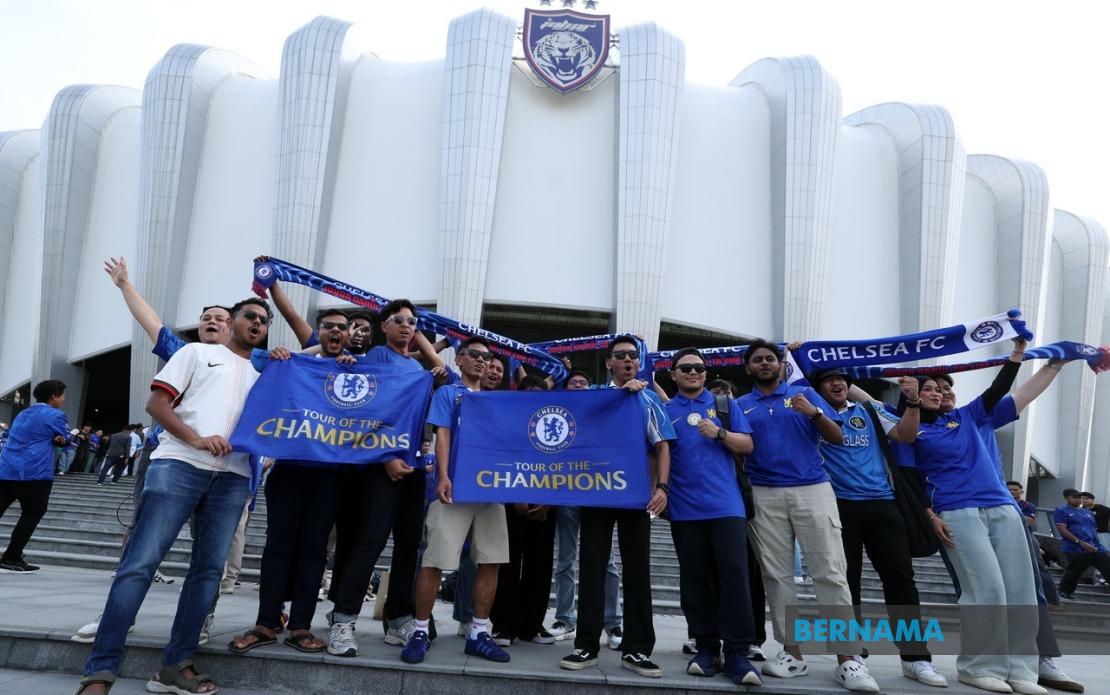
The Sultan Ibrahim Stadium in Iskandar Puteri transformed into a vibrant display of club loyalty on August 9 as supporters dressed in the colours of both Johor Darul Ta'zim and Chelsea FC arrived in waves beginning at 3 pm, several hours before the scheduled 8 pm kick-off. What began as an athletic fixture between a local Malaysian powerhouse and one of Europe's most recognisable clubs evolved into a cultural moment that extended far beyond the boundaries of Johor, drawing devotees from across the nation and neighbouring regions who saw this encounter as an unprecedented opportunity to experience elite English football on home soil.
The stadium's grounds became a striking mosaic of red and blue jerseys, with families, long-time supporters, and younger enthusiasts all converging to witness the occasion. The demographic mix revealed football's broad appeal across age groups—from parents introducing their children to the sport's grandest stages, to veteran supporters who had followed their chosen clubs for decades. The visual spectacle itself became part of the event's appeal, with attendees taking advantage of the SSI's architectural features as backdrops for photographs and social media documentation, transforming the pre-match experience into a shared celebration rather than merely a functional arrival.
The commercial dimension of the fixture proved equally compelling. Official merchandise vendors faced sustained queuing as supporters sought limited-edition memorabilia tied to this rare occasion. Such items represented more than casual purchases; they served as tangible reminders of a moment when global football hierarchy collided with local passion, creating keepsakes that fans could retain long after the final whistle. The scarcity of certain products only amplified demand, reflecting the premium placed on this singular opportunity.
The geographic scope of attendance underscored football's capacity to transcend regional boundaries. Supporters travelled not merely from neighbouring towns but from Singapore and other parts of Malaysia, with some beginning their journeys in the early afternoon to navigate border crossings and congestion. This movement of fans across territorial lines demonstrated how elite sporting events function as magnets for enthusiasts willing to invest considerable time and effort to attend. For cross-border fans, the fixture represented value that justified the logistical complexity of international travel.
Traffic management proved a significant undertaking for local authorities. The Royal Malaysia Police maintained coordinated security measures throughout the afternoon and into the evening, keeping congestion on the main approach routes to manageable levels despite the volume of incoming vehicles. By 7 pm, while traffic remained slower than usual, officials reported the situation remained under control—a reflection of advance planning and real-time traffic management that ensured the event proceeded without major disruptions.
For Chelsea enthusiasts based in Malaysia, this fixture addressed a long-standing constraint in their fan experience. Ahmad Danial Muhammad, a 28-year-old from Bangsar in Kuala Lumpur who had followed Chelsea since the Didier Drogba era, articulated how this match eliminated the necessity for expensive international travel to experience Premier League-quality football. His perspective captured a broader sentiment among overseas club supporters in Malaysia: access to world-class English football without the financial and logistical burden of European travel represents a transformative opportunity. Such fixtures effectively democratise exposure to elite competition, making it available to supporters across economic strata.
Cross-border attendance also featured prominently in the crowd composition. Tan Wei Sheng, a 34-year-old from Singapore who crossed the Johor Causeway at midday with his family specifically to avoid peak congestion, provided perspective on how international fans evaluated the occasion. His comments about the stadium's world-class facilities reflected a secondary benefit of hosting such matches: it showcased Malaysian infrastructure standards to visiting supporters and potentially influenced their perceptions of the nation's sporting capabilities and hospitality.
The match held distinct significance for JDT supporters as well, though their perspective centred on validation rather than access. Mohd Khairul Anuar Ismail, a 41-year-old from Melaka, framed Chelsea's selection of the Southern Tigers' home stadium as recognition of the domestic club's international standing and proof that Malaysian football was gaining respect on the global stage. This interpretation reflected a broader narrative in which hosting prestigious overseas teams serves as external validation of local football's evolution and competitive credibility.
This validation theme extended beyond sporting measurement. Safiyah Rosli, a 32-year-old JDT supporter from Batu Pahat, connected the Chelsea fixture to broader institutional narratives about Malaysian football's trajectory, specifically crediting the Regent of Johor, Tunku Mahkota Ismail, with stewarding the sport's development. Her remarks illustrated how sporting events become intertwined with local governance narratives and how individual leaders gain association with national sporting advancement. The match thus functioned simultaneously as entertainment, infrastructure showcase, and political narrative reinforcement.
The convergence of these elements—international profile, local pride, cross-border enthusiasm, and infrastructure validation—revealed how modern football transcends its pure athletic function. The JDT-Chelsea encounter operated as a multidimensional event with implications extending across economic, cultural, and political dimensions. For Malaysia's football ecosystem and its broader positioning within Southeast Asian and global sports contexts, such fixtures accelerate perceptions of development and integration into elite international competition structures.
Beyond the immediate spectacle, the event illustrated Malaysia's capacity to organise and host fixtures involving world-renowned clubs, positioning the nation as a viable destination for premium sporting events. This capability holds implications for future tournament bids and international sporting partnerships. The enthusiasm demonstrated across all supporter demographics suggested sustainable appetite for such encounters, provided relevant institutions continue facilitating opportunities for global football's elite to engage with Southeast Asian audiences. For Malaysian football's development narrative, Chelsea's visit represented a marker of progress rather than an anomalous occurrence.

