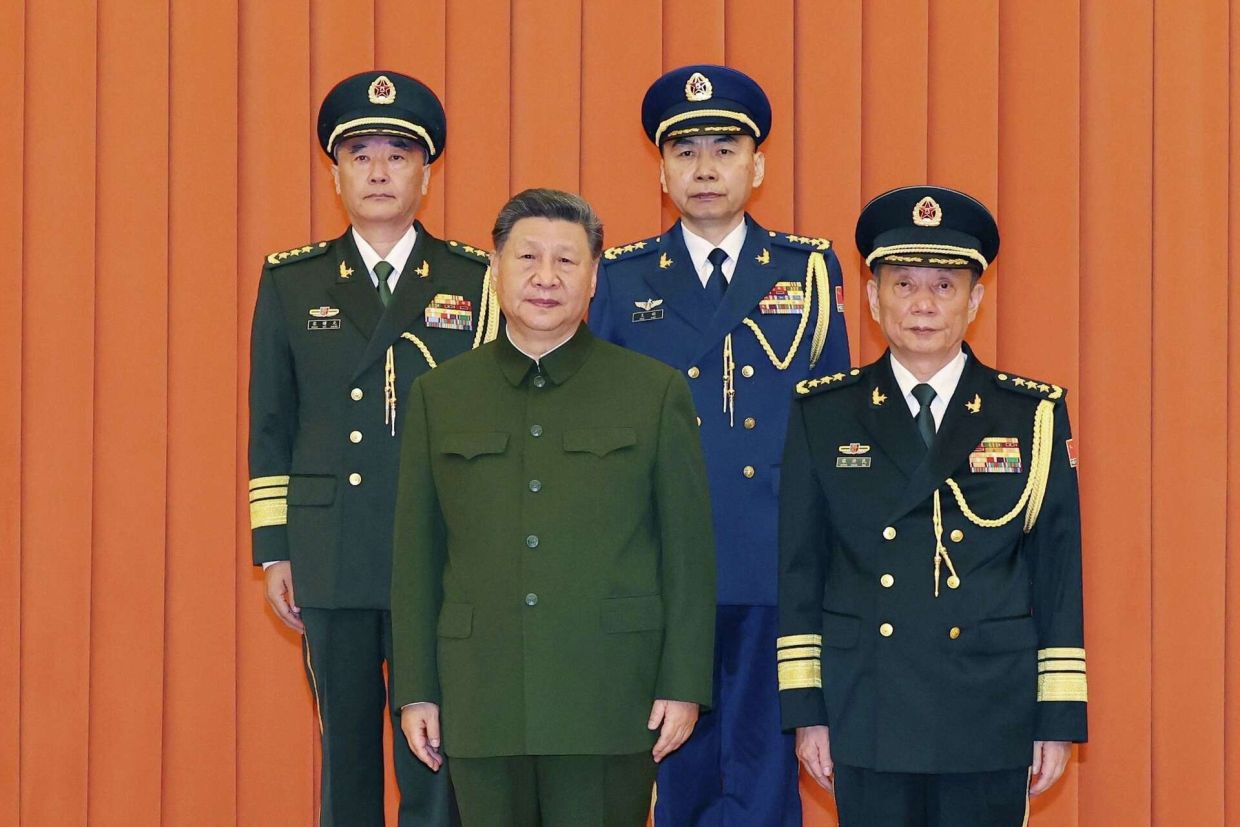
China's military establishment has taken a significant step in refreshing its senior command structure, promoting two prominent officers to the rank of general in a move that observers suggest could herald broader organisational changes within the armed forces. The promotions, formalised during a ceremony on Friday, July 3, come as the People's Liberation Army navigates the consequences of an extended anti-corruption investigation that has substantially altered the composition of its highest decision-making body.
Xi Jinping, who holds dual authority as both China's paramount leader and head of the military, personally presented the orders elevating Zhang Shuguang and air force commander Wang Gang to the coveted rank of general. The ceremonial nature of the appointment underscores the political significance attached to these promotions, transforming what might ordinarily be a routine administrative announcement into a carefully choreographed demonstration of party authority over the military establishment.
Zhang Shuguang's elevation carries particular symbolic weight beyond his new rank. Concurrently with his promotion, he was appointed to lead the corruption investigation division within the Central Military Commission, the paramount governing body overseeing all armed forces operations and strategy. This dual appointment positions him at the nexus of military discipline and renewal, suggesting that the party views him as a trusted instrument for maintaining institutional loyalty during a period of significant personnel transitions and potential structural vulnerabilities.
The promotion strategy appears designed to address a critical capacity crisis afflicting the Central Military Commission itself. Once comprising seven members responsible for formulating military doctrine, overseeing operational readiness, and ensuring alignment with Communist Party directives, the body has been hollowed out by the sustained anti-corruption campaign. Currently, only two members remain in active roles: Xi Jinping himself as chairman and Vice Chair Zhang Shengmin, leaving a dangerous vacuum in the commission's capacity to exercise effective command and control over the military apparatus.
The scale of the purge becomes apparent when examining the absences. Two former vice chairs, including the military's most senior operational general, have either been formally removed or effectively sidelined through the investigations. These removals have sent reverberations through the officer corps, creating uncertainties about career trajectories and factional alignments that could destabilise institutional cohesion if left unaddressed for extended periods. The promotions of Zhang and Wang appear calibrated to provide visible evidence that the purge, while extensive, is transitional rather than indicative of permanent institutional dysfunction.
The timing and mechanics of these appointments suggest a carefully orchestrated succession plan rather than ad hoc responses to corruption discoveries. Officials close to the reform process indicate that the promotions may function as a preliminary step toward reconstituting the commission to full operational strength. The current five-year term for the commission concludes in autumn of the following year, providing a formal occasion and justification for announcing a comprehensively reorganised body. This timeline allows the party to manage perceptions of continuity and renewal simultaneously, demonstrating both its commitment to anti-corruption principles and its capacity to maintain effective governance.
For regional security analysts monitoring Chinese military developments, these leadership changes carry implications extending beyond internal party management. A military leadership structure in flux, even temporarily, raises questions about decision-making processes during crises, the coherence of strategic planning, and the ability to maintain operational readiness across multiple geographical theatres. While the promotions suggest the party retains firm control over the officer corps, the extended period of elevated uncertainty within the commission could incentivise caution in military planners regarding major operational initiatives until the new structure stabilises.
The anti-corruption campaign itself reflects Xi Jinping's broader consolidation strategy, using institutional cleansing as a mechanism for eliminating potential rivals, removing officers whose loyalty predates his assumption of power, and reshaping the military hierarchy to reflect his preferences. The campaign has netted numerous senior figures, including the former defence minister and multiple military region commanders. By appointing Zhang Shuguang to lead the corruption investigation apparatus itself, the party ensures that the purge's continuation remains under the direction of a Xi-trusted loyalist rather than institutional bureaucrats who might moderate the campaign's intensity.
Wang Gang's elevation to general as air force commander indicates that this service branch has successfully navigated the corruption investigations without facing the catastrophic leadership losses encountered elsewhere within the military. The air force's relative institutional stability may reflect either superior internal discipline or fortunate avoidance of the political vulnerabilities that ensnared other services. His promotion to general status provides him enhanced prestige and likely expanded voice in high-level military councils as the commission moves toward reconstitution.
The broader strategic context within which these promotions occur emphasises the Communist Party's determination to ensure the military remains a pliant instrument of state power subordinate to party authority. Military officers require unambiguous assurance that loyalty to Xi Jinping and the party guarantee career advancement, while disloyalty or the appearance of independent institutional thinking triggers investigation and removal. The promotions function as a reassurance mechanism, demonstrating to the broader officer corps that the purge will not persist indefinitely and that service in the reorganised military structure remains a viable path to advancement and influence.
As China's military enters the transition period leading toward autumn reconstitution of the Central Military Commission, the appointments of Zhang and Wang represent tangible evidence of institutional renewal rather than merely destructive upheaval. The promotions signal that the party possesses both the clarity of vision and the organisational resources to manage extensive personnel turnover while simultaneously recruiting talented officers into expanded roles. Whether this restructured military leadership proves sufficiently cohesive to execute complex strategic objectives in the years ahead remains an open question for observers of Chinese security policy across Southeast Asia and beyond.

