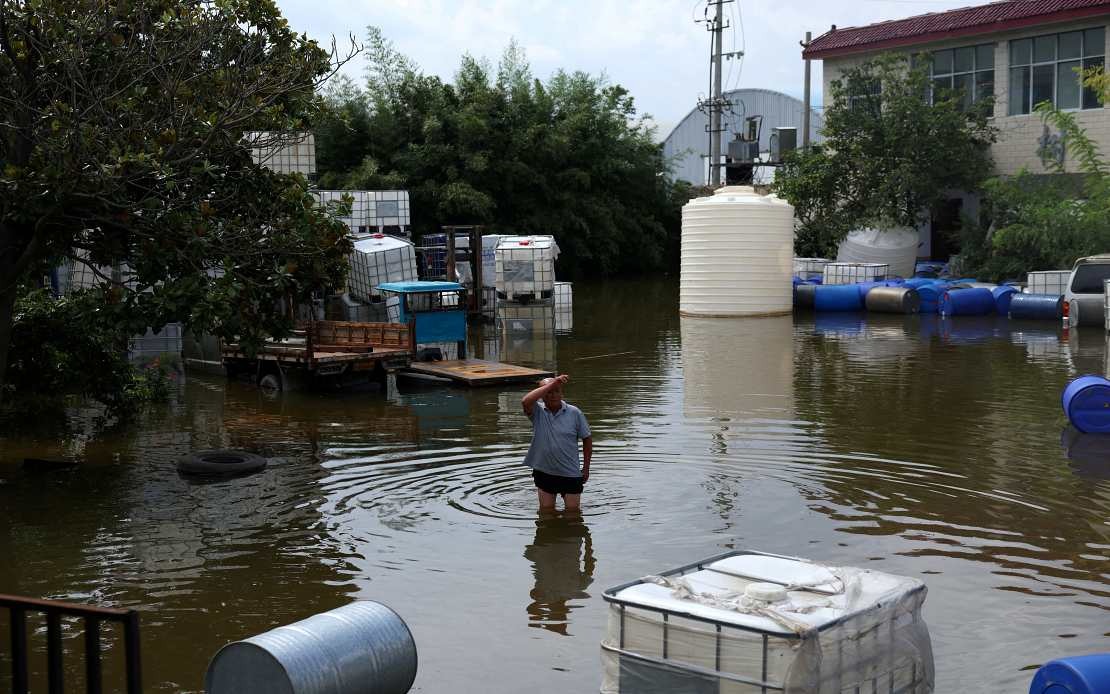
China's Ministry of Emergency Management activated a major disaster response operation on Friday after a critical levee failure inundated Zhoukou City in central Henan Province, with rescue teams and substantial relief supplies now mobilising to assist thousands of affected residents. The breach occurred around 11 pm Thursday evening after the remnants of Typhoon Dolphin, the 13th typhoon of the season, intensified rainfall across the region and caused river levels to surge beyond capacity.
The emergency deployment represents a significant coordinated effort involving China Anneng Group, which supplied 200 specialised engineering rescue personnel alongside 110 sets of large-scale engineering equipment. These rescue units arrived on Friday and immediately joined ongoing emergency operations at the disaster site, working to contain further damage and locate any individuals in distress. The scale of the deployment underscores the severity of the structural failure and the potential for cascading consequences if water levels are not rapidly managed.
Responding to the catastrophic conditions, the National Commission for Disaster Prevention, Reduction and Relief elevated the emergency classification to Level-IV on Friday, a designation reserved for the most serious national calamities. This triggering of the highest national disaster relief emergency response authorises the mobilisation of federal resources and coordination across provincial and municipal authorities. The decision reflects both the immediate humanitarian crisis and concerns about potential secondary disasters as floodwaters continue spreading through populated areas.
Zhoukou and the adjacent city of Xuchang have become focal points of the relief operation, with authorities identifying these municipalities as priority zones for assistance. The levee breach poses particular dangers because such failures often affect large populations dependent on the same water management infrastructure, potentially displacing tens of thousands of residents with little warning. Historical precedent in Chinese river disasters demonstrates how quickly situations can deteriorate once containment fails.
Addressing immediate humanitarian needs, central authorities dispatched 30,000 items of disaster relief supplies on Friday, including folding beds, summer quilts, and comprehensive family emergency kits. This substantial allocation reflects the scale of displacement anticipated across affected communities. The supplies were jointly dispatched through coordination between the National Commission for Disaster Prevention's office, the Ministry of Emergency Management, and the National Food and Strategic Reserves Administration, indicating a whole-of-government approach to crisis management.
Typhoon Dolphin's remnants continue posing challenges beyond the initial levee failure, as the persistent heavy rainfall keeps river systems elevated and saturated. For Malaysian and Southeast Asian observers, this situation illustrates the vulnerability of large populations concentrated in flood-prone regions dependent on aging infrastructure, a concern that resonates across the broader Asian region. The rapid escalation from a weather event to a structural failure highlights infrastructure resilience questions increasingly relevant as climate patterns intensify.
The coordinated nature of China's response demonstrates established protocols for such emergencies, with pre-positioned equipment and personnel capable of deploying within hours. However, the deployment of such substantial resources also indicates that routine local response capacity proved insufficient, suggesting the breach's severity exceeded standard contingency planning. This reality underscores why international disaster management experts emphasise the critical importance of regular levee maintenance and early warning systems.
For neighbouring nations monitoring the situation, the incident provides insight into how transnational water management could be affected by major infrastructure failures. China's Yellow River and Yangtze River systems connect multiple provinces and have implications extending across Southeast Asia through international water agreements and regional environmental health. Disruptions to these systems create ripple effects on agricultural production, shipping routes, and water availability across broader territories.
The activation of Level-IV response status triggers cascading administrative and logistical measures across China's vast bureaucratic apparatus, from provincial governors managing resource allocation to township officials coordinating evacuations. This hierarchical mobilisation, while sometimes criticized for inefficiency, enables rapid deployment of centralised resources to disaster zones. Early response in the critical first 48 hours often determines whether situations stabilise or deteriorate into secondary disasters.
Looking forward, the incident will likely prompt Chinese authorities to conduct comprehensive reviews of levee conditions across Henan and neighbouring provinces vulnerable to similar failures. Typhoon season typically extends through September, meaning the region faces continued exposure to heavy rainfall events in coming weeks. Investment in reinforcing critical water management infrastructure may accelerate as officials recognise that climatic patterns increasingly produce rainfall intensities exceeding historical design parameters.

