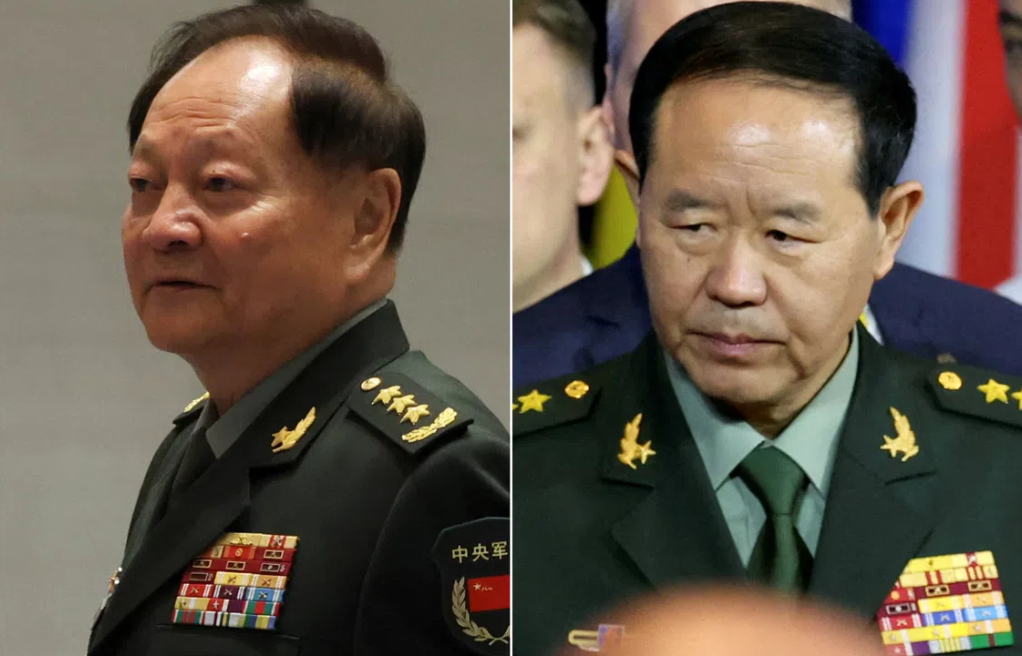
Beijing has purged two prominent military leaders from China's Central Military Commission, the nation's highest defence authority, marking another significant chapter in President Xi Jinping's sustained crackdown on corruption within the armed forces. The removal of General Zhang Youxia and General Liu Zhenli follows disciplinary investigations into suspected serious breaches of party discipline and law, according to state media reports released on Friday.
The purge represents a dramatic reshuffling of China's military hierarchy at its apex. Zhang Youxia held the position of vice-chairman of the Central Military Commission, making him second only to Xi within the defence establishment, and was also a member of the Communist Party's elite Politburo Standing Committee. Liu Zhenli served as chief of staff of the CMC's Joint Staff Department, positioning him as a key operational figure in China's military administration. Their simultaneous removal leaves only two active members remaining on what was formerly a seven-member commission, including Xi himself.
The structural complexity of China's military command system adds significant weight to this action. The country maintains parallel Communist Party and state CMC structures that function as a unified institution, though their formal procedures sometimes operate independently. Friday's announcement specifically addressed the state CMC positions held by both officers, as confirmed by the Standing Committee of the National People's Congress, China's parliament. However, notably, neither Zhang nor Liu has been publicly or formally stripped of their roles within the Communist Party's separate CMC apparatus, suggesting the process may still be developing or that party officials are proceeding with measured deliberation.
For Malaysian and Southeast Asian observers, this development carries implications for regional stability and military engagement patterns. Zhang's removal is particularly significant given his historical role in shaping China's military modernisation strategies and his influence over defence policy decisions affecting the broader Asia-Pacific region. The uncertainty created by such high-level purges can affect predictability in military-to-military communications and decision-making processes that neighbouring nations rely upon for managing tensions and maintaining stability.
The current purge extends well beyond the two principal figures, revealing the sweeping scope of Xi's anti-corruption drive within military institutions. The parliamentary announcement simultaneously removed 10 additional lawmakers and military officials from their positions. Among them are Lieutenant General Zhong Shaojun, who previously directed the CMC's General Office, and General Ju Qiansheng, former commander of the Strategic Support Force, suggesting widespread institutional challenges within China's defence establishment. This broader removal list indicates systemic rather than isolated problems within the military hierarchy.
Xi has maintained corruption investigations as a cornerstone of his leadership since 2012, and military institutions have consistently ranked among his primary targets for reform. Last month, Xi personally directed senior Communist Party leaders to intensify anti-corruption efforts specifically within armed forces, signalling that his administration views this campaign as ongoing and unfinished business. The years-long initiative has resulted in the investigation, removal, and purging of dozens of senior officers and military commanders, fundamentally reshaping the military's command structure and altering promotion pathways throughout the ranks.
The removals also ensnared civilian officials with defence sector connections, demonstrating how corruption investigations cross institutional boundaries. Gao Shiwen, former mayor of Nanchang in southern China, was among those stripped of parliamentary positions. His career trajectory through state-owned aerospace and defence corporation China Aerospace Science and Technology Corporation suggests potential connections between civil-military industrial complexes and disciplinary investigations. This pattern indicates that concerns about corruption extend beyond purely military questions into defence procurement, technology development, and military-industrial policy.
Separate actions underscore the concurrent nature of these purges. Zhao Zongqi, a former commander of the Western Theatre Command who gained prominence during the 2020 India-China border clashes, was simultaneously stripped of his membership in China's top political advisory body. His removal is particularly noteworthy given his role during that conflict, suggesting that military decisions and conduct during the border confrontation may have undergone subsequent scrutiny and investigation.
The timing and scale of these removals raise questions about potential factional struggles within China's military-political establishment or serious institutional governance failures. The maintenance of such a lean active membership on the CMC—down to merely two serving members from the original seven—creates operational challenges for a commission responsible for overseeing the world's largest standing army. This skeletal structure suggests either a deliberate consolidation of power around Xi's immediate circle or a transitional state pending reorganisation and appointment of replacement figures.
For regional analysts, these developments warrant careful monitoring of how Beijing reconstitutes its military command structure and whether reshuffled personnel bring different strategic orientations toward neighbouring states. The purge's impact on military professionalism, institutional knowledge transfer, and operational effectiveness remains uncertain, though such high-level instability typically creates periods of internal focus that can temporarily reduce external provocations. Conversely, new commanders may seek to establish authority through assertive posturing, potentially complicating regional dynamics across the South China Sea and other contested zones.

