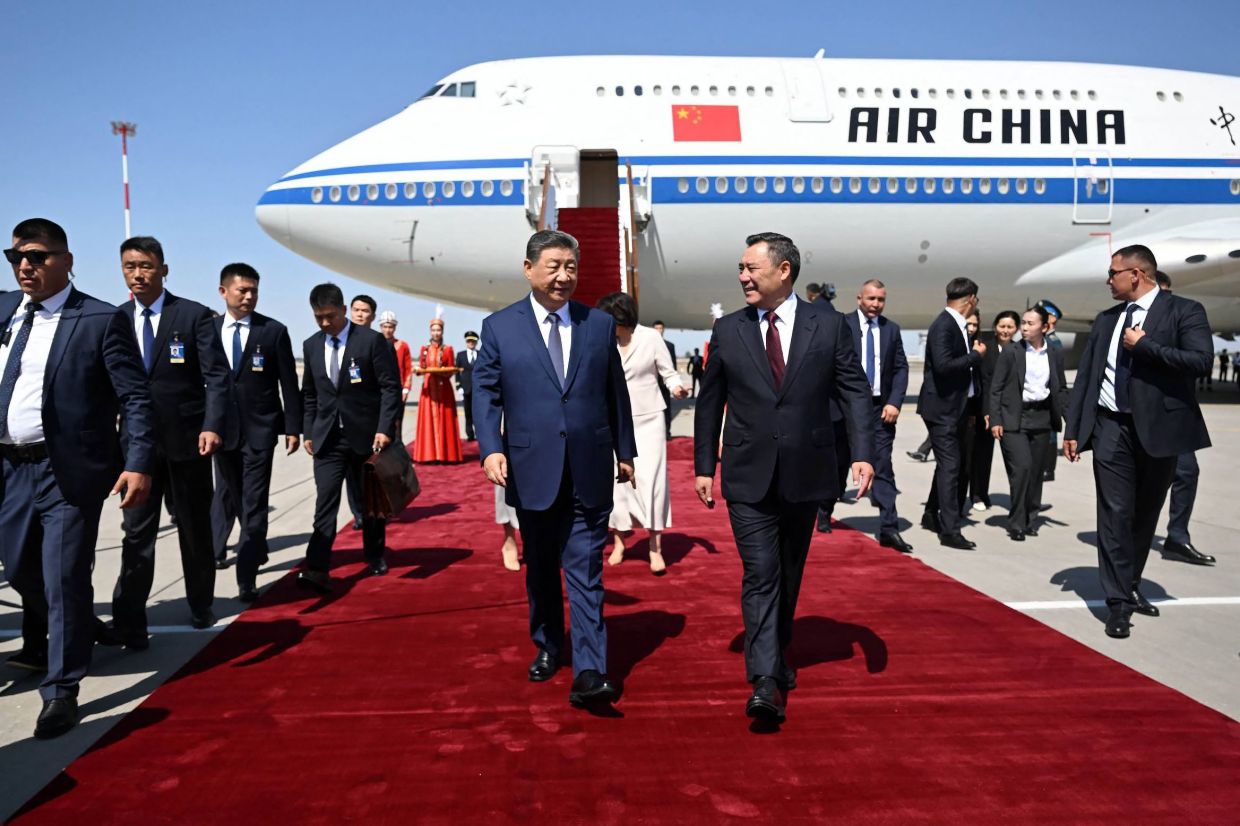
The Shanghai Cooperation Organisation is staging a significant gathering in Bishkek this week, drawing together the heads of state of China, Russia and India in what organisers frame as a demonstration of non-Western alignment and a strategic counterpoint to American-led global structures. The summit underscores how this previously low-profile regional forum has evolved into a platform where major powers increasingly project their geopolitical ambitions across Eurasia and beyond, reshaping the balance of influence in a region long contested by competing interests.
Chinese President Xi Jinping, Russian President Vladimir Putin and Indian Prime Minister Narendra Modi are confirmed participants in the Bishkek proceedings, with numerous bilateral meetings scheduled to run parallel to the formal sessions. Notably, Putin and Xi are slated to meet on Monday, August 31, while Putin will also hold talks with Iranian President Masoud Pezeshkian on Tuesday, the day when official SCO deliberations commence. These sideline engagements often prove as consequential as plenary sessions, allowing leaders to navigate complex bilateral relationships and coordinate positions on pressing regional and international questions.
The timing of the summit is particularly significant given the contemporary geopolitical turbulence affecting several attendees. Russia, now deep into its full-scale military campaign in Ukraine spanning four and a half years, views the gathering as an opportunity to reinforce relationships with nations positioned outside the Western orbit. Similarly, Iran, engaged in a six-month conflict with the United States and Israel, seeks to utilise the forum to demonstrate its strategic connectivity and secure partnerships with countries unwilling to align with American-led initiatives. For both nations, the SCO summit represents a crucial venue for diplomatic positioning and coalition-building at a moment when their international standing faces considerable pressure.
The SCO itself represents an interesting evolution in regional cooperation frameworks. Established in 2001 by China, Russia and four Central Asian republics primarily as a security mechanism, the organisation has substantially expanded over a quarter-century, though its actual operational coherence and widely understood mandate remain nebulous to outside observers. The membership roll has grown to encompass ten nations: Russia, China, India, Iran, Pakistan, Belarus, Kazakhstan, Kyrgyzstan, Tajikistan and Uzbekistan, with numerous other countries holding various partnership statuses that create concentric circles of involvement and influence within the structure.
China and Russia have increasingly promoted the SCO as a functional alternative to Western-aligned institutions such as the G7, with Beijing particularly keen on broadening the organisation's scope and amplifying its international standing. China's Foreign Ministry recently characterised the SCO as having successfully navigated "a new path for regional cooperation," rhetoric consistent with Beijing's broader campaign to articulate and institutionalise a competing vision of global order. This messaging, strongly reinforced by Moscow, appeals to nations seeking alternatives to what they perceive as Western-dominated systems, whilst offering tangible benefits through development assistance and financial commitments that Beijing strategically deploys.
However, the SCO remains fundamentally constrained by structural weaknesses that limit its utility as a genuine unified bloc. Analysts consistently emphasise that member states harbour significant disagreements and pursue distinct national interests that frequently conflict with one another, preventing the organisation from functioning as a cohesive political or military alliance comparable to NATO or other formal alliances. Internal tensions—particularly between India and Pakistan, both SCO members with a history of antagonism, and competition between India and China for regional primacy—inject friction into proceedings and complicate consensus-building on substantive matters.
For India specifically, experts suggest the summit serves primarily as a venue for strategic signalling and diplomatic choreography rather than delivering concrete cooperative outcomes. New Delhi must navigate the delicate position of maintaining its SCO membership whilst contending with the reality that both Pakistan and China, historical rivals, are integral to the organisation. Yet participation itself offers India demonstrable value: it secures representation in a regional forum increasingly shaped by great power competition, provides early warning of shifting alignments and intentions, and permits India to position itself as a stabilising and reliable actor capable of bridging divergent interests across Eurasia.
Dinakar Peri, a security studies fellow at Carnegie India, articulates this calculus clearly, noting that whilst India may lack sufficient leverage to unilaterally determine the SCO's agenda, membership affords New Delhi crucial visibility into regional currents and permits strategic hedging with other major players. This perspective reflects how middle powers like India approach such forums—not as platforms for imposing their vision, but as critical mechanisms for monitoring developments and protecting core interests within shifting geopolitical configurations. The SCO thus functions for India as an essential listening post and diplomatic asset.
Turkey's participation, though currently limited to "dialogue partner" status, reveals how even nations traditionally anchored to Western institutions increasingly seek to diversify their diplomatic portfolios. President Recep Tayyip Erdogan has repeatedly advocated for Turkey's elevation to permanent SCO membership, viewing such status as integral to a balanced foreign policy that maintains NATO ties whilst deepening Eurasian engagement. Turkey's predicament is particularly instructive: despite a 1995 trade agreement maintaining substantial economic linkages with the European Union, its EU membership application has stalled for over two decades, creating incentives to cultivate alternative partnerships and demonstrate strategic flexibility to non-Western powers.
The broader significance of this Bishkek summit extends beyond its formal agenda. It illustrates how regional organisations and diplomatic forums increasingly serve as venues where nations communicate commitment to alternative international arrangements and signpost alignment with non-Western poles of influence. Whilst the SCO lacks the institutional depth and military integration of traditional alliances, its very existence and these high-level gatherings function as symbolic assertions of a multipolar world taking organisational form. For Malaysia and other Southeast Asian nations observing these dynamics, the summit underscores the imperative of understanding how great power competition is reshaping regional structures and the opportunities and constraints this presents for smaller nations seeking to maintain balanced partnerships across competing blocs.

