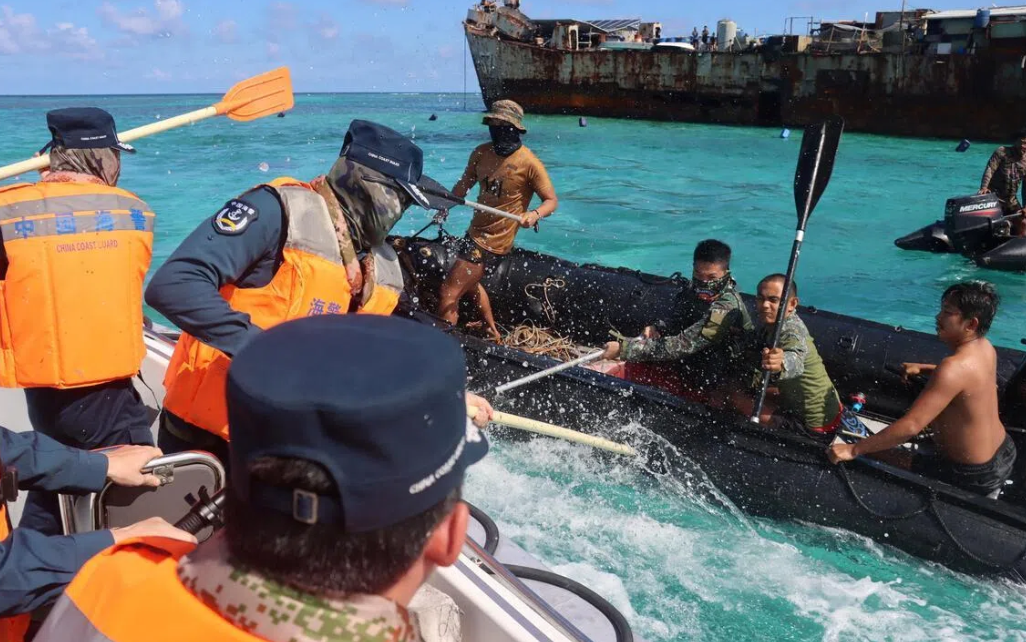
Diplomatic tensions flared across the Asia-Pacific on Tuesday when China formally summoned the Philippine ambassador to Beijing, escalating a confrontation that unfolded the previous day at a heavily contested shoal in the South China Sea. The incident underscores the fragile equilibrium that exists in one of the world's most consequential shipping lanes, where overlapping territorial claims and routine military posturing regularly threaten to spill into open conflict. The shoal at the centre of the dispute, known internationally as the Second Thomas Shoal and called Ren'ai Reef by China, has become emblematic of the broader standoff between Beijing's expansive maritime claims and the resistance of rival claimants supported by major Western powers.
According to Philippine military accounts, the clash occurred when a Chinese Coast Guard vessel intercepted a Filipino supply boat en route to a grounded warship that has functioned as a permanent Filipino military outpost for decades. An officer aboard the Chinese vessel allegedly struck a Filipino sailor with a baton during the confrontation, an allegation that provoked immediate outrage in Manila and condemnation from its security partners. Beijing's version of events diverged sharply, with Chinese foreign ministry officials insisting that the Philippines initiated the provocative behaviour and that they had deliberately mischaracterised the nature of the encounter. The duelling narratives reflect a deeper pattern in the South China Sea, where competing nations routinely interpret the same maritime incidents through fundamentally different strategic lenses.
China's overwhelming claim to the South China Sea rests on historical assertions and a controversial nine-dash line that encompasses roughly ninety per cent of the waterway, encompassing territory and resources claimed by Vietnam, the Philippines, Malaysia, Brunei, and Taiwan. An international tribunal in The Hague definitively rejected the legal foundation for these expansive claims in 2016, determining that they lacked any basis in international maritime law. Nonetheless, Beijing has consistently disregarded the ruling and continues to assert its historical rights over the region, backed by an increasingly capable maritime enforcement apparatus. The economic significance of the South China Sea extends far beyond regional disputes; approximately one-third of global maritime trade transits these waters, making control over key shipping lanes a matter of genuine geopolitical consequence.
The timing of the incident proved particularly sensitive, as it coincided with a major diplomatic gathering in the Philippine capital. US Secretary of State Marco Rubio arrived in Manila on Tuesday to participate in an Association of Southeast Asian Nations summit, arriving amid elevated regional alarm about China's assertive posture in contested waters. The clash provided an immediate backdrop for discussions about regional security architecture and the role of external powers in maintaining stability. Rubio's presence underscored American commitment to Southeast Asian security partnerships at a moment when China's conduct was generating fresh anxiety among regional governments already wary of Beijing's military capabilities and assertiveness.
In a pointed statement published across Philippine news outlets on Tuesday, Rubio articulated Washington's strategic vision for the South China Sea as a domain where freedom of navigation must remain guaranteed and where no single power should exercise hegemonic control. He warned that should these waters fall under the authority of a nation prepared to weaponise trade relationships for political advantage, both American interests and those of Asean member states would face unprecedented vulnerabilities to their economic prosperity and national sovereignty. The statement represented a clear if diplomatically coded warning to Beijing about the consequences of further assertiveness in the region. The message resonated with longstanding American concerns that China might seek to convert its geographic and military advantages into political leverage over the entire region's maritime commerce and security arrangements.
Australian Foreign Minister Penny Wong joined American officials in condemning China's conduct at the Second Thomas Shoal, characterising the encounter as evidence of destabilising and dangerous behaviour that threatened regional peace. Australia's intervention reflected Canberra's deepening investment in Indo-Pacific security architecture and its concern that Chinese actions in contested waters establish dangerous precedents that could embolden further assertiveness elsewhere in the region. The coordinated response from Washington and its allies demonstrates the degree to which individual South China Sea incidents have become focal points for broader geopolitical competition between China and the Western-led international order.
While tensions around the shoal have simmered for years, recent months have witnessed a marked intensification in confrontational behaviour by Chinese maritime forces. The Filipino garrison at the Second Thomas Shoal exists in a state of quasi-permanent tension, resupplied periodically through dangerous passages that increasingly involve direct physical confrontations with Chinese vessels. The sustainability of this arrangement remains questionable; sooner or later, a particularly violent encounter could trigger a military escalation that draws major powers into direct conflict. The international community has acknowledged this danger, yet mechanisms for defusing tensions remain underdeveloped and often ineffective.
Rubio's openness to meeting with Chinese Foreign Minister Wang Yi at the Asean summit offered a potential avenue for dialogue, though both governments have refrained from publicly confirming such discussions. The two officials have maintained some level of engagement, meeting previously in Kuala Lumpur last year and again in Munich in February, suggesting channels exist for communication even amid escalating tensions. However, the fundamental disagreements over maritime claims, freedom of navigation, and regional influence appear too substantial to resolve through routine diplomatic exchanges. The South China Sea thus remains a domain where military posturing, diplomatic maneuvering, and the ever-present risk of miscalculation continue to define the strategic environment.

